










































The Journalists Initiatives on Immunisation Against Polio and Improved Acceptance of the Polio Vaccine in Northern Nigeria 2007-2015
World Health Organization (WHO), Country Representative Office (Warigon, Banda, Zakari, Idowu, Bawa, Gali, Tegegne, Hammanyero, Korir, Vaz); National Primary Health Care Development Agency (Damisa); WHO Regional Office for Africa (Mkanda); Global Public Health Solutions (Nsubuga)
"...the JAP not only covered and monitored immunization activities in the media, but also sensitized and educated the grassroots communities, especially parents and guardians in noncompliant communities, about immunization activities."
In response to setbacks the Polio Eradication Initiative (PEI) faced in Kaduna state, Nigeria in 2003 and 2007 due to media campaigns in which scholars and Islamic clerics criticised polio vaccines, the World Health Organization (WHO) partnered with journalists in 2007 to form the Journalists Initiatives on Immunisation Against Polio (JAP). The purpose was not just to create awareness on public health (e.g., to develop communication initiatives aimed at highlighting polio eradication activities and the importance of immunisation in northern Nigeria) but, in addition, to get endorsements and statements from key religious and political leaders and to change the landscape to allow for more penetration among hitherto hard-to-convince populations. This report highlights the broader role played by the JAP following the partnership with the WHO and, later, with the Nigerian government and the United Nations Children's Fund (UNICEF) to portray the association as a critical change agent.
To begin, the local project team in Kaduna state selected 8 journalists on the basis of information about their possible influence in communities that were resisting vaccination activities. After an initial meeting, these "friends of polio immunization" were sensitised with the support of the WHO on the status of polio eradication, the number of children paralysed, and the negative effects of anti–polio vaccine campaigns in the media. The 8 pioneer members formed a body within the Nigerian Union of Journalists that is tasked with: creating public awareness on the PEI through the provision of accurate and balanced information; mobilising fellow journalists against negative press regarding polio vaccination; mobilising the support of religious leaders, traditional leaders, and other stakeholders to address noncompliance to immunisation; monitoring and evaluating immunisation exercises in Nigeria; and providing feedback to communities and policymakers on progress and remaining challenges.
As reported here, from 2009 to 2010, the JAP inaugurated state chapters in Kaduna, Kano, Jigawa, Sokoto, Niger, the Federal Capital Territory (FCT), Bauchi, Borno, Zamfara, and Katsina. It resolved to expand to other northern states, with the aim of building a network of journalists to support the overarching PEI goals. The JAP conducted a series of advocacy meetings with religious leaders, which led to endorsement of the oral polio vaccine (OPV) by "renowned sect leaders", including the Secretary General of the umbrella organisation for Muslims in Nigeria. Prior to, during, and after supplementary immunisation activities (SIAs), the JAP also facilitated the conduct of more than 100 town hall meetings and performances in local drama theatres, which led to the improvement of the quality of SIAs in communities with strong resistance to immunisation. The town hall meetings "followed an evidence-based process seeking to promote positive and measurable individual and group behavior and attitudinal change in noncompliant communities." Moderated by the JAP members, the meetings also provided a forum for discourse between the community and service providers. This was achieved through the creation of a conducive atmosphere to discuss and understand the knowledge gaps and reasons why heads of noncompliant households had resisted polio immunisation. The meetings always concluded on positive notes, as previously noncompliant heads of households presented their children for immunisation afterward. In addition, the JAP and community influencers invited the heads of noncompliant households, youth leaders, and other members in the communities to a meeting at the traditional or religious leader's house to discuss the benefits of immunisation and risk of continuous noncompliance. In addition, the JAP mobilised free airtime and resources from reputable media companies in an effort to create awareness and visibility for SIAs. The JAP also supported local government areas (LGAs) to cover public launch of SIAs and conduct media monitoring of campaigns in Nigeria, including interviewing key stakeholders. The JAP organised 2 award ceremonies to recognise the contribution of health workers, especially supervisors and other stakeholders, for outstanding performance during polio campaigns in their communities and to reward them with certificates during award ceremonies.
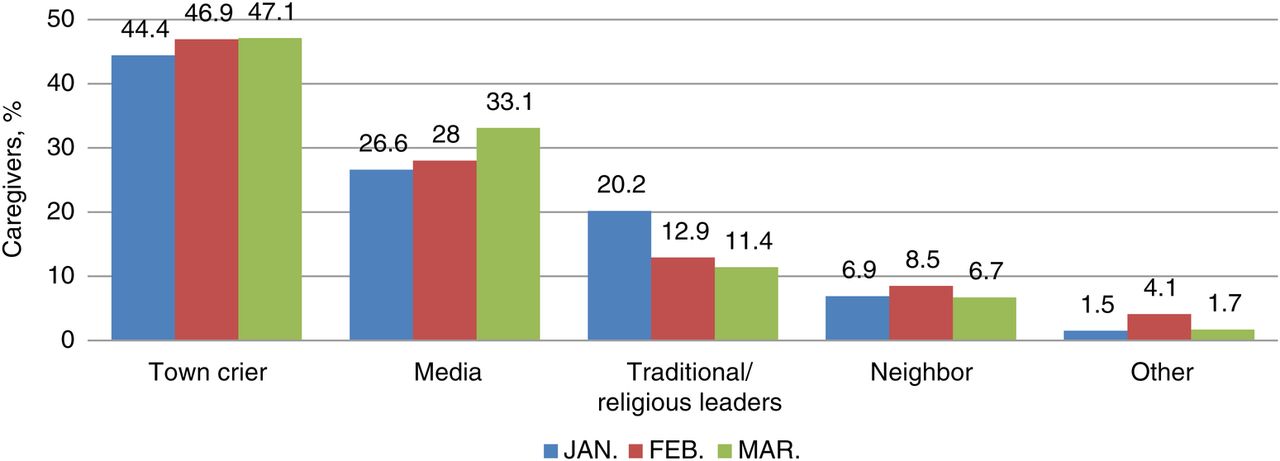
Data were obtained from the Independent Monitoring Board (IMB) of the Global Polio Eradication Initiative (GPEI) after every round of SIAs. During 2007–2015, more than 500 reports were published and aired by JAP members, which mainly portrayed immunisation positively. Table 1 shows quotations from prominent religious and political leaders that were published in various newspapers in Nigeria. Firgure 1 shows the influence of the JAP as a source of information about 3 SIA rounds for caregivers in Kaduna state, Nigeria during 2007 (before and after the JAP was formed). There was an increase in the numbers of caregivers that had heard about SIAs rounds from the media, from an initial 26% in January 2007 to 33% before March 2007. The activities of the JAP resulted in more caregivers citing media as the source of information, which is in contrast to the citing of traditional leaders as sources of information (the frequency of which decreased from 20.2% in January 2007 to 14% in March of the same year. The traditional source of information, the town announcers, almost plateaued with 46.9% and 47.1% for February and March of 2007, respectively. Similarly, citation of "neighbor" and "other sources of data" decreased with the advent of the JAP.
In the discussion section of the paper, the authors point to the JAP's role in helping noncompliant caregivers accept polio vaccination due to its strategy of working with community and religious leaders to beome "a vehicle of social mobilization, education, and enlightenment". As a result, "the community members view them and the media they represent as better avenues for promoting their causes." There are limitations, however, including the fact that there has been no systematic mechanism for data collection over the years to fully estimate the impact of JAP activities. The authors recommend that the National Primary Healthcare Development Agency engage an independent agency to conduct an in-depth survey to explore the divergent opinions of caregivers on JAP activities on the PEI. "Before the survey, state teams with established JAP members can capitalize on the opportunity offered by positive media messages to monitor, collate, and analyze the impact of media activities with measurable indicators."
The Journal of Infectious Diseases (2015), doi: 10.1093/infdis/jiv545, pps. S1-S5.
- Log in to post comments