










































Knowledge of HPV and Acceptability of HPV Vaccine among Women in Western China: A Cross-Sectional Survey
Health Management Center of West China Hospital of Sichuan University
This study was conducted to assess knowledge among women in western China about human papillomavirus (HPV) and its association with cervical cancer, and to assess their acceptance of HPV vaccination. The results of this study may help guide the design and improvement of interventions and campaigns to sensitise women to HPV infection and vaccination, thereby helping reduce incidence of cervical cancer.
A sample of healthy women undergoing routine physical examinations in the Health Management Center of West China Hospital, Sichuan University between January and December 2014 completed a questionnaire. (During pilot testing, several women asked whether HPV is related to breast cancer. This likely reflects the fact that the Chinese name of HPV includes the word "papilla". To avoid such confusion in the full study, a statement that HPV has no relationship with breast cancer was inserted into the questionnaire.) A total of 1,300 questionnaires were distributed, and 1,109 were completed and analysed.
Only 28.85% of respondents (n=320) had heard of HPV; among this subgroup, only half (53.44%) knew that it causes cervical cancer, only 26 (8.13%) correctly answered all questions about HPV. Multivariate analysis showed that respondents who had heard of HPV were more likely than other respondents to have a family history of any cancer, to undergo regular Pap tests, and to have completed at least secondary education. Half of all respondents (51.22%) reported that they would be willing to be vaccinated against HPV. This willingness may reflect knowledge acquired before the survey and/or knowledge gained upon reading the survey question, which explicitly mentioned that the vaccine can protect against cervical cancer.
These results suggest the need to disseminate knowledge about HPV and its association with cervical cancer, and they further indicate that such campaigns are likely to be effective at increasing willingness to be vaccinated. The study found that HPV awareness depends more on education and exposure to HPV or cancer than on family income. One implication is that HPV awareness campaigns should be designed to reach groups that normally receive little or no education about health in general or cancer in particular, including economically poorer, less educated groups without access to advanced healthcare facilities. Such education campaigns should aim not merely to raise awareness of HPV but also to emphasise its link with cervical cancer; most women in the study who had heard of HPV did not know that the virus causes cervical cancer.
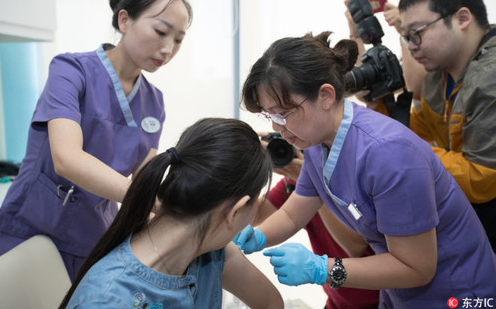
BMC Women's Health 2018 18:130. https://doi.org/10.1186/s12905-018-0619-8. Image caption/credit: "A woman from Beijing becomes the first Chinese to receive the 9-valent HPV vaccine on May 30, 2018, at Boao Super Hospital, Hainan Province. [Photo: IC]"
- Log in to post comments