










































Leveraging Polio Geographic Information System Platforms in the African Region for Mitigating COVID-19 Contact Tracing and Surveillance Challenges: Viewpoint
World Health Organization (WHO) - plus see below for full authors' affiliations
"Since most countries in the region (98%) are familiar with the deployment of the ODK [Open Data Kit] tool from its use in polio eradication, the COVID-19 contact tracing app is quite easy for countries to deploy and use without extensive training."
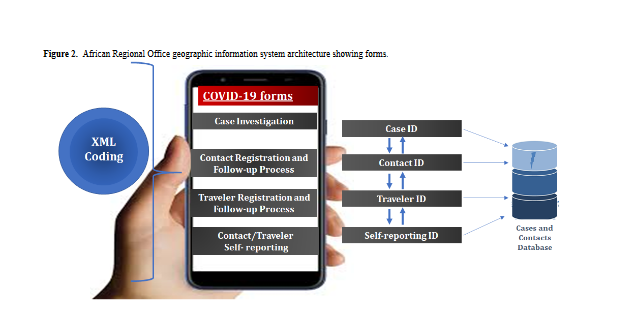
Contact tracing is a process that involves early case recognition, isolation, and tracking of people who have been exposed to a disease. However, in many African countries, this public health tool - critical in a pandemic such as COVID-19 - is impeded by several challenges, including poor infrastructure with associated myths, rumours, and communication barriers. In response, the World Health Organization (WHO) African Regional Office (AFRO) GIS (Geographic Information System) Center, in collaboration with the WHO emergency preparedness and response team, developed a COVID-19 contact tracing smartphone app through the expertise and experience gained from numerous digital apps designed for polio surveillance and immunisation via the WHO's polio eradication programme in the African region. This paper gives an overview of the app and visualisation platform development, app and platform deployment, ease of replicability, and preliminary outcome evaluation of their use in the field.
As outlined in the paper, the app builds on tools such as the Open Data Kit (ODK) to collect and manage data in a constrained environment, combined with the AFRO Polio GIS platform, in order to locate, identify, monitor, and track contacts during the COVID-19 pandemic or any other large-scale pandemic. WHO harnessed the technology for visualisation of real-time COVID-19 data using dynamic dashboards built on Power BI, ArcGIS Online, and Tableau.
The developed app enables contacts in the context of home-based care, self-isolation, and quarantine centres to provide daily updates. In addition, the app provides an opportunity for contacts to be able to identify the nearest health facility to which they can quickly report if they develop any symptoms of the disease. The traditional in-country contact tracing teams are also able to register and follow up contacts and cases with the app or any other app that the country may opt for. If the country opts for other apps, the solution allows for interoperability of the toolbox, which enables aggregating, analysing, and visualising the data in the same regional dashboards.
A module for reporting COVID-19 activities, infection prevention and control (IPC) readiness assessment, and recording of cases that fit the COVID-19 clinical definitions in facility-based registers was developed and deployed for field use by health workers who conduct surveillance at the facility level. This module leveraged an existing intervention called the Integrated Supportive Supervision (ISS) app, which is in use by over 5,000 health workers across the region to support polio surveillance activities.
The contact tracing app and platform were piloted between April and June 2020; they were then put to use in Zimbabwe, Benin, Cameroon, Uganda, Nigeria, and South Sudan. The COVID-19 health-facility-based surveillance app has been used more extensively (in 27 countries in the region). WHO notes that early engagement and meetings with all stakeholders was crucial to ensure ownership, increase coordination, and gain a better understanding of the existing surveillance landscape. Good linkage to the response was described as essential for all systems, as every verified case and contact is documented. In order to ensure timely reporting of cases found via health-facility-based reporting, health workers at the facility level required training and supportive supervision by trained district-level teams.
The authors of the paper contend that the scope of leveraging the polio GIS platform addresses the COVID-19 mitigation plans for contact tracing and surveillance gaps in the region in various ways, including the following:
- The platform was able to support the identification of COVID-19 cases, contacts, and database consolidation gaps (e.g., matching contacts to their index cases), helping to guide the response.
- During outbreaks and routine surveillance activities, the platform was able to identify community transmissions that were not detected by traditional contact and case databases.
- Health-facility-based surveillance was built on an already-existing ISS module and was, thus, quite sustainable, as other active disease surveillance was already being conducted with the app.
- The chain of transmission and surveillance gaps were easily seen on the interactive visualisation made possible by the real-time connection of data being submitted from the apps into Power BI; thus, faster decision-making was possible at all levels.
- The platform allowed ease of use of the data entry modules; there was little or no training, as surveillance teams at the country level were already used to similar technologies as a result of using mobile phones for other interventions.
- The platform includes features that make it more adaptive to the local context. The AFRO GIS Center has been leveraging GIS technology to ensure equitable access to essential health services, ranging from ISS for the Expanded Programme on Immunization, support for microplanning, effective coordination during the Ebola response, and monitoring the cholera outbreak response, among others, thereby making it easy to adapt and implement these solutions for other health programmes such as the COVID-19 response. The tool has been shown to be effective in supporting polio vaccination activities in complex humanitarian settings, including refugee camps and camps for internally displaced people.
- The platform was developed to make it more interoperable, so that other countries' contact tracing efforts and facility-based surveillance systems (e.g., such as District Health Information Software 2 (DHIS2), KoBoTool, and Surveillance Outbreak Response Management and Analysis System, or SORMAS) could be easily connected to share data.
- From a regional perspective, integration of contact tracing and surveillance data into one platform provides the AFRO with a more accurate method of monitoring countries' efforts in their response to COVID-19, while guiding public health decisions and the assessment of risk of COVID-19.
Nonetheless, questions with regard to information sensitivity and privacy of COVID-19 cases and contacts remain. There still exists the possibility of intrusion, careless handling of passwords, and hacking, which may lead to compromised information if countries do not adequately manage their access and control. Also, the app and platform deployment involves users having phones for data entry and visualisation; thus, a lot of phones are required for implementation of all aspects of surveillance and contact tracing.
In conclusion, the authors suggest that, "With the high penetration rate of mobile phones across the African region, mobile-based monitoring of COVID-19, from traditional methods to voluntary self-reporting and remote follow-up of contacts, will greatly improve the identification of suspected cases and contacts; these are important resources to help in the region's fight against this debilitating disease. Additionally, the use of this tool should reduce the burden on health systems, allowing for the provision of essential health services and minimizing mortalities from COVID-19 and neglected secondary diseases, which can result from a system overwhelmed by the pandemic."
Full list of authors, with institutional affiliations: Godwin Ubong Akpan, WHO; Isah Mohammed Bello, WHO; Kebba Touray, WHO; Reuben Ngofa, WHO; Daniel Rasheed Oyaole, WHO; Sylvester Maleghemi, WHO; Marie Babona, WHO; Chanda Chikwanda, WHO; Alain Poy, WHO; Franck Mboussou, WHO; Opeayo Ogundiran, WHO; Benido Impouma, WHO; Richard Mihigo, WHO; Nda Konan Michel Yao, WHO; Johnson Muluh Ticha, WHO; Jude Tuma, WHO; Hani Farouk A Mohamed, WHO; Kehinde Kanmodi, Teesside University; Nonso Ephraim Ejiofor, WHO; John Kapoi Kipterer, WHO; Casimir Manengu, WHO; Francis Kasolo, WHO; Vincent Seaman, Bill and Melinda Gates FoundationL Pascal Mkanda, WHO
JMIR Mhealth Uhealth 2022 (Mar 17); 10(3):e22544; and email from Godwin Ubong Akpan to The Communication Initiative on March 21 2022. Image credit: JMIR