










































Mako-mere Radio Drama
Mako-mere is set in the fictional village of Awendo. The characters include Posh, a sulky rebellious teenager who has been dragged unwillingly to the village by her mother. Posh yearns for the bright lights of Kampala and is appalled by the lack of running water and electricity in the village, and disgusted by the pit latrines. Then she meets Junior, cool son of the village chief Teko, and Junior wins her heart by helping her get a solar-powered mobile phone. The village chief, Teko, is a charming and outrageous egotist, who uses bribery to become re-elected as chief of the village. There is also the kindly priest Father Antonio, whose peaceful life is disrupted by the arrival of his scheming alcoholic brother.
The first ten episodes of the radio drama were written by Jane Rogers, a writer and Sheffield Hallam University professor, one of her former students, Atuki Turner (who is also the executive Director of Mifumi), and four other Ugandan writers. The group spent a month in November 2010 working in villages around Tororo researching and developing the scripts. The drama was designed to follow the model of The Archers, blending an entertaining and amusing drama with educational information relevant to the local people.
During the first week of research in the village, the writers heard first hand stories (via a translator) from women survivors of domestic violence. According to Jane Rogers, the drama fictionalised and softened the often very raw material. However, she adds that there are "little gems" that one couldn't invent, that make the research invaluable, such as one women recounting how her husband took all her produce and gave her none of the income from it, leaving her with no money "even for matches or soap."
During the second week, the writers worked intensively to storyline 10 episodes, interweaving the different characters' strands on pages of a flip chart which were stuck up all over the walls of the dining room where they wrote. Each writer was assigned 2 episodes which were read aloud, discussed, rewritten, and given a final edit. On the Friday afternoon of the second week, scripts were printed, and on Saturday auditioning started.
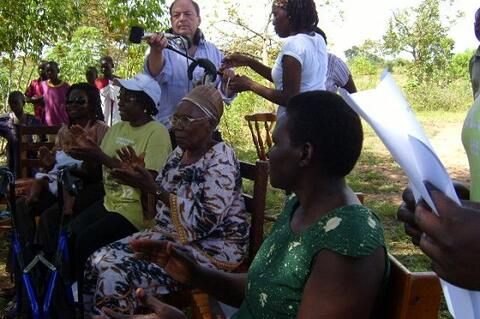
The drama was recorded on site in the village and the actors were all amateurs, while local cooks and farm workers gathered to be recorded as the cheering election crowds, hymn-singing congregations, or angry villagers chasing after an escaped bull. A theme song was recorded with an 82 year old lead singer and a chorus of around 30 women. Producers Clive Brill worked with two trainee technicians to teach them recording and editing skills, and the final few days were devoted to editing.
Click here to listen to episodes of Mako-mere online.
Gender, Democracy and Governance
MIFUMI is an international aid and development agency that works to reduce the burden of poverty by securing basic rights for people living in remote communities of Uganda. MIFUMI supports the needs of and promotes protection for women and children affected by domestic violence and abuse, as well as bride price violations. According to MIFUMI, research has shown that bride price is an underlying cause of domestic violence, and can create wretched situations for victims who try to flee abusive husbands. Women's families are often unwilling to take them in again, as they are unable to repay the bride price. In addition, bride price can be financially crippling for young men, as well as reduce women to the status of a commodity.
MIFUMI, Sheffield Hallam University, and United Nations Population Fund (UNFPA)
Open College of the Arts blog, MIFUMI website, and Sheffield Hallam University website on April 18 2011.