










































Mapping Refugee Media Journeys: Smart Phones and Social Media Networks
The Open University / France Médias Monde
"We urge states and news organisations to work together with tech companies, NGOs, and other stakeholders, in order to develop sustainable partnerships which in turn can orchestrate a coherent news and information strategy for and with refugees: in their home countries, on their journeys, and when they arrive in Europe. This is also important for the digital management of migration."
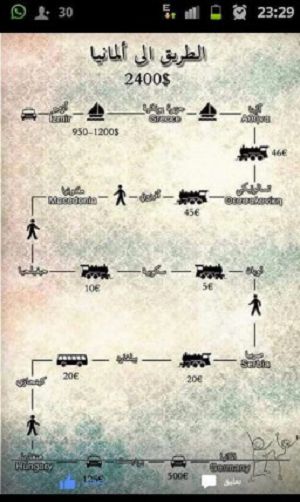
The "Mapping Refugee Media Journeys" project investigates the parallel tracks of the physical and digital journeys of Syrian and Iraqi refugees. It documents the media and informational resources that refugees use from the point of departure, during their journeys across different borders and states, and upon arrival (if they reach their desired destination). By identifying the news and information resources used by refugees and where they experience gaps or misinformation, the researchers intend to make recommendations to the European Commission (EC), European Member states, and their state-funded international news organisations about what resources might they might provide - not only to help refugees make better informed decisions but to offer protection as required to fulfil their obligations under the United Nations (UN) Refugee Convention 1951. This report, which concludes with a best practice guide for organisations seeking to provide digital resources for refugees on smartphones, summarises the first of three planned phases of research.
Led by Professor Marie Gillespie at the Open University in partnership with France Médias Monde, this research was carried out between October 2015 and April 2016. The interdisciplinary project team used mixed and mobile methods: interviews with over 50 Syrian and Iraqi refugees about their uses of smartphones and social media along their journeys, a content and discourse analysis of 342 English-language news items to assess the shifting nature of public and media discourse on refugees, an analysis of refugee social networks (Facebook and Twitter especially) by computer scientists, a survey of existing resources available and a critical analysis of a best practice in providing digital resources for refugees on their smartphones, and interviews with staff at the EC, international broadcasters, and non-governmental organisations (NGOs).
In short, this research found that the smartphone is both an essential tool and a threat for refugees. The tool allows refugees to navigate their journeys, use translation tools, access vital services (legal, medical, food and shelter, support networks) and to keep in touch with friends and family. But the digital traces smartphones leave behind make refugees vulnerable to surveillance by state- and non-state actors and intimidation by extremist groups. The research identified "a huge gap in the provision of relevant, reliable, and timely digital news and information for refugees on their journeys and upon arrival in Europe. There is a growing number of digital resources designed for refugees. Most are inadequately resourced and unsustainable. They can do more harm than good if they disseminate misinformation. Quick 'tech fixes' don't work. Governments and newsrooms in Europe are failing to provide what refugees need, because they fear that they may be seen to be facilitating attempts to seek asylum in Europe. This is forcing refugees to rely on alternative, often unverified and unreliable sources of news and information circulated on social media, particularly by smugglers and handlers. This is endangering them and exacerbating an already dire situation."
Key findings by chapter are outlined on pages 9-15 in bullet-point lists. For example, Chapter 5 indicates that the provision of resources for refugees should seek to have the following components of value:
- User-centred: User involvement in design, implementation, and evaluation is vital and should be research led: All involved - from designers to content producers - should be culturally and ethnographically informed.
- Secure and private
- Checked, curated, and collaborative: Consider reusing/repurposing of existing resources rather than creating from scratch.
- Trustworthy, credible, and regularly updated
- Accessible in terms of cost, technology, language, and literacy
- Sustainable
- Serving a public purpose: Consider the resource's utility value and function for particular groups of refugees at different stages.
Three initiatives were assessed on the basis of these components of value. "All three provide crucial resources and information that refugees might not attain in any other way. The second part of the chapter offers detailed description of the resources and their advantages and disadvantages."
Various recommendations are offered, such as: "Find ways of making best use of key influencers in refugee social network to express solidarity and build trust, plug communication and information gaps and in so doing contribute to a more effective settlement process for refugees in their new homes."
The research is featured in the short video "The map Syrian refugees use to get to Europe" with a commentary by Marie Gillespie as part of the BBC's World On The Move Day: Click here to view it.