










































Maria's Children
Maria's Children is an art studio where Russian boys and girls who are orphans from state boarding schools come to make art, receive therapy, learn skills, and have the opportunity to work on preparing to integrate themselves into mainstream society. Maria's Children uses arts therapy to help in the social, psychological, and intellectual rehabilitation of orphans and special needs children. Their goal is to enable these children to become fully valued members of society, sharing in the rights available to everyone.
The arts centre strives to create an atmosphere of warmth and goodwill which, combined with contact with children from regular families, helps, according to volunteers, to: "prepare orphans for independent life, facilitate their social adaptation, expand their outlook, and correct their psychological and emotional upbringing."
The children study drawing and painting, sewing and embroidery, music and ceramics, theatre and elements of circus arts, and are offered consultations with a psychologist. Students have made creative works, including more than a hundred collective panels, "many of which adorn private collections, and public and government organizations in Russia and abroad," and they are displayed at various exhibitions, including an annual one at the Central House of Artists in Moscow.
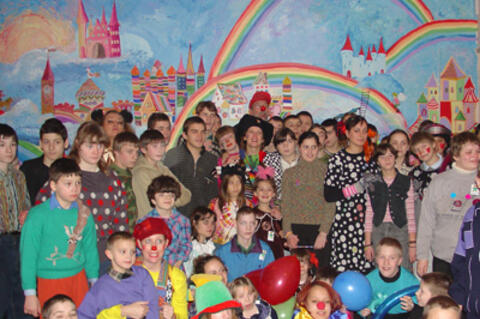
The centre has special programmes, including a social adaptation programme for orphanage-school graduates, the goal of which is to assist them in their integration into society and to help "continue their education in a chosen field, find work, and set their lives in order." It has a programme in which children volunteer outside the centre with very young children in an oncology hospital, with special needs organisations, and with developmentally impaired children. One of their regular volunteer activities is clowning.
A summer camp with an international team of volunteers is associated with the centre and has included inviting children from refugee camps in Chechnya. Future vocational/creative training projects include a restaurant.
Children, Youth
According to the Maria's Children website: "The number of orphans in Russia is currently approaching one million. Lacking life experience in a normal family, and faced with modern demands of education and psychological stability, the majority of these children are unable to fully integrate themselves into society. Some of these children belong to the group now put into the general category of “social orphans,” that is children whose parents are in fact alive, but have relinquished their parental rights or had them revoked. At seven years of age, children leave their baby house to enter an orphanage school, and if they cannot read or write - or if they speak poorly, as often happens - they are diagnosed as 'debil'. From that point, their path is set: special school, technical high school, unskilled work, a room in a communal apartment, and the stigma of being 'underdeveloped'. Their own children end up in baby houses, and the cycle continues."
Maria's Children website, Facebook page, and The Gesundheit! Institute website, July 20 2012.
- Log in to post comments