










































Girls' voices driving the change
Summary:
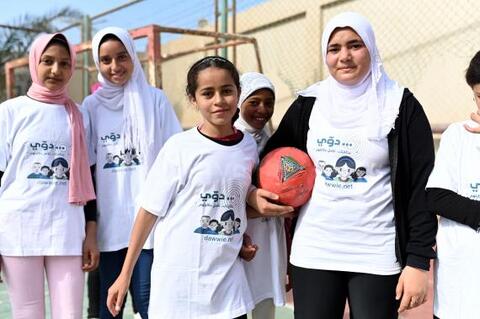
The Government of Egypt (GoE) is using storytelling to empower adolescents, especially girls. In support of Egypt 2030 Agenda's priorities, a Girls' Empowerment Initiative led by the National Council for Childhood and Motherhood (NCCM) has been launched in January 2019 with UNICEF technical support. Named Dawwie (which translates to "loud voice with an impact), the Initiative is using social and behavioral change communication to influence social expectations in terms of gender equality and promote girls' self-efficacy facilitating organic participatory dialogue among children and adolescents. Dawwie is the first coordination mechanism bridging the voices of adolescents' girls and boys with institutions, services and public discourse. Within a continuum that goes beyond community engagement, to skills development to media advocacy and policymaking, Dawwie is a growing coalition that includes already six ministries, two national councils, international organizations, and civil society. Using social marketing, community engagement and knowledge sharing techniques, the Initiative focuses on storytelling between peers, intergenerational dialogue and digital literacy to facilitate an organized diffusion of innovation supporting an enabling environment to overcome social barriers hindering girls' empowerment. With a paradigm shift, the government in Egypt is investing in a long-term collective listening process where girls and boys are supported to speak up and adults, communities, media, and institutions are encouraged to listen to them. Because Dawwie is scalable by design building on open source tools it is already reaching out to millions of girls also trough the Education System which is mainstreaming Dawwie within extracurricular activities.
Background/Objectives:
Egypt has successfully prioritized gender equality within its Sustainable Development Strategy 2030. While there are some positive trends in terms of reducing inequalities between genders, girls in Egypt are less likely to achieve their full potential. Against this backdrop the National Council for Childhood and Motherhood (NCCM) launched Dawwie, in January 2019, with three key objectives: 1) Provide girls with opportunities for their voices to be heard and experience their rights; 2) Provide opportunities for skills development; 3) Improve access to services (e.g. health, education, protection).
Description of Intervention and/or Methods/Design:
The Dawwie Initiative operates at different levels based on the Social Ecological Model, and it is custom-tailored and scalable by design. It builds on a digital literacy programme for girls and boys supported by digital platforms to amplify their voices and positive gender socialization experiences and facilitating access to relevant information and services. Peer to peer storytelling conversations are taking place organically trough a Dawwie Circle Toolkit and the Overall Dawwie Toolkit available on line and distributed in Youth Centers, in public schools and used by several NGOs and trained social and community workers. A TV drama is modelling positive gender socialization nationwide. The Initiative is the first mechanism catalyzing institutional support for girls' empowerment in Egypt by enhancing access to relevant skills and services, evidence generation for policy making and by coordinating an organized diffusion of innovation process based on opportunities for girls and boys to be heard.
Results/Lessons Learned:
Within 6 months of its launch Dawwie resulted in around two million people being reached through social media campaigns, 15,000 adolescents attending the Dawwie digital literacy programme, 10,000 people being reached by the Dawwie Road Show and approximately 5,000 adolescents (10-18 year old) participating in Dawwie Circles, a story-telling forum for girls to share their experiences with peers on a range of relevant topics including health and wellbeing, marriage and aspiration. Further to this, a coalition composed by six ministries, two International Organizations (UNICEF and UNFPA) and three NGOs (Plan, Save the Children, ACDA) has been established and a National Policy Brief on Girls' Empowerment has been published, generating media attention and paving the way for advocacy opportunities. The initiative resonates extensively at the individual, community and institutional levels. As a result, it is growing organically very rapidly across sectors ensuring its sustainability.
Discussion/Implications for the Field:
a. SBCC driven activities entail a great potential to reach out to the most vulnerable in tailored and transformative manners. How can we support relevant institutions to capitalize on those voices and customer-tailored solutions to inform policymaking processes in fluid contexts such as the MENA Region?
b. Girls' voices can trigger changes in current and future generations. What do we need to measure to assess the impact of girls' amplified voices in changing social expectations in terms of acceptance of gender inequality?
Abstract submitted by:
Gaia Chiti Strigelli - UNICEF
Dina Heikal - UNICEF
Approved abstract for the postponed 2020 SBCC Summit in Marrakech, Morocco. Provided by the International Steering Committee for the Summit. Image credit: UNICEF/Egypt 2019/Rehab El Dalil