










































OneLove Campaign: Mid-term Qualitative Evaluation Report
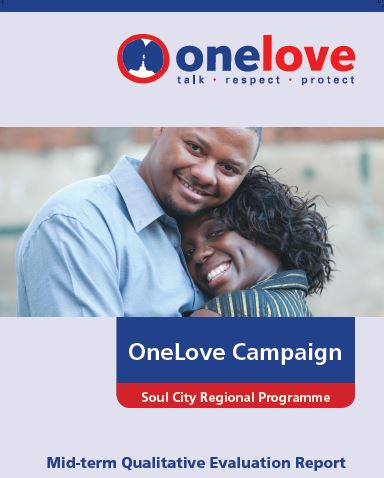
This 32-page report shares the summary results of a meta-analysis of evaluation reports conducted by OneLove regional campaign partners to assess the mid-term progress of the campaign. The OneLove campaign is a regional initiative developed by The Soul City Regional Programme and partner organisations in 10 southern African countries (Lesotho, Malawi, Mozambique, Namibia, South Africa, Swaziland, Tanzania, Zambia and Zimbabwe, and Botswana (TV only), designed to reduce multiple concurrent partnerships (MCPs), which have been identified as a key driver of HIV/AIDS. The evaluations consisted of the OneLove mid-term evaluation as well as audience reception research on the series of films called Love Stories. According to the report, the research findings are encouraging with significant evidence of campaign impact on important drivers of the process of change, and self-reported evidence of actual behaviour change.
The main message of the Onelove campaign, 'Having multiple concurrent relationships puts you and your loved ones at risk of getting infected with HIV', is being carried by a mix of materials, media and community action that is uniquely researched and developed by each country partner. Communication strategies include TV and radio drama series, talk shows and public service announcements broadcast by national and community broadcasters, billboards, social mobilisation and community dialogues, as well as community capacity-building through training. The TV component of the OneLove Campaign broadcast across participating countries in the region comprises ten 24-minute African films, which were produced collaboratively by Soul City and its regional partner organisations. These are called "Love - Stories in a time of HIV and AIDS".
According to the evaluation, the OneLove Campaign materials were well received by audiences across countries. Evaluation participants reported the materials to be entertaining, engaging, enjoyable, helpful, and educational, while also being extremely realistic and relevant to their life contexts. Audiences could identify with situations portrayed in the edutainment media. Furthermore, the materials' main messages of the importance of having one sexual partner, and of the risks posed by having multiple sexual partners, were exceptionally well retained.
Love Stories films were also positively received across countries. Participants mentioned gaining, through exposure to the films, an understanding of HIV as a common southern African regional phenomenon. There was appreciation for the rich cultural diversity that came across in the films, but audiences generally showed a particular support for their local production. Audiences were drawn to the cultural diversity conveyed in the films, and were interested in how 'their country' compared to others.
In terms of impact, the OneLove Campaign materials elicited various rich emotional responses, such as sadness, concern, anger, pain, and gladness in the audiences. Moreover, participants demonstrated that they had reflected on the materials' content, holding it up for scrutiny, which is a trigger for desired behaviour change. Some participants reported perceived change around them in descriptive norms in association with exposure to the OneLove Campaign materials. This is important in that it can be associated with maintenance of desired behaviour and behaviour change itself. Results also revealed that exposure to the materials sparked debates and discussions among romantic couples, peers, and family members (parents and children, and siblings).
Participants also questioned existing patterns of behaviour as a result of exposure to the OneLove Campaign materials. Women, in particular, reported being empowered to challenge powerful cultural practices that put them at risk of contracting HIV. Exposure to the campaign was also reported to be linked to changes in beliefs, attitudes, behaviour of having one sexual partner, open communication in relationships, correct and consistent condom use, HIV testing, and intergenerational and transactional sexual relationships. Other positive behaviour changes that were attributed to exposure to the OneLove Campaign materials, but not prominently across all groups, included change in the quality of relationships and maintenance of safe sexual behaviour in general.
In conclusion, the evaluations suggest that there is strong qualitative evidence that some of the underlying OneLove Campaign message objectives are being reached. The campaign is notably promoting dialogue and debate at an interpersonal level. The report explains that social and behaviour change is a complex process that is emergent in nature, that is, it emanates from the interaction of system elements in ways that are not necessarily linear and predictable, and where the whole is more than the sum of its parts. In this analysis there is clear and consistent evidence that multi-media edutainment, in particular that of the regional OneLove Campaign, is a significant contributor to this process.
Email from Lebohang Letsela on November 29 2013.
- Log in to post comments