










































OpenIDEO
"What tools, campaigns or services might we design to support habit changes that stick?"
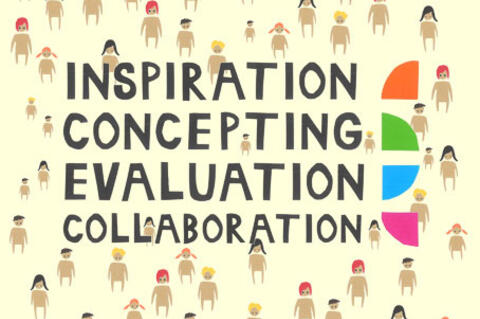
This is one question posed on OpenIDEO, an online platform launched in July 2010 in an effort to gather and connect thinkers around the world who want to share and implement creative ideas for social good. IDEO, a design and innovation organisation, developed OpenIDEO as a way to include a broader range of people in the design process through inspiration, concept generation, and evaluation.
IDEO posts a design problem for social change, which includes 5-7 phases, depending on the challenge. "Users participate and provide feedback every step of the way, receiving points (known as their Design Quotient, or 'DQ') for their contributions).... At the end of the process, which takes about 10-16 weeks, a final design is chosen." Any ideas from the challenge may be produced by whoever chooses to do so - all concepts are generated under a Creative Commons license and are thus shareable, remix-able, and reusable.
More specifically, every challenge starts with a big question - a call to action around a social issue to tackle. During the Research phase, community members are invited to share stories, experiences, tools, case studies and examples to lay the groundwork for future ideation. During the Ideas phase, community members develop solutions, collaborating with each other to drive ideas forward. A Refinement phase and Feedback phase offer people the opportunity to strengthen, iterate, and prototype ideas. (OpenIDEO invites the community to share their feedback and insights during the Research phase on the platform here). Top Ideas are selected based on their potential for impact, receiving various types of support from OpenIDEO and challenge sponsors.
IDEO states: "No matter what field you work in, what level of experience you have, what country you're from - if you're keen to collaborate on solutions to challenges facing the world today - you're welcome to join OpenIDEO."
Conflict, Children, Education, Environment, Gender, Governance, Rights, Youth
According to IDEO: "Thinking like a designer can transform the way organizations develop products, services, processes, and strategy. This approach, which IDEO calls design thinking, brings together what is desirable from a human point of view with what is technologically feasible and economically viable. It also allows people who aren't trained as designers to use creative tools to address a vast range of challenges" - including development challenges as outlined above.
OpenIDEO website and IDEO website - both accessed on July 3 2014; and email from OpenIDEO to The Communication Initiative on October 16 2014.
- Log in to post comments