










































Oral and Inactivated Polio Vaccine Coverage and Determinants of Coverage Inequality Among the Most At-Risk Populations in Ethiopia
Addis Ababa University (Gebremedhin); Project HOPE (Shiferie, Tsegaye, Alemayehu, Wondie, Biks); Bill & Melinda Gates Foundation (Donofrio, DelPizzo); USAID Ethiopia (Belete)
"Polio vaccination coverage in the most at-risk populations in Ethiopia is suboptimal, threatening the polio eradication initiative."
A major threat to the Global Polio Eradication Initiative (GPEI) is the inability of endemic and outbreak-prone countries to sustain high vaccination coverage within all at-risk populations. Inequality in vaccination coverage is likely the reflection of both supply-side (e.g., inaccessibility to health services) and demand-side (e.g., limited care-seeking due to low socioeconomic status) factors. Wild poliovirus (WPV) type 1 remains endemic in two countries (Afghanistan and Pakistan), and 33 countries, including Ethiopia, are designated as outbreak countries. Combining oral (OPV) and inactivated (IPV) poliovirus vaccines prevents importation of WPV importation and emergence of circulating vaccine-derived poliovirus (cVDPV). This study measured the coverage with IPV and third dose of OPV (OPV-3) and identified determinants of coverage inequality in the most at-risk populations in Ethiopia.
The data for this study came from a national survey that Project HOPE (Health Opportunities for People Everywhere): The People-to-People Health Foundation, Inc. undertook in mid-2022 with the goal of estimating the burden of zero-dose children in remote settings of Ethiopia. A national survey representing 10 partly overlapping underserved populations - pastoralists, conflict-affected areas, urban slums, hard-to-reach settings, developing regions, newly formed regions, internally displaced people (IDPs), refugees, and districts neighbouring international and interregional boundaries - was conducted among children 12 to 35 months old (N = 3,646). Socioeconomic inequality was measured using the concentration index (CIX) and decomposed using a regression-based approach.
The study revealed that one-third (95% confidence interval (CI): 31.5-34.0%) of the children received OPV-3 and IPV. The dual coverage was below 50% in the following: developing regions (19.2%), districts neighbouring international (24.1%) and interregional (33.3%) boundaries, conflict-affected areas (29.3%), newly formed regions (33.5%), and hard-to-reach areas (38.9%). It was also below 50% among: pastoralists (22.0%), IDPs (22.3%), and refugees (27.0%). Conversely, coverage was better in urban slums (78%). Children from the economically poorest households, living in villages that do not have health posts, and having limited health facility access had increased odds of not receiving the vaccines. IPV-OPV3 coverage favoured the economically wealthy (CIX = -0.161, P < 0.001), and causes of inequality were: inaccessibility of health facilities (13.3%), dissatisfaction with vaccination service (12.8%), and maternal (4.9%) and paternal (4.9%) illiteracy.
Some findings with particular implications for communicators include: Low paternal education, dissatisfaction with vaccination service, fear of vaccine side effects, female-headed households, and employed and less empowered mothers were risk factors. For example:
- Partners' educational status emerged as a predictor of children's IPV-OPV-3 status, independent of maternal education or household wealth status, and explained a significant proportion of inequality with polio vaccination.
- Caregivers who reported that they were not satisfied with vaccination service (adjusted odds ratio (aOR): 2.15, 95% CI: 1.53-3.01) or had not been visited by frontline health workers in the past 3 months (aOR: 1.63, 95% CI: 1.26-2.12) had lower uptake.
- Nearly all (99.4%) knew where to get their child vaccinated. However, only 45.1% managed to mention at least three vaccine-preventable diseases, and only 19.1% were aware that infants have to be vaccinated starting from birth. Smaller proportions reported fear of vaccine side effects (2.1%) and refused vaccination offered by a health worker (0.4%). Caregivers who did report fear of vaccine side effects had significantly reduced odds of receiving the vaccines.
- Infants born to women with low decision-making power had 3 times increased odds (aOR = 2.93, 95% CI: 2.16-4.00) of not receiving IPV-OPV-3 vaccines than those born to women with high decision-making power. As the researchers explain: "poor household decision-making power compromises care seeking behavior."
The researchers suggest that, to keep pace with the GPEI, Ethiopia needs to take actions such as these:
- Roll out periodic intensification of routine immunisation in remote areas, and strengthen outreach and supplementary immunisation activities such as campaigns so as to bring the vaccine closer to the most at-risk communities.
- Integrate immunisation with other services to reduce missed opportunities.
- Address parents' concern over vaccine side effects by integrating counseling activities into routine immunisation programmes.
- Be gender responsive: Engage husbands more effectively in polio vaccination, and become more responsive to female-headed households and employed mothers.
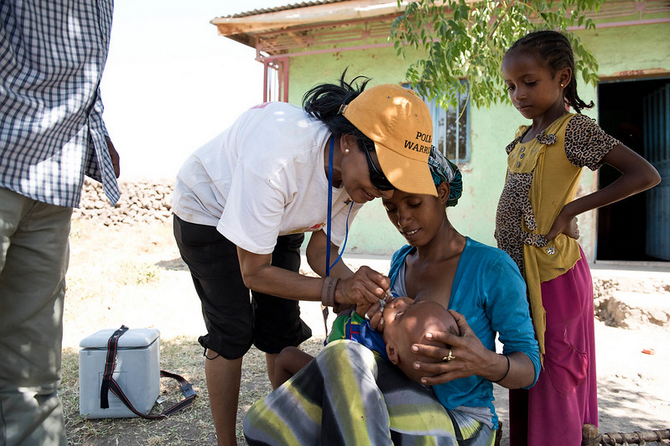
American Journal of Tropical Medicine and Hygiene, 00(00), 2023, pp. 1–9. doi:10.4269/ajtmh.23-0319. Image credit: © UNICEF Ethiopia/2014/Tsegaye via Flickr (CC BY-NC-ND 2.0 Deed)
- Log in to post comments