










































Participatory Intervention with Women's Groups
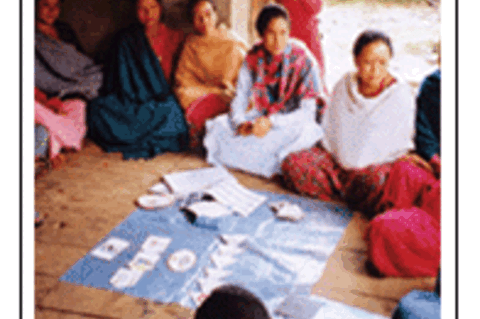
A team from Mother and Infant Research Activities (MIRA), a non-governmental organisation (NGO) based in Kathmandu, Nepal, undertook a low-cost, community-based participatory intervention with women's groups to test their impact on birth outcomes. In the hilly rural and economically poor Makwanpur district, local women participated in facilitated, all-women community groups to strategise about how to address perinatal health problems, and increase access to health care. The aim of the project was to implement, and examine the effects of, a participatory approach to saving children's and women's lives.
Communication Strategies
The communication approach emphasised participatory learning, rather than instruction, and was designed to fully involve women in community-focused problem solving. In each intervention cluster (average population 7000), a facilitator - a literate locally resident woman - was selected. This woman needed to have "abilities and training in participatory communication techniques." Although organisers intentionally chose women who did not have a healthcare background, they did provide the facilitators with brief training in perinatal health issues and interventions so that they could "act as a broker of information and a catalyst for change". Supervision throughout the course of the project, and a printed manual, were also designed to support the facilitators in their work.
With these facilitators' guidance, women gathered to discuss problems related to neonatal and maternal care in their community, and together figure out ways to address them. Each facilitator convened 9 women's group meetings every month. In the early series of meetings, the women discussed issues around childbirth and care behaviours in the community, "which allowed facilitators to develop participatory learning skills and generated information on pregnancy and childbirth, covering beliefs and practices in both uncomplicated and complicated pregnancies." The facilitators then supported the women's groups through monthly meetings focusing on:
Thereafter, the group and community implemented the strategies and evaluated them, before beginning the process again.
Based on the priorities decided by the women's groups, the MIRA team facilitated the implementation of their strategies to improve the health of mothers and newborns in the community. Examples of the women's group strategies include starting emergency funds, making stretchers, and making clean home-delivery kits.
MIRA also took concrete action to remedy various weaknesses in the provision of health care in the entire District, based on a service audit of facilities and equipment. As an example of the team's communication-related action, MIRA organised training in essential newborn care for all cadres of government health staff and for female community health volunteers and traditional birth attendants. Community-based workers received a basic newborn care kit that contained basic medical tools and a pictorial manual.
With these facilitators' guidance, women gathered to discuss problems related to neonatal and maternal care in their community, and together figure out ways to address them. Each facilitator convened 9 women's group meetings every month. In the early series of meetings, the women discussed issues around childbirth and care behaviours in the community, "which allowed facilitators to develop participatory learning skills and generated information on pregnancy and childbirth, covering beliefs and practices in both uncomplicated and complicated pregnancies." The facilitators then supported the women's groups through monthly meetings focusing on:
- Introduction of the study to the group
- Discussion of why mothers and newborn infants die
- Discussion of how women understand maternal and neonatal problems
- Discussion of maternal and neonatal problems in the community
- Identification of strategies to obtain information in the community
- Sharing of information from other women in the community; prioritisation of 3 maternal and 3 neonatal health problems
- Discussion of possible strategies for addressing the priority problems (such as home visits by group members to newly pregnant women, and awareness-raising with a locally made film to create a forum for discussion)
- Discussion of how to involve other community members in developing strategies and preparatory work for a meeting of community members
- Community meeting to discuss the activities of the women's groups and the priority problems identified by the groups, as well as to reach consensus on strategies to address these problems
- Group discussion of strategies and finalisation of implementation plan
Thereafter, the group and community implemented the strategies and evaluated them, before beginning the process again.
Based on the priorities decided by the women's groups, the MIRA team facilitated the implementation of their strategies to improve the health of mothers and newborns in the community. Examples of the women's group strategies include starting emergency funds, making stretchers, and making clean home-delivery kits.
MIRA also took concrete action to remedy various weaknesses in the provision of health care in the entire District, based on a service audit of facilities and equipment. As an example of the team's communication-related action, MIRA organised training in essential newborn care for all cadres of government health staff and for female community health volunteers and traditional birth attendants. Community-based workers received a basic newborn care kit that contained basic medical tools and a pictorial manual.
Development Issues
Children, Health, Women.
Key Points
MIRA was established in 1992 by a Nepalese group of perinatologists led by Dr. Dharma Sharna Manandhar - in close collaboration with Dr. Anthony Costello of the Institute of Child Health, London - to improve mother and infant health in Nepal through research, training and advocacy, and develop appropriate and cost-effective interventions to improve maternal and infant health in economically poor communities. They were concerned and motivated by such figures as these: the estimated infant mortality rate in Nepal was 64 per 1000 livebirths, the neonatal mortality rate 39 per 1000 livebirths, and the perinatal mortality rate 47 per 1000 births. In rural areas, 94% of babies were born at home, and only 13% of births were attended by trained health workers. Through research, service provision, and advocacy, MIRA explores and implements methods to reduce birth asphyxia, improve nutrition for pregnant mothers and babies, and change behaviour through health promotion. MIRA also works closely with the government sector, and has helped the Ministry of Health devise the national policy for newborn care at each level of care.
Partners
MIRA, Institute of Child Health, London, Ministry of Health, Government of Nepal. Funded by the UK Department for International Development (DFID), United Nations Children's Fund (UNICEF), United Nations Population Fund (UNFPA), and the World Health Organization (WHO).