










































Planning for Life (PfL)
To facilitate integration, IYF provided its partners in the 3 implementing countries with technical and administrative guidance, as well as programme materials and curricula including: a Framework for Integration of FP and RH into Youth Development Programs; RH Integration Self-Assessment Tool; the FP, HIV/AIDS & STIs and Gender Matrix; Project Design and Proposal Writing Guide; and Reproductive Health Supplemental Curriculum. This guidance is meant to enable teachers, health workers, vocational training staff and peer educators (PEs) to integrate topics such as abstinence, consequences of early pregnancy, and various contraceptive methods into lessons already being taught about HIV prevention. The emphasis during various trainings offered as part of PfL was on the importance of interacting with youth in a friendly, non-judgmental manner. Health professionals, vocational training staff and teachers were encouraged to engage youth in interactive discussions about RH issues, rather than providing information in a didactic manner.
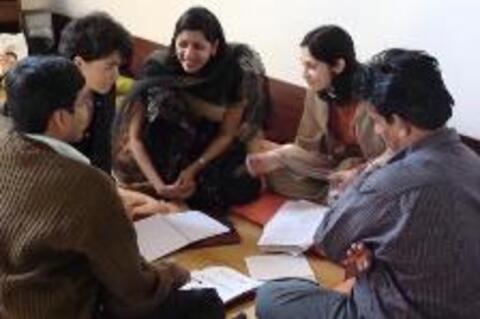
In India, IYF worked with Youthreach and 4 sub-partners - Dr. Reddy's Foundation, Byrraju Foundation, Sahara, and PRERANA - to implement Project Samriddhi, the local PFL project. An additional partner, Thoughtshop Foundation, was also identified to develop training material for the project. Project Samriddhi reached youth with FP/RH knowledge and skills by integrating an RH curriculum and teaching aids into existing livelihoods projects implemented by the 4 partner organisations. Staff from the partner organisations took part in a training of trainers (ToT) session held in March 2009. The trainers reportedly spent considerable time befriending and establishing rapport with the participants before facilitating sessions on sensitive FP/RH issues. They said that when they used examples and experiences and had an open and interactive dialogue they were best able to reach youth. They also felt that their body language and maintaining a healthy and friendly environment helped the youth be more interactive. The teaching aids included various card games, puzzles on reproductive parts, and a flip book to facilitate storytelling. The final evaluation found that integrating RH lessons into vocational training programs towards the end of the training was most successful, as trainers had established a rapport with the students by that time.
In the Philippines, IYF partnered with the Consuelo Foundation and its sub-partners to include an RH curriculum for Muslim youth in the Foundation's employability and education training. Namely, the Foundation for Adolescent Development (FAD) adapted Consuelo Foundation's Adolescent Reproductive Health Curriculum for Young Muslims and then, in March 2009, trained 14 staff members from 9 youth-serving Consuelo Foundation partner organisations to implement the curriculum (which centred around an Islamic perspective and included Quaranic verses). The Friendly Care Foundation (FCF) provided a 2-week training on youth-friendly services in February 2009 to service providers in YRH/FP at 2 health facilities in Mindanao. The training included intensive discussions on how to be more sensitive towards youth, and especially Muslim youth. It also focused on teaching providers how to use verbal and non-verbal communication, and was intended to be culturally appropriate and respectful of the religious view of the area.
In Tanzania, IYF worked in partnership with 2 organisations, Tanzanian Red Cross Society (TRCS) and Iringa Development of Youth, Disabled, and Children (IDYDC), to integrate FP and RH messages into existing youth HIV/AIDS prevention programmes:
- IYF works with TRCS on Empowering Africa's Young People Initiative (EAYPI), a programme aiming to scale up peer education programmes, stimulate broad community discourse on healthy norms and risky behaviours, reinforce the role of parents and other influential adults, and reduce sexual coercion and exploitation of young people in project sites. The intention of the PfL project was to integrate youth FP and RH messages into the existing peer education project, while training youth friendly service providers in the community for referrals and consultation. As part of the PfL programme, TRCS and the Tanzania Ministry of Health (TMOH) provided health care professionals and teachers with a 2-week training on provision of youth-friendly FP/RH services and education. Youth peer educators (PEs) also participated in this training to provide information and suggestions to the service providers. The sessions focused on increasing knowledge about life skills, pregnancy prevention, contraceptive methods, and sexually transmitted infections (STIs), as well as providing them with strategies to better relate to and interact with young people. Strategies introduced to engage youth included question-and-answer techniques and incorporating songs and storytelling into the lessons. In addition to providing education and services (e.g., counselling youth on dual protection against HIV and unplanned pregnancy) in health facilities, during the PFL programme health workers visited schools to increase awareness of existing FP/RH and other services and to demonstrate their own youth-friendliness by providing basic health services (e.g. taking blood pressure and height and weight measurements, cleaning and bandaging minor cuts, etc.) on school grounds. Teachers trained by TRCS provided youth education on abstinence, the consequences of early sexual activity, FP methods, and STI and HIV prevention and detection. PEs provide outreach on FP/RH and HIV to both in- and out-of-school youth ages 8-30 (different PEs stated different age ranges of the beneficiaries). The teachers and PEs refer youth to trained youth-friendly service providers.
- With IDYDC, IYF worked through sports clubs in Iringa Regions to provide HIV prevention messages and life-skills education. Football and netball (volleyball) coaches had previously been trained to provide HIV prevention education to youth ages 13-17 years old who participate in the sports club. As with EAYPI, PFL worked with IDYDC to integrate HIV/AIDS prevention messages with FP/RH messages and reinforce life-skills education for youth. Before or after practice games, the trained coaches provide youth with education on RH and HIV/AIDS.
HIV/AIDS, Reproductive Health, Youth.
Because the pathway to becoming HIV-infected and pregnant is the same - unprotected sex - IYF contends that HIV prevention programmes and services offer an opportunity to provide youth with the knowledge and skills needed to address a range of RH issues, including pregnancy prevention.
IYF, USAID, World Learning - with Dr. Reddy's Foundation, Byrraju Foundation, Sahara, PRERANA, Consuelo Foundation, FAD, FCF, TRCS, and IDYDC.
- Log in to post comments