










































Polio Communications Global Guide
"Whether you are reacting to the initial report of a poliovirus outbreak and need to get the word out quickly or managing a protracted outbreak and need a more nuanced communication approach that can address campaign fatigue or localised immunisation resistance, this guide provides the guidance and resources you need to reach your target audience with creative and effective communication."
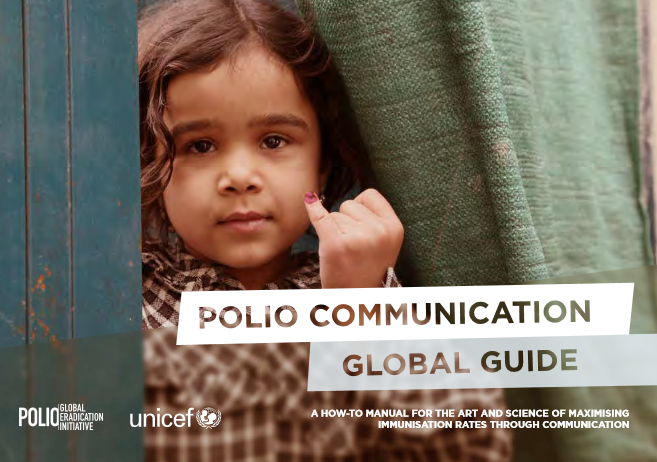
This four-part Global Polio Eradication Initiative (GPEI) guide is a how-to manual for planning and building effective mass media and interpersonal communication (IPC) strategies with the ultimate goal of eradicating polio. Part 1 of the resource outlines the United Nations Children's Fund (UNICEF)'s global approach to polio communication, which is informed by data and on-the-ground experience - with a focus on reaching the hardest-to-reach populations in the final polio reservoirs of the world. It provides a comprehensive strategic framework and identifies the key steps of planning and executing an effective and adaptive polio communication response. The Polio Communication Global Guide is designed for UNICEF country and regional officers, their communication counterparts, GPEI partners, and government counterparts.
First, the introductory section of Part 1 explores the rationale behind the GPEI approach, which has moved from the utilisation of risk communication to reach individual caregivers with facts about polio and polio vaccination toward specific efforts to address the dynamic perceptions and social norms that deter caregivers in the remaining 1% of the world from vaccinating their children. This shift to social norm communication is grounded in recent polling research on populations affected by polio in endemic and outbreak contexts. "It is important to remember that communication to support positive perceptions of the health worker and programme can only be successful when complemented with qualified, properly trained, paid, and motivated health workers."
The GLOBAL COMMUNICATION STRATEGY section elaborates on the single pivotal moment: the short, interpersonal interaction between health workers and caregivers. Therefore, the strategy is twofold: to promote all vaccination, including polio, as a social norm that everyone adheres to, and to build trust and goodwill for health workers by humanising them in all communication.
There are three principles that all GPEI polio materials and communication strive to adhere to:
- understand and leverage social perceptions, norms, and beliefs related to polio and polio vaccination;
- humanise health workers by emphasising their social and emotional depth; and
- continuously refine communication to maintain authenticity and credibility for the intended audience(s). Concrete guidance for each of these principles is offered, such as in the form of a list of questions to help understand how an audience member views communication and to help tailor materials to appear real and authentic (e.g., "Are individuals with polio, as well as all children, depicted and portrayed with respect and dignity?"). Sample communication: "We Are All Intertwined" - the idea is to make polio immunisation a social norm.
It is suggested that, when constructing and adapting communication tactics, practitioners consult the Social Ecological Model (SEM). The SEM is a framework used by UNICEF to understand and address norms that influence individual and collective behaviours and societal norms, such as the acceptance or rejection of the polio vaccine. The model outlines 5 levels of society: individual, interpersonal, community, organisational, and policy/enabling environment. See ELEMENTS OF SEM (page 15). During the development of norm-based behaviour change communication, consider possible interventions at all five of the framework's levels. Utilising a cohesive approach will help ensure communities and decision-makers at local, national, and regional levels are engaged in dialogue toward promoting, developing, and implementing policies and programmes that enhance the quality of life for all.
One of the sections in Part 1 looks at how to apply the strategy. This involves building social demand for vaccination and presenting the health workers as trustworthy, admirable, compassionate, helpful, and competent across all of the touch points and caregiver-focused messages. To organise communication across touch points, according to the guide, it is useful to create "a structured journey". This journey was created using both empirical findings and the framework of the theory of reasoned action (TRA). The latter focuses on an individual's intent to perform a specific behaviour, such as the intent to vaccinate, and how attitudes and societal norms contribute to this intent. The journey illustrated on page 18 is composed of touch points that influence a caregiver's intent to vaccinate their child. For example: "We want to encourage people to talk with neighbours, relatives, and community members about the dangers of polio, other vaccine-preventable diseases, and the importance of vaccination. Peer-to-peer advocacy is an essential measure of our success within a community, and the goal is to increase and sustain the perception that vaccination is popular and accepted and that working as a health worker is admirable."
The resource next explores the importance of "a brand" as we go about the work of ending polio and beyond. As explained here, a brand "isn't just a logo or name. Rather, it is a promise from the branded entity to its intended audience about what to expect from every interaction or touch point." The Guardians of Health brand is used here as a case study.
"Just as our operational and vaccination strategies differ according to the epidemiological situation, our communication strategies must also differ according to a community's polio scenario and related social perceptions. Our efforts against polio take place across three potential scenarios: Outbreak, Enduring Outbreak, and Maintenance."
Part 1 of the guide next asks the reader to identify the polio phase of the outbreak corresponding to his or her country setting and describes each phase and necessary actions. Each phase is also the subject of its own entire section of the four-part resource:
Part 2: OUTBREAK. One or more cases of polio in an area that had previously been polio-free for a minimum of six months.
Click here for the 42-page guide on Outbreak in PDF format. This section contains:
- Outbreak Communication Phases
- Strategic Overview
- Communication Planning Process
- Audience Analysis
- Barrier Analysis
- Communication Planning Worksheet
- Media Channel Selection
- Creative Concepts
- Measurement, Monitoring, & Evaluation
Part 3: ENDURING OUTBREAK. After six months of an outbreak or if polio transmission has never been interrupted - endemic country.
Click here for the 70-page guide on Enduring Outbreak in PDF format. This section contains:
- Applying Strategy in an Enduring Outbreak
- Communication Planning Process
- Barrier Analysis
- Audience Analysis
- Audience Types
- Interpersonal Engagement & Key Messages
- Communication Planning Worksheet
- Media Channel Selection
- Creative Concepts
- Measurement, Monitoring, & Evaluation
Part 4: MAINTENANCE. Comes after an outbreak is closed or after an endemic country is declared polio-free.
Click here for the 50-page guide on Maintenance in PDF format. This section contains:
- Communication Strategy
- Communication Planning Process
- Barrier Analysis
- Audience Analysis
- Moving from Polio to Health
- Communication Planning Worksheet
- Media Channel Selection
- Creative Concepts
- Measurement, Monitoring, & Evaluation
Within the guide, planning tools, audience segmentation, and information about barriers to vaccination help clarify appropriate communication priorities. Sample creative concepts tailored to specific situations provide guidance on creating targeted mass communication, while messaging gives direction for how to connect those concepts through a comprehensive approach, ranging from mass media all the way down to IPC.
Also available is a webinar on operationalising the Polio Communication Global Guide. It reviews some creative and effective solutions for social mobilisation in the last polio reservoirs, including communication phases and overcoming barriers to vaccination. Please see below for access.
English and French (intro portion only)
32 (Part 1); 42 (Part 2); 70 (Part 3); 50 (Part 4)
GPEI website, November 29 2016; Rhizome, May 31 2017; and email from Marianna Zaichykova to The Communication Initiative on July 18 2017.
- Log in to post comments