










































Polio Eradication - Using Qualitative Comparative Analysis to Strengthen Understanding of Social Factors in Programme Effectiveness
"Understanding the specific ways material and social factors - acting in context-specific conjunctions - affect participation in the [polio eradication] programme, can help to identify at the micro-level, which particular community or household characteristics in a specified locality appear to obstruct or facilitate vaccination."
This briefing note outlines Qualitative Comparative Analysis (QCA) as a research method and relates it to the Polio Eradication Initiative (PEI). (For further background on QCA, please see Related Summaries, below.) As Sebastian Taylor explains here, QCA enables a more systematic (and, hence, case-comparable) approach to the organisation of qualitative data. QCA is generally considered to be optimal in studies with a small to medium number (3-250) of "cases" (e.g., households, groups, or communities accepting or reluctant to accept polio vaccine). Taylor explains that this makes it highly applicable to the close study of communities or indeed households in localities targeted for PEI activities.
QCA proceeds from principles of realist evaluation (Pawson & Tilley, 1997). The idea is that individuals, households, and communities being sought for participation in a programme such as polio vaccination decide whether or not to seek out or accept vaccination according to constraints and opportunities generated both by their beliefs and attitudes about the world around them, as well as the material, economic, social, and political resources they have at their disposal. Realist evaluation, using QCA, thus requires collection of data on the local context of programme implementation to complement already-collected data on programme outcomes and/or process. Rather than setting one external variable against another to determine which has dominant statistical relevance, QCA sees an outcome as the conjunctural effect of factors and, hence, promotes integrated factor analysis.
Specifically, QCA takes a group of cases, systematically assesses a set of characteristics across the cases, quantifies these characteristics through coding, and looks for patterns in the resulting data providing interpretive (as opposed to statistical) evidence of causality between patterns and (positive/negative) outcomes. For each case, a set of characteristics can be compiled (based on a set of correlational hypotheses - what localised factors might be associated with worse or better programme performance). For each case, data on hypothetically programme-influencing characteristics can be gathered, coded binomially (1 or 0) or ordinally and set against the independent variable (e.g. polio vaccine compliance/non-compliance). A set of results can be organised in a matrix, allowing for cross-comparison of patterns in characteristics against positive or negative outcome.
This approach can be seen in two tables in the document. The first table provides a sample set of some objective and subjective variables that could be included in a QCA (e.g., health conditions and behaviour, political, gender). Given some of the quantitative (objective) data cited, it is likely that this level of table would be more appropriate for assessing a small group of communities. The second table offers some sample characteristics that could be applied to the analysis of households within a single community (where half are known to have been non-compliant in past supplementary immunisation activities (SIAs), and half are known to have been compliant), or between two communities (where one community is poor-performing in PEI, and the other is assessed to be well-performing).
"Acknowledging practical challenges in ongoing PEI operations (such as finding time and resources for small-scale surveys, gaining access to respondents in households that have been non-compliant with vaccination etc), this brief suggests that QCA could be used to compare the characteristics of communities engaging positively and negatively with the polio programme, and with groups of households divided similarly."
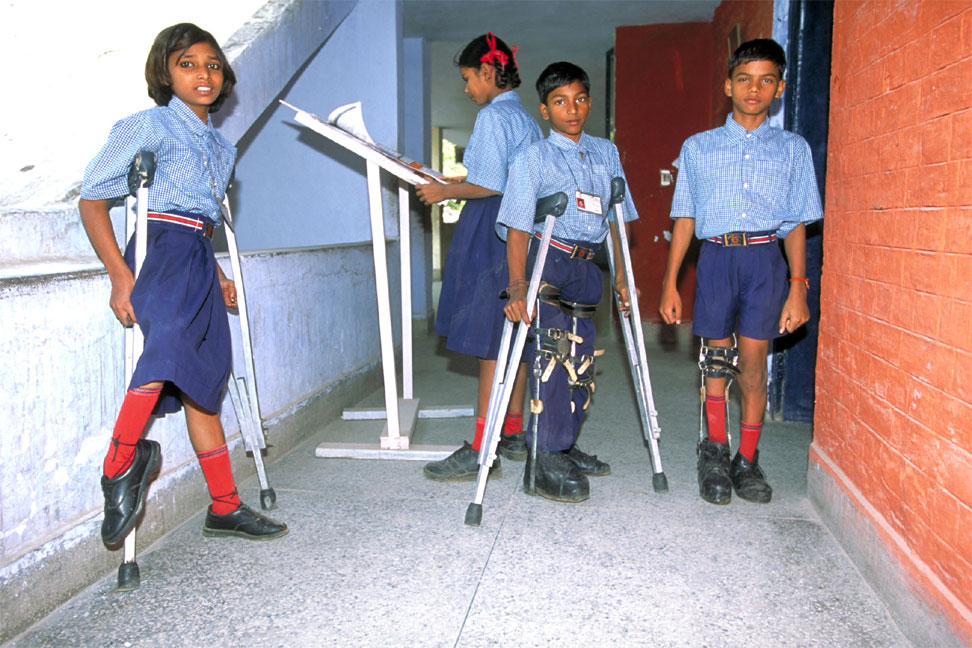
Email from Sebastian Taylor to The Communication Initiative on December 8 2013. Image credit/caption: United Nations News Centre. Children with polio at the Amar Jyoti Research Centre, Delhi, India