










































Poverty Requiem
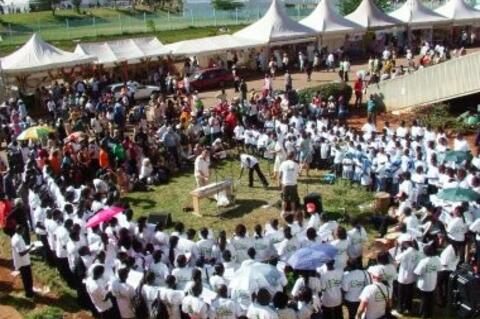
The requiem is a vocal work bridging the gap between groups from different cultural backgrounds, between different continents and nationalities. Because - according to organisers - the Requiem can be performed in any social and cultural context, by small and big troupes, with different musical and other artistic elements (such as dance), it is possible to view the Poverty Requiem as a community art project, in which a balance is created between amateurs and professionals, and between the artistic performance and the political message. In a worldwide marathon of music (on October 17), people from all walks of life in many time zones sang the same songs about human suffering and hope for a better life, free of poverty.
Specifically, the Poverty Requiem is a work of music for choir, percussion, and 2 soloists. The piece was written to allow conductors to compose their own Poverty Requiem, whatever the cultural context. Sound examples, instructions, scores, and lyrics, which were made available on the Poverty Requiem website (no longer in operation as of September 2009) are intended to enable many people to study the piece over a short period (3 weeks), and then stage it. In addition, conductors from around the world attended a Requiem Conductors workshop and master classes in The Netherlands prior to this event. During the conductors' meeting, each participant shared his or her view on conducting the Poverty Requiem. Click here to access the blog of one of these conductors (and see the Right Navigation Bar on that blog for others). The result was performances on October 17, such as one that took place in Palestine, where the Jenin Choir staged performances in Jenin and in refugee camps.
Various spin-offs of this experience have been created, and the internet is being used as a tool to guide those wishing to take part. For example, on the project website, one may download a dance structure, which features choreography that has been developed for dancers with different levels of experience to participate (i.e., set forms are basic and non-technical in execution). Video examples, available for online download, are designed to guide those seeking to transform in all 5 parts the musical counting into danceable counting. In addition, visitors to the project website may access various YouTube films, rehearsal and organising details, and ways to participate in online discussions about the issue of poverty.
Involving children in the effort reflects the goal of bringing people from different cultures together for a common goal - through art. Specifically, 3 weeks before the International Day for the Eradication of Poverty, children from Kenya, The Netherlands, and Suriname started an exchange project inspired by the Poverty Requiem. Participants studied the 5 different Poverty Requiem songs and discussed several underlying themes (i.e., hope, sadness, and "where were you born?"). The pictures, drawings, stories, and poems the children made to reflect these themes were exchanged through the internet; they had live chat-sessions, and showed and explained their different lives and visions to one another.
Poverty.
According to organisers, "The Poverty Requiem's basic principle is to make music democratically. Nobody is excluded on the basis of musical experience or know-how, age, sex or cultural background. All participants use the audio and visual examples and instructions published on this website to prepare. An ability to read music is not required. The piece has several layers. Simple movements sung by children and/or unpractised singers, and more complex layers to be performed by amateur choirs and/or practised singers. Layers can be deleted or inserted. This allows for a flexible work of music to emerge, one that can be performed in any international or local context."
In 2007, 43.7 million people joined GCAP, and in 2008 116.7 million people joined Stand Up and Act against Poverty, also with GCAP.
GCAP, Oxfam Novib, Europa Cantat, Education International, the International Federation of Choral Music, and UNESCO - with support from NXS Internet and New Fountain.
E-CIVICUS listserv, August 29 2007, Issue No. 354; Poverty Requiem website (no longer in operation as of September 2009); and emails from Ciara O'Sullivan and Sylvia Borren to The Communication Initiative on October 27 2008 and February 4 2009, respectively.


- Log in to post comments