










































Reflections on Polio Lessons from Conflict-Affected Environments [Introduction]
The Communication Initiative
Introduction

The Global Polio Eradication Initiative (GPEI) has worked in conflict zones since it began in 1988. During this time, it has successfully stopped transmission of wild poliovirus (WPV) in all but three endemic countries and outbreaks of vaccine-derived poliovirus in conflicts as severe as the Syrian civil war. It has also learned many lessons about the strategies and operational approaches that enable such success. However, the documents that capture those lessons are limited and often broadly thematic and suggestive rather than strategic and programmatically specific. Nevertheless, as GPEI program staff and researchers have reflected on experience, they have identified strategic approaches and operational tools that today constitute core elements of a communication and operational framework for working in conflict-affected environments.1
What follows looks back at lessons captured—albeit sometimes only summarily—across several points in time: at the end of the 1990s and the first decade of the GPEI; after the polio outbreaks in Central Africa, the Horn of Africa, and the Middle East in 2013; and more recently in the context of the remaining three endemic countries: Afghanistan, Pakistan, and Nigeria2 (GPEI 2017; Nnadi, Etsano et al. 2017; Rubenstein 2010; Tangermann et al. 2000). As might be expected, understandings of necessary polio program capacities and operational and communication requirements have evolved and been sharpened over time. However, certain elements had emerged during GPEI's first decade that have become the foundations upon which today's operational thinking is based—the ability to negotiate with all parties, the need to ensure health infrastructure for vaccine delivery and surveillance, the importance of routine immunization services as the foundation for vaccine delivery, the necessity of building trust with communities, and the struggle to ensure that even the hardest to reach and most marginalized are vaccinated - have emerged as foundations upon which today's operational thinking is based.
This document is neither a literature review nor an academic paper. Rather, it seeks to outline the evolution of strategies and tactics and how they demonstrate an increasingly complex and sophisticated response to conflict. It is also a reflection on how the simplistic, often almost bullet-point nature of the relatively few attempts to distill lessons seems inadequate to the context the polio program now faces. What follows attempts to describe the foundations and framework that guide today's polio interventions in conflict-affected areas while arguing that more systematic research is needed to help refine and critically analyze strategies and approaches in ways that strengthen future work. Given the certainty that polio eradication will need to take place in the context of significant conflict in Afghanistan, Pakistan, and Nigeria, as well as in several outbreak or high-risk countries such as the Democratic Republic of the Congo (DRC), Somalia, and Niger, understanding these lessons in greater detail should be a central concern for the GPEI and its stakeholders.
1For the purposes of this document, "conflict-affected environment" refers to a geographic location, within a country or region, that is experiencing or emerging from a period of violent political or civil conflict (Campbell 2017). The term can refer to interstate violence, but in relation to the GPEI it is more common that conflict and insecurity are found at subnational levels and among nonstate actors either against the state or among themselves. Such conflicts can be wide-scale with different actors controlling significant territory or more fragmentary with localized and often transitory violence.
2August 21, 2019, marked 3 years since Nigeria has had a WPV case, but as of writing, it had not been declared polio-free and remains on the endemic list.
Click here to go to the References page.
Editor's note: Above is the beginning excerpt from "Reflections on Polio Lessons from Conflict-Affected Environments". You can navigate between sections of the full paper by clicking on the links in the list of Contents, below.
Contents:
Introduction
A Brief History of the GPEI in Conflict-Affected Environments
Lessons: Strategies and Activities
In Summary
Conclusion
References
"This report is made possible by the generous support of the American people through USAID [United States Agency for International Development] under the terms of the Cooperative Agreement AID-OAA-A-14-00028. The contents are the responsibility of MCSP Maternal and Child Survival Program] and do not necessarily reflect the views of USAID or the United States Government."
The next section in this paper is A Brief History of the GPEI in Conflict-Affected Environments.
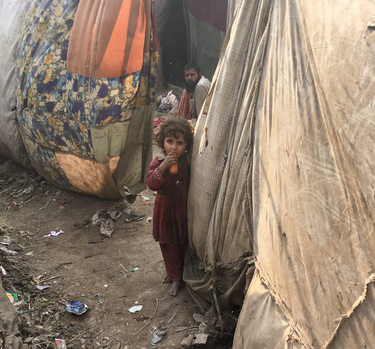
Image credit: Chris Morry
- Log in to post comments