










































Representing Vaccine Misinformation Using Ontologies
The University of Texas Health Science Center
Vaccine misinformation, which can spread rapidly via the internet, is one of the drivers leading to vaccine hesitancy and diminished vaccine uptake. This study uses semantic web and ontological technology to represent the domain scope of vaccine misinformation. With an ontology, it is possible not only to collect and analyse varied misunderstandings about vaccines but also to develop tools that can provide informatics solutions.
An ontology is a machine-readable artifact that encodes a logical representation of a domain space using vocabularies, and their semantic meanings. It is the output of a knowledge engineering process where tools and methods are used to build the ontology. Overall, ontologies are used for representing information and knowledge.
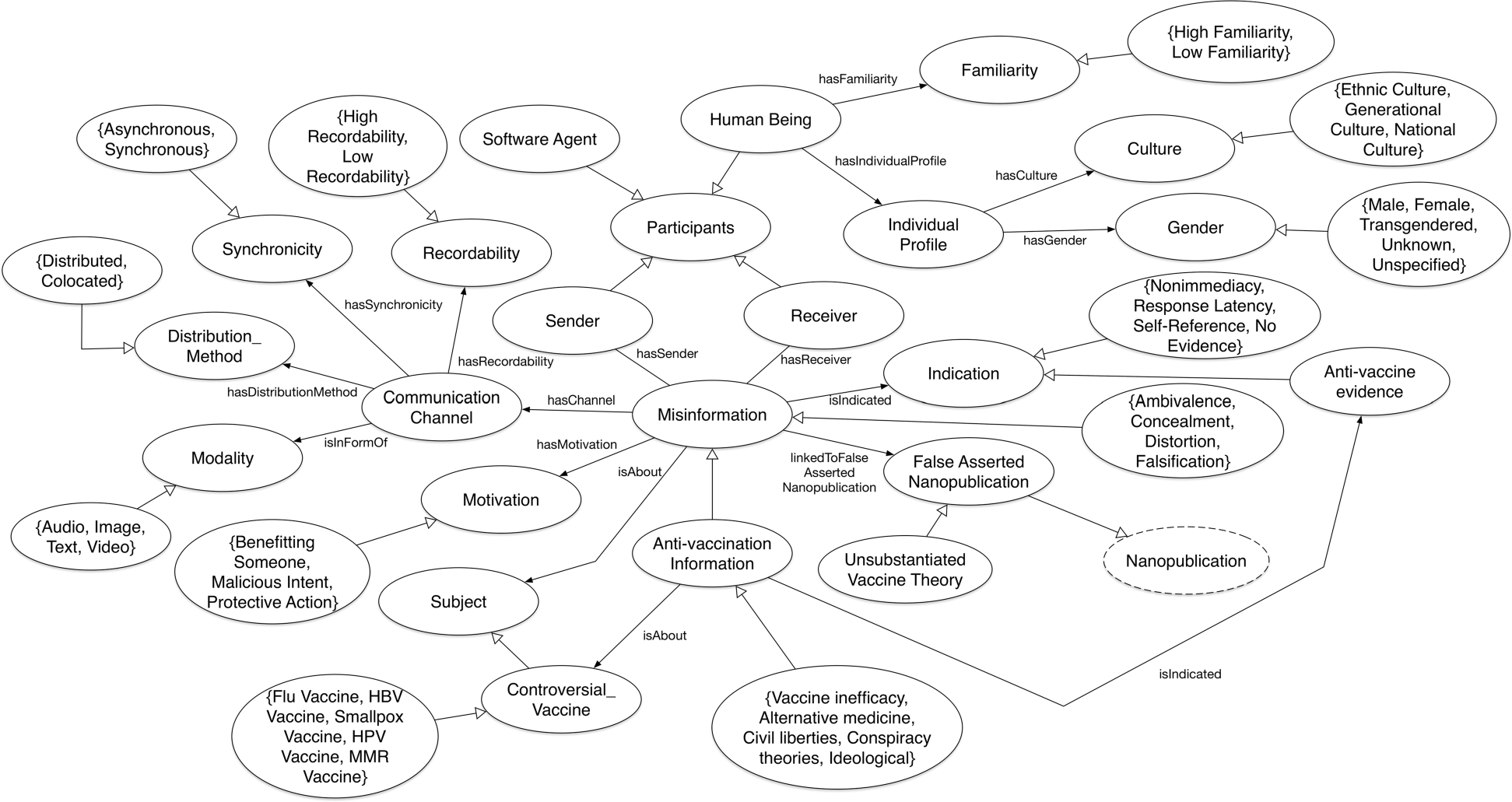
The researchers developed the Vaccine Misinformation Ontology (VAXMO), which extends Zhou and Zhang's Misinformation Ontology (MO) and links to the nanopublication Resource Description Framework (RDF) model for false assertions of vaccines. VAXMO's purpose is to catalogue and analyse vaccine misinformation.
The central concept for VAXMO is Anti-vaccination Information, which is a subclass of the Misinformation concept from MO. In addition to the subclasses for Misinformation (Ambivalence, Concealment, Distortion, and Falsification), Anti-vaccination Information concept introduces subclasses of itself - Vaccine inefficacy, Alternative medicine, Civil liberties, Conspiracy theories, Falsehoods, and Ideological. These subclasses for Anti-vaccination Information are based on classification of misinformation and myths.
VAXMO associates Anti-vaccination Information concept with the Communication Channel. The Communication Channel represents how, when, and where misinformation is transmitted. This is depicted by concepts like Availability, Synchronicity, Distribution Method, and Modality classes - classes originating from MO. Also, Anti-vaccination Information has a property associated with Controversial Vaccine (a subclass of Subject) that defines what the Anti-vaccination Information class is referring to. In this specific domain, Anti-vaccination Information is about the vaccine topic (Controversial Vaccine concept). The Controversial Vaccine concept is further broken into subclasses pertaining to specific type of vaccines (e.g., human papillomavirus (HPV) vaccine, etc.).
The researchers produced some initial scoring to determine an early evaluation of VAXMO's quality using an in-house web application, OntoKeeper. Zhou and Zhang have stated that their MO, which is the foundation for VAXMO, could be used for machine-learning tasks to enable machines to detect vaccine misinformation. The features for training would be the classes from the ontology that annotates text, and, based on these features, potential models can be generated to automatically assess if certain documents or text harbour anti-vaccination opinions. Another future direction is to utilise this ontology to annotate a collection of false statements from the public, specifically in an application-based system where a web-based portal would allow community participants to log statements about vaccines into the system. These false statements would be annotated as "nanopublication-types assertions" and later be annotated by other concepts of VAXMO to extrapolate features of the false statement.
Aside from machine-learning opportunities and application-based usage, the researchers may also explore more semantic-based approaches involving natural language processing techniques with ontologies. In the next section of the paper, they further discuss two use-cases involving machine learning and a method to identify vaccine misinformation in textual content.
They conclude that "the impact of this work could lead to applicable uses of semantic web ontologies for public health informatics and future informatics tools that can assist researchers to understand and address health misinformation in the post-modern era."
Journal of Biomedical Semantics 2018 9:22. https://doi.org/10.1186/s13326-018-0190-0
- Log in to post comments