










































The Role of Attitudes, Norms, and Efficacy on Shifting COVID-19 Vaccine Intentions: A Longitudinal Study of COVID-19 Vaccination Intentions in New Zealand
Massey University (Thaker); National University of Singapore (Ganchoudhuri)
"Campaigns that aim to help change public attitudes, social norms, and self-efficacy beliefs are likely to have short-term and long-term impact on vaccination uptake."
This study focuses on identifying changing public intentions to get a COVID-19 vaccine in New Zealand, a country that has been largely successful in containing the pandemic but risks new outbreaks, as less than 20% of the population was fully vaccinated in August 2021. It uses a longitudinal study based on the Theory of Planned Behaviour (TPB), testing whether attitudes, social norms, and efficacy beliefs were significantly associated with COVID-19 vaccine intentions at the baseline and after three months using a national sample survey. The manuscript intends to clarify the role of TPB constructs on intentions over time, as previous studies have found mixed evidence, and to guide New Zealand government health authorities in their efforts to improve COVID-19 vaccine uptake.
Data on COVID-19 intentions were collected using nationally representative online panels just after the vaccine approval and rollout to high-risk, older age groups in February 2021 and then before the general public rollout in May 2021 (N = 650, 60% re-interview response rate).
- To measure intention, respondents were asked, "When a COVID-19 vaccine becomes available, would you accept the vaccine for yourself?"
- To measure attitude, respondents were asked, "To what extent do you feel that getting a COVID-19 vaccine will be..." (e.g., harmful/beneficial) on a scale consisting of 1-7 items.
- For social norms measurement, the questions were, "Most of my family members and friends will take a COVID-19 vaccine when available", "Most people who are important to me would approve of my getting a COVID-19 vaccine when available", and "Doctors would think I should get a COVID-19 vaccine when available". The three items were treated as descriptive norm, subjective norm, and injunctive norm, respectively.
- Self-efficacy to get a vaccine was measured by assessing responses to the statement, "I am confident I will get a COVID-19 vaccine as soon as it is available in my area" on a 5-point scale.
The results indicated that, in March 2021, 60.1% of the respondents said they would "definitely" take a COVID-19 vaccine when available, which jumped to 66.6% in May 2021. There was a decline among those who were "unsure but leaning towards 'yes'" - from 19.1% in March to 15.8% in May - as well as among those who were "unsure but leaning towards 'no'" - from 11.7% in March to 9.5% in May. Those who said "definitely" "no" to getting a vaccine remained stable, from 8.6% in March to 8% in May.
Intentions in March and May were also strongly associated with attitudes, social norms, and efficacy beliefs, with more positive attitudes towards vaccine, higher degree of positive social norms to get a vaccine, and efficacy to get a COVID-19 vaccine associated negatively with vaccine hesitancy at both time periods. While demographic variables accounted for only 6% of variance, TPB constructs of attitudes, social norms, and efficacy beliefs accounted for 74% of variance in vaccine intentions at baseline and 55% of variance in vaccine intentions three months later (e.g., baseline measures of social norms were significantly associated with baseline intentions but not intentions after three months).
Some reflections on the findings:
- Vaccine attitudes have been found to be strongly associated with intentions, and the findings of this study show that these associations persist over time. "Given the importance of attitudes in predicting intentions and behaviour, future research and interventions should focus on how changing attitudes can help increase public enthusiasm for vaccination."
- Some prior studies have shown no association between social norms in encouraging vaccine behaviour, arguing instead that attitudes are better predictor of public-facing health behaviours rather than private behaviours such as vaccination. It is also possible that the association between social norms and vaccine intentions is mediated by other variables of TPB. These mixed findings highlight the need for more research on how social norms align with COVID-19 vaccine intentions and future vaccine uptake.
- Efficacy belief was one of the strongest correlates of COVID-19 vaccine intention. Thus, while it is important to communicate how effective COVID-19 vaccines are in preventing severe illness and mortality, the findings of this study highlight the need to make self-efficacy part of the strategy to communicate about COVID-19 vaccines. In particular, messages about ease, control, and ownership may help improve public enthusiasm for vaccines.
The researchers conclude by making several suggestions for future research. For example, because public judgments change over time, and external risks may not always be a prime motivation for people to get a COVID-19 vaccine, studies could investigate how changing severity of the disease spread influence vaccine intentions. As the need for booster shots is likely due to reduced efficacy of the vaccine against new variants, it is important to track changing public opinion. The influence of media sources and trust on intentions to get a COVID-19 vaccine is also worthy of study, as suggested here.
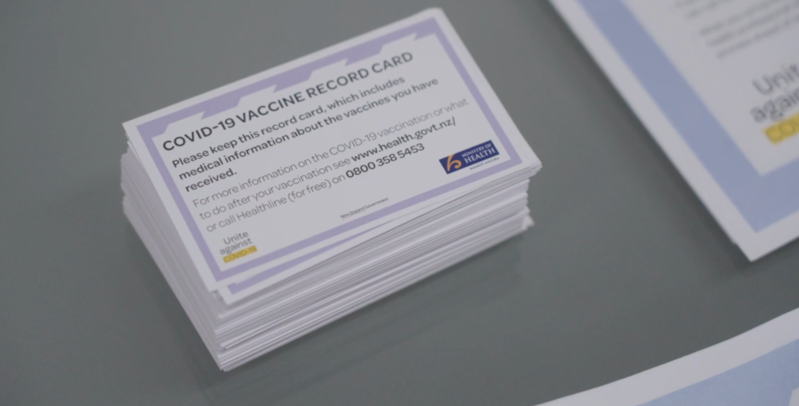
Vaccines 2021, 9, 1132. https://doi.org/10.3390/vaccines9101132. Image credit: Ministry of Health via Wikimedia (Creative Commons Attribution 3.0 Unported license)
- Log in to post comments