











































Samastha
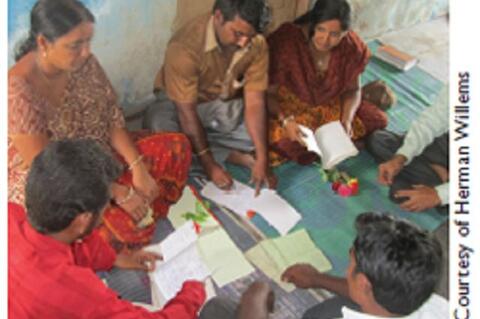
Keeping people living with HIV (PLHIV) - including children - adherent to antiretroviral (ART) treatment was a key goal of Samastha, a 5-year project that was launched in January 2007 with support from the United States (US) President's Emergency Plan for AIDS Relief (PEPFAR) through the U.S. Agency for International Development (USAID). Implemented through a consortium of international and Indian partner non-governmental organisations (NGOs), Samastha sought to provide comprehensive HIV services in 12 high-prevalence rural districts and 3 urban centres in Karnataka, India, as well as 5 coastal districts in neighbouring Andhra Pradesh. The project was designed to reduce the risk of HIV transmission among the most-at-risk populations (MARPs), as well as vulnerable populations in rural areas, while building the capacity of existing health care institutions to provide quality HIV care, support, and treatment services and to promote the utilisation of these services by PLHIV.
Samastha used a number of communication strategies to improve access and adherence to treatment, a particular challenge in rural areas (Karnataka is approximately 3 hours away from the nearest HIV care and ART centre). The project trained, collaborated with, and coordinated existing community-based services (accredited social health activist (ASHA), anganwadi ("courtyard shelter" in Hindi, part of the Indian public health-care system), and auxiliary nurse midwives), government cadres and structures (such as the District AIDS Prevention and Control Unit (DAPCU) and integrated counselling and testing centres, or ICTCs), NGOs, and PLHIV networks. Samastha also provided preventive services directly and strategically deployed a number of trained outreach and link workers. The project worked to develop networks that could help government agencies and NGOs coordinate their work, which was a strategy for enhancing their capacity to recruit new patients, keep them in care, and monitor their status at the district level. Procedures developed by Samastha were also designed to help HIV workers track and retrieve patients who had been lost to follow-up (LFU) after diagnosis, a difficult population in these remote areas.
One of the central activities involved the creation of linkages between workers and other outreach workers so as to coordinate follow-up and tracing activities according to geographic areas. Link workers were PLHIV who were selected by Samastha from a small number of HIV-positive candidates proposed by their community; they received an allowance for their work. The link workers' key tasks revolved around prevention, stigma reduction, and support for PLHIV that included adherence support to both treatment and care. Samastha provided the outreach and link workers with a 5-day induction training in mapping, micro-planning, the basics of HIV, sexually transmitted infections (STIs) and HIV care, needs assessment, and counselling. The induction training was followed by 3 days of communication skills training. Link workers were also introduced to the concept of "shared confidentiality" (sharing medical information with family, health workers, and others as needed), and many received additional training packages. The link workers helped PLHIV connect with government and community agencies, kept track of adherence, provided home care, and performed numerous other tasks as necessary. Samastha provided home visits through three different cadres of field workers.
For instance, home visits to consenting PLHIV were a fundamental part of the link workers' follow-up. They maintained a set of maps of their catchment villages: a social map identifying formal and informal facilities and services in the village and detailed maps indicating the houses of the different types of clients - PLHIV, orphans and vulnerable children, widows, female sex workers, pregnant women, and others. PLHIV who feared HIV-related stigma, a significant issue in Karnataka, could also opt to meet the link workers at other locations. Those who refused home visits were mapped but not visited. During visits, the workers checked the government-issued "Green Book" (the clinical log), discussed past and upcoming clinical appointments, and conducted and documented a pill count to check adherence. When link workers found inconsistent compliance with treatment, they provided extra counselling and helped clients identify ways to improve adherence. Outreach workers' home visits largely focused on retrieving PLHIV who were missing or LFU. They did so in villages that were not covered by link workers and in urban areas where no link worker scheme was implemented. While both link workers and outreach workers would respond to adherence problems that were identified at the facility level, link workers would provide more continuous support through regular visits to homes of PLHIV. The female sex worker peer educators were a third type of field worker that Samastha used. Their role in adherence support was similar to that of the outreach workers and link workers, but limited to the female sex worker community.
To read about the initiative's strategies in more detail, please see this case study [PDF].
HIV/AIDS
Research has shown that the HIV epidemic in Karnataka has a strong rural component, driven by migratory labour and the availability of cash that attract commercial sex workers.
According to organisers, although Samastha's link workers improved local understanding of HIV, stigma remained a major challenge with particular relevance for adherence to treatment. While the proportion of people who provided the correct address for home visits increased considerably (from an estimated 10% at the start of the project to an estimated 30-40% in later years), a large number of people still did not want to be contacted at home. In other areas (e.g., Mysore rural), an estimated 70% provided the correct address, while in areas like Bagalkot, where one of the participating NGOs (Karnataka Health Promotion Trust, or KHPT) had been active well before the start of the Samastha project, the proportion of PLHIV who were open to home visits was estimated at around 90%.
The pill count was instituted mid-project because the previous approach, a 3-day recall, appeared to be unreliable. The Samastha database, which collected information on all adherence assessments performed by link workers, showed that overall adherence was high: nearly all (95%) of over 24,000 PLHIV on ART who participated in the project showed good adherence (adherence greater than 95%).
Karnataka Health Promotion Trust (KHPT) and EngenderHealth - with USAID funding.
"Linking Resources for Antiretroviral Therapy Adherence: The Samastha Project in Karnataka, India" [PDF], by Herman Willems, AIDSTAR-One, July 2012 - sent from Anna Lisi to The Communication Initiative on August 17 2012; and EngenderHealth website, August 17 2012. Image credit: Herman Willems
- Log in to post comments