










































Scaling Accountability through Vertically Integrated Civil Society Policy Monitoring and Advocacy
Accountability Research Center; School of International Service, American University
"'Scale' has many different meanings across fields and contexts. Looking at scale from different angles - drawing insights from different ways of using the term - helps [us] understand how we can take scale into account when developing strategic approaches to transparency and accountability that tackle symptoms rather than causes."
This working paper argues that the growing field of transparency, participation, and accountability (TPA) needs a "conceptual reboot" in order to address the "limited traction gained so far on the path to accountability. To inform more strategic approaches and to identify the drivers of more sustainable institutional change, fresh analytical work is needed", according to the paper's co-producers, the Empowerment and Accountability Research Programme - led by the Institute of Development Studies and funded by UK aid from the United Kingdom (UK) government - and Making All Voices Count. (Making All Voices Count works in Kenya, Uganda, Tanzania, Ghana, Mozambique, South Africa, Nigeria, Liberia, Bangladesh, Pakistan, Indonesia, and the Philippines.) The discussion focuses on 4 general core questions: (i) Beyond scaling up: What does it mean to take scale into account? (ii) What is the rationale for vertical integration? (iii) What is the potential synergy between civil society organisation (CSO) policy monitoring and advocacy? and (iv) How can we analyse varied state-society terms of engagement with a more three-dimensional approach?
Author Jonathan Fox distinguishes between "strategies", which start with the overarching change goals and connect them to the action plan to reach them, and "tactics", which are the more specific actions for carrying out the strategy. Tool-led approaches in the TPA field deploy citizen report cards, community monitoring, social audits, apps, or open data, but often not as part of broader, multi-pronged, multi-level strategies. The latter (strategies) involve, for example: enabling environments for collective action to reduce perceived risk; citizen voice coordinated with governmental reforms that bolster public sector responsiveness; and campaigns rather than interventions ("iterative, contested and therefore uneven processes"). The paper makes the case for one among several possible strategic approaches - approaches that address the systematic embeddedness of anti-accountability forces in multiple levels and branches of the state - by distinguishing between "scaling up" (a process of expanding, replicating, adapting, or sustaining successful policies, programmes, or projects to reach a greater number of people) and "taking scale into account", which involves more than replication or expansion: It links pro-accountability actors across scale in order to promote mutual empowerment and to either target or bypass accountability bottlenecks.
Fox goes on to examine several different ways that "scale" is used in different fields. "For example, if a social accountability initiative involves community interface meetings between health clinic workers and communities, then scaling up as replication would mean convening them at more clinics (e.g., from 10 to 50 to 500 villages). Yet the underlying causes of medicine stock-outs or abusive staff may lie far upstream. If civil society oversight efforts to address these problems were to do accountability differently, and make connections across scale, they would bring together democratic representatives from those 10, 50 or 500 grassroots communities. Such meetings could ground a strategy to build a broad-based civic or social process that would have not only significant evidence-generating capacity, but also the civic clout needed to persuade policymakers to act on those findings - especially regarding problems in the health system that are caused by factors located beyond their respective clinics."
Fox notes that information and communication technology (ICT) has enabled rapid scale-up of transparency through digital media and has played a role in the projection of citizen voice for accountability in a wide range of settings. ICT allows citizens to broaden both the horizontal projection of voice (communicating with each other to get issues onto the policy agenda) and the vertical projection of voice (targeting messages that communicate with elites). But diagonal voice (when social media campaigns move beyond their online communities and convert allies into actors that can pressure anti-accountability forces) is also important for scaling advocacy, Fox stresses. Horizontal and diagonal projection of voice can be seen as key steps on the causal chain towards successful vertical "messaging" aimed at getting authorities to listen.
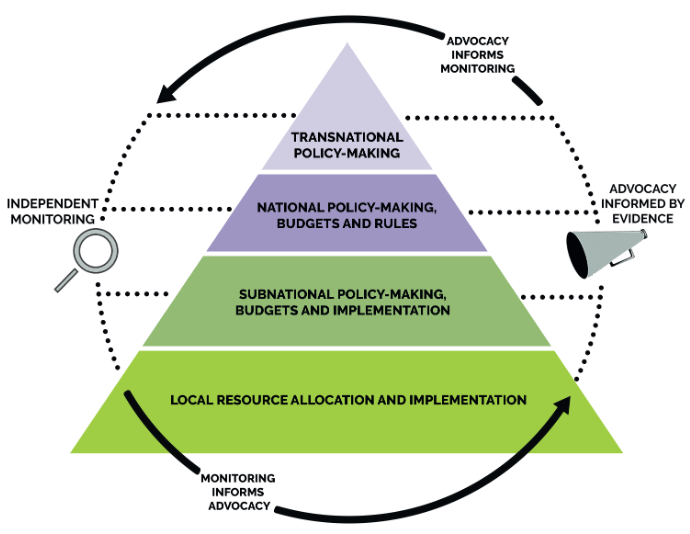
Fox goes on to explain and discuss the strategy of vertical integration, which involves multi-level coordination by CSOs of policy monitoring and advocacy, grounded in broad pro-accountability constituencies. In brief: "Vertical integration tries to address power imbalances by seeking the coordinated, independent oversight of public sector actors at local, subnational, national and transnational levels....Vertical integration of public oversight puts coalition-building between social and civic actors with different but complementary strengths at the centre of the strategy; for example, CSO policy analysts plus membership-based civic organisations to do bottom-up oversight and advocacy, plus independent media to disseminate both the findings and the citizen action." He discusses vertical integration from several different angles. Beginning with the term's origins in political economy, the discussion addresses: the way in which vertical integration can address the problem whereby authorities and vested interests resist independent oversight efforts; the limits to locally bounded citizen oversight; the significance of different kinds of policy targets; the role of "partial" vertical integration; and the elusive prospect of feedback loops. For instance, in the latter section, Fox notes: "For ICT-enabled feedback loops to connect with the vertical integration strategy, their relationship to pro-accountability advocacy needs to be problematised. Clearly, ICT-enabled voice can play an agenda-setting role, revealing and naming previously unrecognised accountability failures (e.g. police violence against unarmed citizens). Yet crowd-sourced voices have limited capacity to negotiate with authority about what to do about these new agendas. If and when the political space created by voice makes it possible for the excluded to gain a seat at the table, who decides who is going to sit there and negotiate on behalf of those whose voices are trying to be heard?"
In one portion of the paper, Fox examines the relevance of ICTs' potential for scaling multi-directional communication. The idea is that, if citizens can become the eyes and ears of an oversight initiative, they can gather and forward information in real time. To counter claims that such citizen reports are unreliable, user-friendly tablet devices can make possible the consistent reporting of key indicators of public sector performance and allow the real-time aggregation of data. Digital media allow for a broadening of the kind of evidence that citizens can project: It is not limited to the kind of "hard data" that has attracted greatest interest in the tech for development field. From an advocacy point of view, "pictures are still worth a thousand words, whether they are of human rights abuses, politicians' private mansions, or cash changing hands. Citizen journalists around the world have demonstrated the power of crowdsourced images to generate viral uptake of evidence for accountability. This broader notion of 'open evidence' for accountability contrasts with the more focused emphasis of open data on a very specific kind of evidence (big data sets that require substantial investment and a clear advocacy target to be rendered intelligible, relevant and actionable). This suggests that the frame for exploring ICT's contribution to bolstering the resonance and uptake of pro-accountability messages should emphasise the visual communication and 'civic design' as much as the data."
The paper goes on to unpack the relationships between policy monitoring and advocacy. "To sum up, this issue of how to generate synergy between monitoring and advocacy raises the specific issue of how to construct and sustain coalitions that bring together socially and politically diverse pro-accountability actors, including reaching across the state–society divide in pursuit of shared goals."
To spell out how the vertical integration strategy can empower pro-accountability actors, the paper contrasts varied terms of engagement between state and society, proposing a focus on collaborative coalitions as an alternative to the conventional dichotomy between confrontation and constructive engagement. This section examines the limitations of this widely assumed dichotomy and explains why theories of change for accountability-building need a more three-dimensional approach, which can account for diverse combinations of conflict and collaboration between actors in state and society.
The paper continues by reviewing existing multi-level approaches, summarising 9 cases - 3 each in the Philippines, Mexico, and India - to demonstrate what can be revealed when TPA initiatives are seen through the lens of scale. All 9 cases involve multi-level monitoring and advocacy initiatives that target specific national public service delivery policies that directly affect social constituencies, and several involve the monitoring of policy implementation jointly with government counterparts. These experiences with at least partial vertical integration all address the gaps between capital city non-governmental organisations (NGOs) and social organisations that are closer to the grassroots - a problem that is especially relevant in fragile and conflict settings. Few of the 9 cases profiled have received much scholarly attention, so the brief summaries draw primarily on grey literature and interviews with participants. In the Philippines, the cases are Textbook Count, the reproductive health law, and their conditional cash transfer programme (4Ps). In India, the cases involve the right to information campaign, community-based monitoring within the National Rural Health Mission, and the right to food campaign. In Mexico, the cases are the community food councils, the Maternal Mortality Observatory, and family planning budget reform. The reason for considering 3 cases within each country is to illustrate that where there is some political space, national civil societies may generate multiple vertically integrated initiatives. The cases show that multi-level CSO initiatives are not all that uncommon, though they are rarely studied through the lens of scale.
The paper concludes by looking ahead to 3 questions for future research agendas, including the issue of what drives transitions to vertical integration (i.e. scale shift), how to draw more lessons from existing literature on collective action, and how to get inside the "black box" of the state in order to better understand what motivates state actors. The annex proposes several preliminary testable hypotheses for discussion. Each suggested question responds to a specific dilemma involved in multi-level strategies and sketches out a preliminary suggested method. "Because of the central role of territorial variation involved in 'scaling accountability', the subnational comparative method would play a crucial role in testing hypotheses involving vertical integration."
Email from Making All Voices Count to Soul Beat Africa on December 6 2016, and "Open governance - the complexity of scale", by Duncan Edwards, Making All Voices Count, December 6 2016, and Making All Voices Count website - both accessed on December 7 2016. Image credit: Fox and Halloran (2016); design by Jonathan Fox and Waad Tammaa
- Log in to post comments