










































Scaling Digital Learning in Kenya
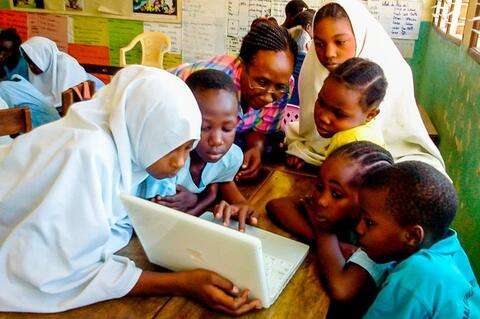
This project, implemented by the Centre for the Study of Learning and Performance (CSLP) at Canada's Concordia University, applies interactive multimedia software coupled with extensive professional development for teachers to enhance teaching and to improve the learning of children in Kenya. Its objective is to achieve significant, scalable, sustainable, and cost-effective increases in student learning alongside enhancements to teaching practices. The project is also exploring the challenges involved in scaling up and sustaining the programme; working to understand the relationship between levels of teacher support, teaching practices, and student learning outcomes; and promoting improved educational technology-related policies and practices in Kenya.
This information and communication technology (ICT)-based intervention centres around a suite of evidence-based educational software tools developed by CLSP. The Learning Toolkit (LTK+) is a suite of interactive, bilingual multimedia tools available free to the education community. It is designed to support the development of literacy, inquiry, self-regulation and other cross-curricular competencies within an environment that encourages self-regulated learning, which is considered an essential strategy for effective, lifelong learning.
LTK+ includes A Balanced Reading Approach for Children Always Designed to Achieve Best Results for All (ABRACADABRA, or ABRA), which is a highly interactive, early literacy software that supports beginning readers through digital stories and engaging stories that develop reading comprehension, fluency, and writing skills. ABRA also includes teacher professional development materials (training videos, assessment tools, communication tools) as well as literacy resources for parents. Young readers also have access to READS, a repository of over 450 free digital stories in 27 different languages that have been catalogued by theme, genre, reading level, country of origin, and language. Finally, ELM is an interactive emerging numeracy tool used to improve mathematical skills for primacy school age children.
The LTK+ is evidence-based and evidence-proven learning software. The suite of tools have been independently evaluated numerous times and have been found to have large positive effects. Research has found that the success of LTK+ was largely attributed to the students' enjoyment in using technology and gadgets to play educational games, instead of learning through recitation and drills. Teachers also found that the children were more social, making friends as each completed their assigned activities.
This current phase of research focuses on sustainability and scaling. Essential to this process is the ability to cost-effectively train teachers to successfully integrate the LTK+ into classrooms. Concordia University is now developing and testing teacher training materials that can be used to reach teachers at scale in Kenya. They will be engaging with the Teacher Professional Development at Scale Coalition for the Global South in this endeavour. Similarly, a research team from Hong Kong is now exploring possibilities for implementing the intervention in China.
Children, Literacy
According to the 2016 UNESCO Global Education Monitoring report, some 61 million children of primary school age do not attend school. In low-income countries, only 14% of the children that do, complete primary schooling. Many children face a lack of educational competencies such as reading, writing, and numeracy skills, and they do not gain the multiple social development benefits that come from greater education, such as reduction of poverty and improved health. For example, an analysis for the aforementioned report suggested that poverty among the working poor would fall by as much as 39% if workers from disadvantaged backgrounds had similar education levels to those from advantaged backgrounds.
Prior projects explored the feasibility and measured the effectiveness of using ABRA early literacy software with emerging readers and their teachers in Kenya. Evaluations have shown that ABRA is both a feasible and an effective educational intervention. Students who use the tools on a weekly basis for several months have substantial learning gains. Click here to learn more.
For their work creating and implementing the LTK+, in 2017, the CLSP won the United Nations Education, Scientific and Cultural Organization (UNESCO) King Sejong Literacy Prize, awarded annually to candidates who have proven their capacity to develop and deliver mother-tongue literacy education and training.
Concordia University, International Development Research Centre (IDRC)
Emails from Liane Cerminara to The Communication Initiative on October 17 2018 and October 22 2018; and IDRC website and "UNESCO honours Concordia's Centre for the Study of Learning and Performance", by Renée Dunk, August 30 2017 - both accessed on October 18 2018. Image credit: CLSP
- Log in to post comments