










































Sembramos Palabras, Cosechamos Derechos [Sowing Words, Harvesting Rights]
"A territorial experience that marks the opening of doors to basic rights such as habitat, land, water and marketing..."
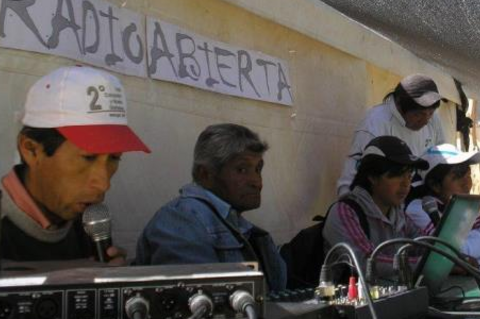
"Sembramos Palabras, Cosechamos Derechos" (Sowing Words, Harvest Rights) is a community media initiative designed to give voice to the experiences of farming communities through 19 rural radio stations managed by farmer organisations in rural and peri-urban areas of 12 provinces of the Republic of Argentina.
During 2014 and 2015, the Ministry of Agro-industry for the Argentine Nation provided specific funding for establishing the radio stations. The decision was to involve the Argentine Forum on Community Radios (FARCO) with their extensive technical experience to support organisations in operationalising the equipment, towers, and antennas, and to provide courses on voicing, production, and artistry. Nineteen radio stations were established, which added to those that had already joined individually. So there are about 25 radio stations linked to INTA - Argentinian Institute of Agricultural Technology that make up the "Sembramos Palabras, Cosechamos Derechos" network. INTA's Florencia Lance explains that, at first, there was an individual demand from some farmer associations and family producers: "Even though we are not an institute that is specifically responsible for radios, INTA, through its extension system, incorporated this need into their territorial development strategies. Historically, the radio has been a strategic tool at a time of working on extension activities or to support rural development processes through programmes, radio plays, radio campaigns, where they have shared knowledge with producers and communities."
The stations are managed by the farmer organisations, in rural areas, and the contents are developed by extension workers, farmers, indigenous people, popular journalists, family farmers, and peri-urban producers throughout the country. For example, Diaguita Calchaquí de Cieneguilla is radio managed by an organisation of indigenous peoples in a place that is more than 3 thousand meters high, in Salta. The transmitter works with solar panels, because in that area there is no light, internet, or phone. Likewise, the FM band functions with a VHF system. The transmitter communicates with all the places and institutions in the community such as the school, the health centre, the police, or INTA, so it fulfills a communicative function: from sharing the dates of vaccination of animals to birthday messages for the people of the community. Read more about this particular station here, in Spanish.
Half of radio stations that were set up have internet access and can share content, like the information from FARCO. But to broadcasters without connectivity, it is difficult for them to access the content. In those cases, the bulk of what is broadcase is local programming of issues and local music. "The idea here is to work on those local cultural identities. We are trying to sign an agreement with the National Institute of Music to obtain a sound bank with musical interludes, instrumentals, local music. We have to be creative with the resources", says Florence Lance.
To accompany the process of production and exchange of content on the network, the National Systems Assistant of Information, Communication and Quality Directorate is working on a comprehensive communication system for rural development: INTA Radio. INTA Radio arises as a platform for production and movement of radio content which, among its objectives, will give visibility to the network of rural radio stations and their productions to stimulate the exchange of materials and join in the production of content within the network, taking into account the issues of accessibility to the internet as one of the many experiences of rural communication.
Read more (in Spanish) about Sembramos Palabras, Cosechamos Derechos in this PDF document (162 pages), published in 2013.
Agriculture, Rights
INTA, FARCO
CCComDev Newsletter, Issue No. 7, July 2016, and "Rural radio network in Argentina: Sowing words, harvesting rights", by Cora Gornitzky, INTA Argentina, July 29 2016. Image credit: INTA
- Log in to post comments