










































Soccer for Re-integration
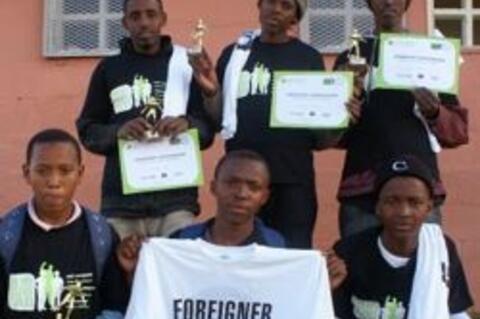
The tournament in Khayelitsha attracted 14 teams. Each team comprised of 2 foreign nationals and 2 South Africans with the hope of strengthening friendships, connections, and common bonds. The main message of the event was "One man can halt xenophobia, stop violence, support reintegration, celebrate diversity, demand justice, and make a difference." Teams that attended featured Abafethu FC, Shining Stars, Zim Dollar, Mashall Stars, Shona FC, Future Stars, and many more.
The street soccer festival also included entertainment by popular musicians who passed along messages of unity and tolerance. According to the organisers, "amongst spectators were all races from black, white, Indian, and coloured with one message, to stop xenophobia."
Click here to watch a video about the street soccer festival.
Conflict.
The "One Man Can" Campaign is being implemented in 8 of South Africa's 9 provinces, and in Burundi, Kenya, Malawi, Mozambique, Namibia, and Uganda. The campaign promotes the idea that each person has a role to play to create a better, more equitable, and more just world. At the same time, the campaign encourages men to work together with other men and with women to take action - to build a movement, to demand justice, to claim rights, and to change the world.
Sonke is involved in other projects where sport plays a major role in raising awareness about xenophobia and other kinds of violence, such as gender violence. The projects hope to encourage men both to look at their own behaviours and attitudes, and to get actively involved in ending violence and abuse. Other recent soccer events include the following:
- A soccer tournament was held in Qumbu on December 8 2008. Men told their stories to players and fans in between matches, with HIV prevention as a major theme.
- On December 9 2008, Sonke hosted a street soccer tournament in Guguletu, Cape Town, in order to talk to people, especially men and boys, about testing for HIV and taking antiretrovirals (ARVs), and stopping violence against women and children.
Sonke Gender Justice, Hope World Wide, Western Cape Street Soccer League, and Grassroot Soccer.
Sonke Gender Justice website on February 23 2009.
- Log in to post comments