










































Social Norms and Women's Risk of Intimate Partner Violence in Nepal
Emory University (Clark, McGhee, Cheong, Yount); Equal Access International (Ferguson, B. Shrestha); Equal Access, Nepal (P. Shrestha); University of Minnesota (Oakes); George Mason University (Gupta)
Globally, attention has been drawn to the need for better statistics on the prevalence, causes, and consequences of intimate partner violence (IPV) against women as a precursor to its elimination. The Change Starts at Home project (hereafter, Change) is addressing this need by examining the epidemiology of the global health crisis of IPV in Nepal and by testing a social behavioural change communication (SBCC) intervention designed to change norms and ultimately behaviour to prevent the occurrence of IPV. Using baseline data from the Change project, this manuscript examines the association of social norms with individual women's experiences of IPV and provides preliminary psychometric characteristics of a new measure of social norms, the Partner Violence Norms Scale (PVNS). Specifically, this study assesses the within-community, between-community, and contextual effect of the PVNS on women's risk of IPV and whether this measure adds any additional information than that garnered from a measure of aggregated attitudes, which is the most frequently used proxy for collective normative expectations.
Social norms are informal rules derived from social systems that prescribe what types of behaviour are expected, allowed, or sanctioned in particular circumstances. Various social norms have been identified that may jointly influence women's risk of experiencing IPV, including men's dominance and superiority over women, men's ownership of their wives through bride wealth, acceptance of wife beating (and the unacceptability of women seeking help), appropriateness of violence to resolve conflict, men's right to discipline or control women's behaviour, men's entitlement to sex, acceptability of mobility and restrictions on the freedoms of women, women's responsibilities to maintain the marriage and family, family privacy, stigma and shame associated with divorce or being unmarried, and men's or family honour being linked to women's purity. Prior studies in Nepal, including baseline qualitative data from the Change trial, find support for many of these norms in Nepal. To date, however, little quantitative research in Nepal has examined the relationship between social norms and risk of IPV.
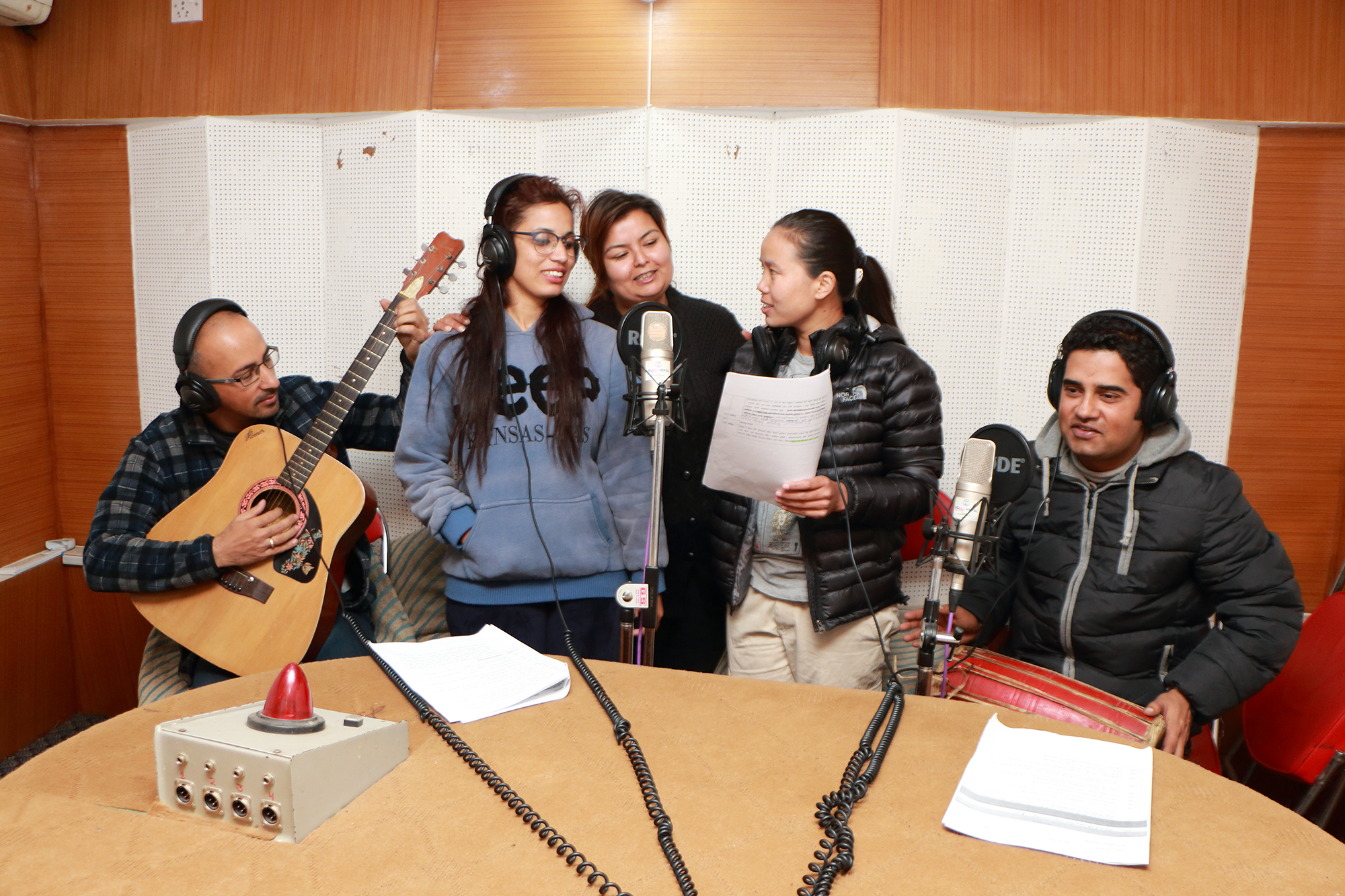
In brief, the Change project (see Related Summaries, below) is a pair-matched, repeated cross-sectional 2-armed, single-blinded cluster trial (N=36 clusters), comparing a SBCC strategy to radio programming alone for its impact on physical and/or sexual IPV at the end of programming (12 and 24 months post-baseline). The purpose of Change is to shift attitudes, social norms, and behaviours that underpin the power imbalances which increase Nepali women's vulnerability to marital IPV. Recognising the social ecology of IPV, the intervention engages actors across multiple domains of influence, including family members and community leaders, in addition to the primary audience of reproductive age women and their husbands. The intervention approaches IPV prevention through three key approaches: advocacy, social mobilisation, and behaviour change communication. The latter component is a 9-month, weekly radio drama with listener engagement through interactive voice response (IVR) and short message service (SMS), to which the intervention and control conditions are exposed. The intervention communities are further engaged in radio listening and discussion groups (LDGs), through which the men and women participants meet to reflect critically on the content of the radio episode through a curriculum-based process of guided discussion, in-group, and home-based activities.
The PVNS was developed for the study from a review of the norms literature, examination of prevailing practice to measure social norms, and formative research in Nepal including focus group discussions, cognitive interviews, and a pilot test of the survey instrument. The PVNS measures perceptions of normative expectations at the individual level and collective normative expectations when aggregated to the community level. The scale was designed to tap into a single underlying construct. Items measure traditional gender role expectations (2 items), intra-familial dynamics (1 item), acceptability of violence (1 item), silence and tolerating violence to preserve the family and family honour (2 items), non-interference in family affairs (1 item), and appropriate expressions of women's sexuality (1 item). An individual-level perception of normative expectations score was calculated as a mean across the 7 items, with higher values indicating greater endorsement of gender-inequitable community norms. These individual-level mean scores were averaged at the ward level to form a measure of collective normative expectations. In addition, an aggregate measure of gender-inequitable attitudes was generated to assess whether the PNVS added any additional information.
Data come from baseline surveys collected from 1,435 female, married, reproductive-age participants, residing in 72 wards in 3 districts (Chitwan, Kapilvastu, Nawalparasi) in Nepal who were enrolled in the Change cluster randomised trial.Results of unconditional multilevel logistic regression models indicated that there was cluster-level variability in the 12-month prevalence of physical (intraclass correlation coefficient, or ICC=0.07) and sexual (ICC=0.05) IPV. Mean PVNS scores also varied across wards. When modeled simultaneously, PVNS scores aggregated to the ward level and at the individual level were associated with higher odds of physical (odds ratio, or ORind=1.12, confidence interval, or CI=1.04, 1.20; ORward=1.40, CI=1.15, 1.72) and sexual (ORind=1.15, CI=1.08, 1.24; ORward=1.47, CI=1.24, 1.74) IPV. The contextual effect was significant in the physical (0.23, standard error (se)=0.11, t=2.12) and sexual (0.24, se=0.09, t=2.64) IPV models, suggesting that the ward-level association was larger than that at the individual level. Adjustment for covariates slightly attenuated the ward-level association and eliminated the contextual association, suggesting that individual perceptions and the collective community phenomena were equally strong predictors of women's risk of IPV and should be taken into consideration when planning interventions.
The authors reflect on these findings, saying: "The PVNS was robustly associated with physical and sexual IPV when modeled at the individual- and ward-levels, highlighting its potential utility. These findings are a promising first step. Further assessment as the trial progresses and additional psychometric testing are needed to draw firmer conclusions about the utility of PVNS to assess potential impacts of a social behavior change communication intervention on women's risk of IPV."
They continue: "The significant and robust findings linking perceived normative expectations to women's risk of IPV is also significant, as perceived expectations remain the focus of many behavior change communication interventions, including studies of IPV....Additionally, aggregation of phenomena across members of a community may not accurately represent the collective norm, as perceptions may be inaccurate...and the most salient groups may not be represented. The significant ward-level findings suggest that there are important area-level associations that should be considered. Ultimately, trial results are required to assess whether changes in one level or both are needed to impact women's risk of IPV as well as to tease apart the sequencing of social norms and behavior change."
In conclusion: "Additional psychometric testing and ultimately, the [Change] trial's results, will shed light on the potential for a social behavior change communication intervention to alter norms around the acceptability of IPV, and ultimately, reduce the occurrence of IPV...and the ability of the PNVS to measure that change."
Social Science & Medicine https://doi.org/10.1016/j.socscimed.2018.02.017. Image sent via email from Gemma Ferguson to The Communication Initiative on January 26 2017 and used with permission.
- Log in to post comments