










































Solidarity Association to Promote Human Development (ASPIDH)
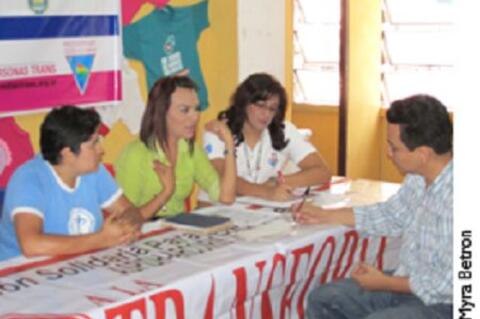
ASPIDH is a non-governmental, nonprofit organisation that aims to improve the human development and quality of life of transgender populations (including transvestites and transsexuals) in El Salvador. To that end, ASPIDH conducts sensitisation, education, and advocacy activities to: promote the human rights of transgender people and contribute to the reduction of stigma and discrimination against them; facilitate their access to employment, education, health, and safety; and reduce the prevalence of HIV and other sexually transmitted infections (STIs) within the transgender population.
ASPIDH is made up entirely of transgender staff and volunteers who conduct HIV prevention outreach using a face-to-face approach, which involves talking to transgender individuals about HIV on the streets at night where they are typically found selling sex.
Formed initially as an advocacy organisation seeking to promote the rights of transgender people, ASPIDH has developed public campaigns aimed at increasing recognition of transgender people and their rights. This is done primarily through the following: marches; the distribution of information, education, and communication (IEC) materials; press conferences; legal petitions; and direct meetings with government personnel. Within this work, specific United States (US) President's Emergency Plan for AIDS Relief (PEPFAR) gender strategies and approaches include the following:
- Increasing gender equity in HIV programmes and services: ASPIDH conducts advocacy with the government and directly with health providers to ensure that they provide services to transgender people, who suffer discrimination by health providers and are often turned away from hospitals. ASPIDH also sensitises health clinics to understand the importance of using transgender women's preferred names so that they do not feel humiliated by being called a male name when they identify as female. Finally, ASPIDH's drop-in services include the accompaniment of clients to health centres with which ASPIDH has an established relationship and more transgender-friendly services.
- Increasing legal protection: ASPIDH accompanies programme users to the Human Rights Protection Office to file complaints when service providers - especially health providers and the police - violate their rights. ASPIDH also makes presentations at Ministry of Public Health-sponsored workshops for the police on human rights, the HIV Law, and discrimination against most-at-risk-populations. Finally, ASPIDH's major objective is to advocate for the passage of a gender identity law that would allow individuals to change their legal names so that transgender people can use the female- or male-identified name that matches their gender identity.
- Addressing harmful gender norms and behaviours: ASPIDH is working to increase the recognition of a range of gender identities, including transgender people and transvestites. For example, in May 2010, ASPIDH organised a transgender pride march. ASPIDH also hosted a public launch of the movie Translatina, which portrays the discrimination and vulnerabilities faced by transgender women. According to organisers, these events attracted significant media attention and discussion. In addition, the leadership of ASPIDH often holds press conferences or talks with the media about transgender issues to bring them to broader public attention.
- Reducing violence and coercion: ASPIDH encourages friends and clients who experience violence to file complaints with the Human Rights Protection Office. To help transgender individuals cope with violence and discrimination, ASPIDH facilitates support groups and, occasionally, offers the services of a psychologist.
HIV/AIDS, Gender, Rights.
According to the Central American Sexual Behavioral Surveillance Survey (ECVC), HIV prevalence among the transgender population in the capital city of San Salvador is 19.7%, compared to the gay and heterosexual/bisexual populations, where HIV prevalence is 10.6% and 8.8%, respectively (Ministerio de Salud, Programa Nacional de ITS/VIH/SIDA El Salvador, 2008). The Joint United Nations Programme on HIV/AIDS (UNAIDS) estimates that HIV prevalence among all Salvadorans aged 15 to 49 is 0.8 percent (UNAIDS 2011). According to ASPIDH, discrimination, which limits access to employment, housing, health services, education, information, and other resources, "contributes to the vulnerability of transgender people. As a result, many enter into sex work as the only means of economic livelihood they can find. The ECVC found that more than half of men who have sex with men (MSM) who self-identify as transsexuals or transvestites were selling sex at the time of the study. Other barriers to health services can directly affect HIV vulnerability by blocking access to sexual and reproductive health information and care. Discriminatory behavior by health providers and the humiliation of being called a male name in front of other patients discourage many transgender women from seeking health services. Outright denial of service by providers is also commonplace. Finally, transgender women may make sex reassignment their primary health concern, which may compete with HIV prevention or relegate prevention to a secondary health need. Until very recently there has been little HIV programming in El Salvador specifically for the transgender population. Instead, transgender women have been historically categorized as MSM, rendering them an 'invisible' group whose special needs and risks are neglected." It is this lapse that ASPIDH seeks to address.
ASPIDH has learned the following from its experiences:
- "Consider the full range of gender identities in the target population when designing programs and messages: Not all transgender people identify themselves as MSM or gay and, thus, may not feel HIV prevention campaigns are relevant to them....
- Continue to research the health needs of transgender people...
- Use a comprehensive approach, including gender needs of women, not just the issue of gender identity....HIV prevention strategies for transgender women should also integrate key strategies for HIV prevention for women, including empowerment to negotiate condom use, interventions to reduce risk and occurrence of sexual and intimate partner violence, and livelihood programs.
- Build the capacity of transgender people to lead HIV prevention and outreach efforts within their own community....HIV programmers can endanger the transgender community by bringing unwanted or unexpected attention to them from the general public. ASPIDH's careful and effective strategies of reaching transgender people in their neighborhoods and places of work are worthy of replication.
- Network and collaborate with partners both nationally and internationally..."
Email from Anna Lisi to The Communication Initiative on November 9 2011; and Different Needs But Equal Rights: Giving Voice to Transgender Communities through ASPIDH in El Salvador, by Myra Betron, October 2011.