










































Strengthening Malaria Service Delivery Through Supportive Supervision and Community Mobilization in an Endemic Indian Setting: An Evaluation of Nested Delivery Models
Health, Nutrition and Population, The World Bank (Das, Ramana, Govindaraj), Development Research Group, The World Bank (Friedman, Kandpal), National Vector Borne Disease Control Programme, India (Gupta), Department of Health and Family Welfare, India (Pradhan)
"A community-based intervention combining the supportive supervision of community health workers with intensive community mobilization and can be effective in improving care-seeking and preventive behaviour and may be used to strengthen the national malaria control programme."
Given the global health challenge of malaria, this study tested the effectiveness of two service delivery models in the State of Odisha, India, for reducing the malaria burden, e.g. supportive supervision of community health workers (CHW) and community mobilisation in promoting appropriate health-seeking behaviour for febrile illnesses.
In a region of 50 highly malaria endemic districts, the study population comprised 120 villages, with 40 villages randomly assigned to each of the two treatment arms, one with both supportive supervision and community mobilisation (i.e., combined interventions) and one with community mobilisation alone, as well as an observational control arm. "Under the community-based approach, the village CHW, known as Accredited Social Health Activist (ASHA) is designated to address early detection, management and prevention of malaria at the community level", having been trained in and provided supplies for rapid diagnostic tests and treatment of these cases with artemisinin combination therapy (ACT). "In addition, long-lasting insecticide-treated bed nets (LLIN) have been distributed free of cost to populations in high endemic districts to strengthen prevention activities." Three operating non-governmental organisations (NGOs) received training in the specific design of the community-based activities and their operationalisation, developed from an evidence-base on the communities socio-economic and cultural characteristics, life style, health-seeking pattern and knowledge regarding febrile and other common illnesses. Baseline qualitative research provided such evidence. "Community level meetings and participatory social mapping exercises conducted in every study village led to further fine-tuning of intervention strategies. These meetings also provided an opportunity for the implementing NGO and the community to build rapport."
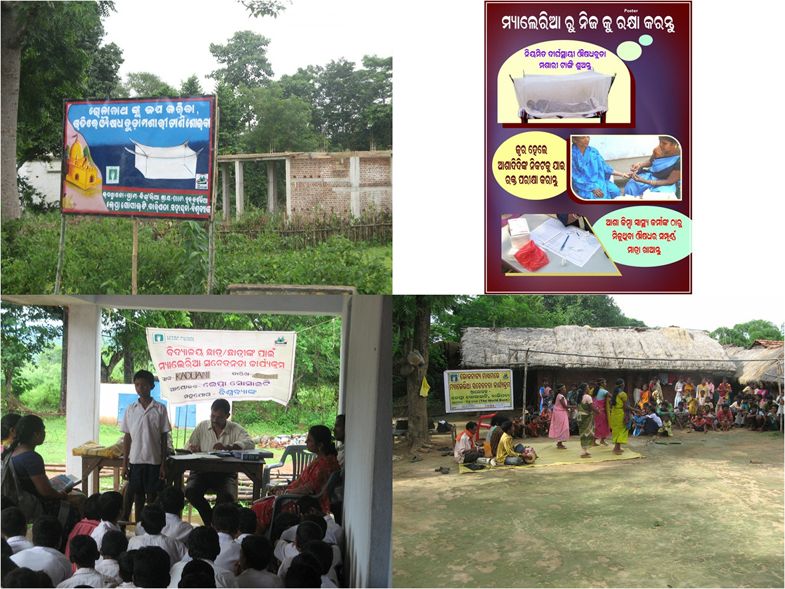
"[M]obilization efforts aimed at 1) increasing the consistent use of long lasting insecticide treated bed nets that were provided to the community free of cost..., and 2) timely care-seeking for febrile illnesses from the ASHA in the village. Activities included the dissemination of appropriate behaviour change messages through locally acceptable communication channels. The formative research conducted during the planning phase helped incorporate local norms and customs into the design of the community mobilization strategies and messages....The main messages for the community mobilization activities were as follows: (1) 'whenever you have fever, visit the ASHA as early as possible to get your blood tested"; (2) "avail medicines from the ASHA if the blood test is positive for the malaria parasite'; (3) 'always consume the full course of drugs given by the ASHA'; (4) "use bed nets every night during sleep'; and (5) "'give preference to pregnant women and young children if bed nets are insufficient in the household'. The messages were conveyed through community-based meetings (held separately for different target groups considering the local social norms), posters and leaflets, cinema shows, street plays, and community notices (photo examples given in Figure 3). Further, door-to-door visits were undertaken to promote the consistent use of bed nets as well as timely care-seeking from the ASHA for fever. The NGOs utilized local community-based groups (CBO) such as the Village Health and Sanitation Committee (VHSC) and women’s Self Help Groups (SHG) for community mobilization. The SHG members were assigned a few households (10–15) each in every participating village to monitor bed net usage at nights."
Supportive supervision of the work of the ASHAs aimed to enhance professional competence and confidence, increase community engagement, and ensure the regular availability of drugs and supplies. A trained NGO field worker visited each ASHA at least twice a month. "The supervision activities involved sensitization on the knowledge about transmission, diagnosis and treatment of malaria; hands-on support for performing and interpreting rapid diagnosis tests; administration of the correct dosage of ACT and follow-up to ensure compliance; management of malaria surveillance records; and orientation on community and health centre engagement."
Outcome measures included changes in the utilisation of bed nets and timely care-seeking for fever from a trained provider compared to the control group. Analysis was by intention-to-treat. Evaluation instruments included a quantitative household survey (base;line and endline in the local language) and an individual fever questionnaire on treatment-seeking behaviour. Two major outcomes of interest were considered: proportion of fever cases tested for falciparum malaria within 24 hours and proportion of households correctly utilising at least one LLIN.
Results showed that bed net use patterns varied across study arms: significantly more respondents reported to have slept under a bed net the previous night of the survey in Arm A and B than in the control arm - 97 percent of all children in arm A and 94% in arm B and less than 91 percent in the control arm. Women of reproductive age in arm A reported significantly higher use of bed net than the control arm. Prompt diagnosis from a trained provider was significantly higher in both intervention arms, as was diagnosis and treatment from a frontline CHW. However, reduced fever incidence was only slightly lower than in the control arm.
Email from USAID and Breakthrough ACTION to The Communication Initiative on June 11 2019.
- Log in to post comments