










































Summary Report on the Technical Advisory Group Meeting on Polio Eradication for Afghanistan [June 2014]
"As the newly elected government establishes itself, it is critical that the national commitment to achieving polio eradication is maintained at the highest level."
From the World Health Organization (WHO), Regional Office for the Eastern Mediterranean, this report from a June 5-6 2014 meeting focused on polio eradication in Afghanistan (yet held in Islamabad, Pakistan) offers reflections on the situation in this country, one of the 3 remaining endemic countries, in terms of communication and other strategies needed to eliminate the spread of wild polio virus (WPV) - via immunisation - globally.
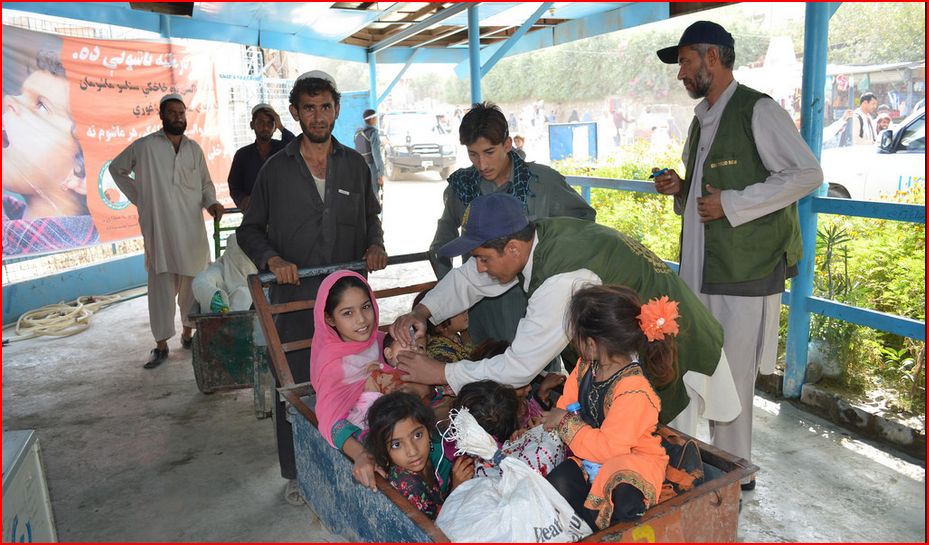
The introductory section of the report provides context and shares positive information, such as the fact that Afghanistan has detected only 1 case of endemic WPV type 1 since December 2013, which "places the country on the verge of interrupting endemic wild poliovirus circulation if the right actions can be taken in the coming months." As outlined here, there are significant challenges, however, such as - due to ongoing conflict - mass movement of populations in the Eastern Region, where regular population movements across the border with Pakistan have established a shared zone of cross-border transmission.
The TAG "commends the increased efforts in communication and social mobilization, particularly the scale up of social mobilizers in the Eastern and Southeastern Regions, continued efforts to recruit females into the Immunization Communication Network (ICN), and interpersonal communication (IPC) training for frontline workers. The TAG was concerned about the unclear data on missed children and refusals and urges further efforts of the Afghanistan programme to deliver an integrated programme that seamlessly merges epidemiologic, operational, surveillance, and communication data and activities."
Several specific recommendations are offered, some of them communication-related, such as (echoing the quotation above) the importance of developing a plan for engaging and advocating with the new government at the highest level, as soon as possible, after it is officially installed. Other suggestions include strengthening efforts to foster cross-border coordination with Pakistan via direct communication between local government and partner staff operating on either side of the border. "This should include at least monthly exchange of information and standard operating procedures for cross-border reporting on AFP [acute flaccid paralysis], population movements and supplementary immunization activities [SIAs]."
It is proposed that efforts to access all children, especially missed children, are driven by "detailed and documented analysis of the barriers in each cluster with proposed plans and strategies documented for each area" that are built upon "experience in low key, local approaches to access children in areas with barriers to immunization campaigns." Suggestions to address the challenge of missed children include, for example, more transit teams paired with social mobilisers during SIAs in all low-performing districts and more market, madrassa (religious school), and other special teams.
With regard to communication, social mobilisation, advocacy, and media, specifically, the TAG recommends that:
- "The programme should implement the plans for granular, district level research focused on implementation and outcome indicators in order to measure the impact of behaviour change activities. Efforts should be made to determine a methodology or approach where this can be measured at the district level in priority areas.
- Messages on routine immunization and broader health services should be integrated with polio messaging and the impact on increasing community demands should be regularly assessed.
- IPC [interpersonal communication] training should be enhanced and integrated into all vaccinators' and surveillance officer's induction/refresher training, and the impact of training on performance should be monitored.
- The opportunity of IPV introduction should be used to intensify awareness/demand for all vaccine-preventable diseases and capacity development of frontline health workers. Avoid individual focus on IPV due to potential implications on demand.
- Media partnerships and ownership should be further strengthened at national and local levels to promote routine immunization and broader child health practices between rounds."
Email from Chris Morry to The Communication Initiative on August 26 2014. Image credit: Chris Morry
- Log in to post comments