










































Supporting the Peace Process in Guatemala
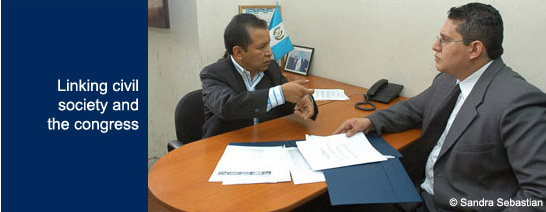
This initiative uses interpersonal communication in an effort to strengthen the capacity of civil society organisations specialising in security issues to work with the state (from the military to the police, Parliament, and the Office of the President) to elaborate public policy and establish mechanisms for citizen control and monitoring of the security sector. It is implemented in partnership with 8 FOSS national partners and in close collaboration with the Congress and the Advisory Council on Security, which serves as an institutionalised platform between civil society and the Office of the President. This collaborative strategy is designed to create a constructive relationship between political institutions and local citizens in order to formulate more effective public policies.
In its third phase, the initiative is continuing along these strategic lines, working together with the state to support the implementation of the National Security System, which FOSS staff have played a central role in developing. Interpeace is also working to strengthen the capacity of civil society groups to participate in the advancement of democratic security, to the end of hopefully allowing these groups to make informed joint policy proposals and inputs to legislative debates. Finally, organisers are facilitating focused face-to-face dialogues between the state and civil society on various aspects of democratic security and consolidating the institutional mechanisms for such dialogue.
Conflict, Democracy and Governance.
According to Interpeace, years after the signing of the Peace Accords on December 28 1996 that brought a formal end to 36 years of brutal civil war, Guatemala remains a fragile democracy. It has seen a rise in violent crime, the growing threat of youth gangs (pandillas or maras), and drug trafficking and money laundering. The homicide rate is higher than during the civil war. In this context, "[s]ecurity has become a primary concern for both the population and the political elite. In turn, rising insecurity is encouraging repressive measures with a recourse to autocratic habits and army involvement in what should be domestic police responsibility. These trends threaten basic democratic principles and institutions, including human rights and public confidence in the state and its institutions. Confronted by all these challenges, the ability of the Guatemalan state to formulate and implement policies remains weak. Security problems constitute the main threat to democratic governance and reflect the unfinished security sector reform processes spelled out in the Peace Agreements."
Asociación de Investigación y Estudios Sociales (ASIES), Asociación para el Estudio y Promoción de la Seguridad Democrática (SEDEM), Centro de Estudios de Guatemala (CEG), Fundación Myrna Mack (FMM), Incidencia Democrática (IDEM), Instituto de Enseñanza para el Desarrollo Sostenible (IEPADES), Instituto de Estudios Comparados en Ciencias Penales de Guatemala (ICCPG), Universidad Rafael Landívar (URL).
International Development Research Centre (IDRC)'s Lasting Impacts: "Countries in Transition", June 2010 - forwarded from Bill Carman to The Communication Initiative on June 10 2010; and the Interpeace website, October 29 2010. Image credit: © Sandra Sebastian
- Log in to post comments