










































The Talking Book
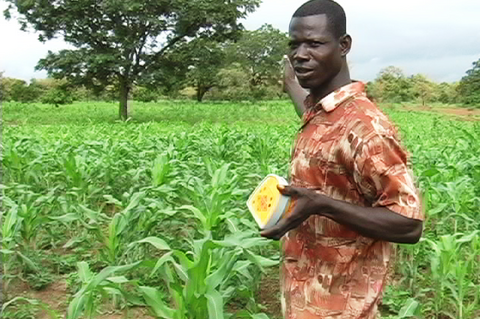
Developed by Literacy Bridge, a non-governmental organisation (NGO) based in the United States, The Talking Book is a handheld audio computer which records locally produced agricultural and literacy information for Ghanaian farmers to play back in their own language. The initiative was created to investigate how local organisations could affordably use laptop computers, cell phones, and digital audio recorders to improve the delivery of agricultural, health and educational information to rural areas.
According to the developers, The Talking Book is a low-cost, digital audio computer designed to provide locally relevant information to improve health and income, and to help people develop their literacy skills. The Book was designed to be durable and easy to use for people with little formal education and exposure to technology. There is no display, for example, which could be easily broken. Instead, the device plays audio instructions in the local language to guide users. They respond by pressing any of the ten buttons. For instance, pressing the right and left arrows navigates through categories such as livestock, fish farming, and health. Once the user has selected a category, it is easy to use the up and down arrows to rotate through individual messages.
The device can be programmed to include learning exercises and quizzes to test the listener's understanding of the subject. Users can play, record and categorise audio recordings and copy those recordings directly to any other Talking Book with a USB cable, or via computer. Organisers say recordings are stored on an internal microSD memory card, providing between 35 and 140 hours of audio. There is a built-in speaker for group listening, but power can be conserved using earphones. The device operates with rechargeable batteries, but for areas where grid electricity is not available, they also work with locally available zinc-carbon batteries.
The Talking Book is also being used to improve literacy rates. Organisers say children without a literate parent often have difficulties with reading and writing during primary education and even beyond. By using Talking Books, teachers with larger classes have given their students an opportunity to listen to their text books at their own pace and practice pronunciation, vocabulary, and reading comprehension. Parents and children can also practise reading at home if they have access to a Talking Book.
Government education offices can provide recordings to match the curriculum lesson plans, but communities can also create their own content. When a teacher, parent or community member has created a recording, students can listen back to it, control the speed of playback, define specific words, and skip ahead or backwards in a lesson. The software for the Talking Books is open source, and therefore available for developers to add new features, develop applications and test the software to increase its reliability.
Literacy, agriculture, education
Organisers say during a pilot study in Ving Ving, a village in the Upper West Region of Ghana, agricultural experts from Ghana’s Ministry of Food and Agriculture recorded a series of lessons, including techniques for improving crop production. The community quickly saw the benefits of the new system. In a year when their neighbours had a 5% fall in crop production, the farmers using Talking Books saw an average increase of 48%. One farmer, Anthony Dery, was able to harvest over four times as much corn from a single plot compared to the nearby land he farmed at the same time using traditional practices learned from his grandparents.
An evaluation of the project showed that 91% of residents applied a new health or agricultural practice after using the Talking Book. After controlling for a variety of other factors, organisers say use of a Talking Book correlated to an increased production of 2.75 bags of goods per farm, valued at US $89. The project cost approximately US$1000, which included 21 Talking Books, batteries, staff fees for training and fuel, but the value of the additional crops produced in just one year was nearly $3000.
Organisers say throughout the testing phase of the project in schools, the Talking Books remained popular among students during their literacy-learning exercises. They enjoyed listening to their voices and playing educational games over a sustained period, indicating that the novelty of the new technology was unlikely to decline quickly.
ICT Update website on March 1 2011.
- Log in to post comments