










































The Ties That Bind: Building Social Cohesion in Divided Communities
"Discussions involving social cohesion generally evoke thoughts about trust, tolerance, harmony, ties and networks."
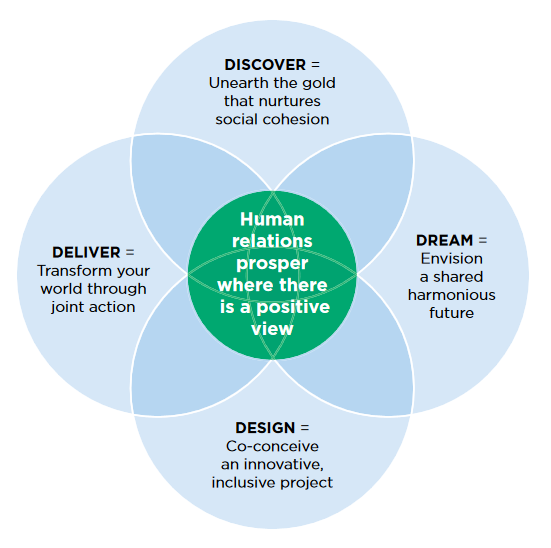
This guide from Catholic Relief Services (CRS) is an instrument to instruct and inspire practitioners to restore broken relationships, overcome mistrust, reduce hatred and mitigate violence. CRS uses a definition of social cohesion that closely approximates that of the Council of Europe, "the capacity of a society to sustainably ensure the wellbeing of all its members, namely equitable access to available resources, respect of dignity in diversity, personal and collective empowerment, and responsible participation." The guide combines the 4Ds of Appreciative Inquiry (AI - "Discover, Dream, Design, and Deliver") with the 3Bs CRS' people-to-people peacebuilding methodology ("Binding, Bonding, and Bridging"). It is designed to help groups address disagreements and disputes, find common ground, collaborate for mutual benefit, and envision a harmonious future.
According to CRS, the exercises can be used by anyone in societies or communities that are experiencing latent or active violence, or that are emerging from conflict. Field practitioners may use it to design and implement social cohesion training programmes. Each module offers detailed guidance on objectives, timing, steps, tools, and notes for the trainer. It has also been used within CRS Country Programmes to build trust and productive working relationships, both internally and between CRS and its local partners.
CRS provides several examples of its work to illuminate the origins of the 3Bs and the application of AI to the 3Bs in CRS's practice. To cite one: In Central Mindanao, Philippines, communities long at odds over land searched for a way to mitigate land conflicts. Disputes, at times violent, negatively impacted relations between the native Lumad; the Muslim population; and the Christian settlers, who were recent newcomers. To respond, CRS - with funding from the United States Agency for International Development, Office of Conflict Management and Mitigation (USAID/CMM) - developed and implemented "Applying the 3Bs to Land Conflict in Mindanao (A3B)." A3B ran from 2012-2015, and applied the 3Bs to transforming conflicts over land use, access, and ownership within and among identity groups. In the A3B model, binding activities created space for individual self-transformation and trauma healing; bonding activities strengthened relationships and mutual understanding within respective identity groups; and bridging activities developed trust between and among identity groups, fostering dialogue in the resolution of land conflicts. To encourage joint action in the face of diversity, conflicting interests, and disparate goals, A3B worked in 20 local government units (barangays) across 4 municipalities.
According to CRS, the strength of A3B lay in its capacity to mobilise and engage traditional and religious leaders (TRLs) to be community peace facilitators, and to equip them with tools that revitalised and reinforced local conflict-resolution mechanisms, such as the government-mandated Lupong Tagapamayapa (LTs, or village pacification committees). Soon after participating in 3Bs workshops, local non-governmental organisations (NGOs) trained and supported TRLs and LTs to facilitate community-level dialogue and mediation among conflicting parties. The resolutions and action plans evolving from these encounters were made available to provincial and central agencies, thereby connecting grassroots initiatives and national land policies, and aligning the former with the latter. In short, A3B offered multiple levels of healing for the conflict groups and engagement for the stakeholders, from the grassroots to high policy levels.
The guide is organised into 4 chapters and 16 interactive modules:
- Chapter 1: The first B - Binding. This chapter addresses change at the level of the individual. What goodness is there within me? What can I do, and what changes can I make, to transform my neighbourhood, workplace, province, or nation into a more harmonious and enabling environment?
- Chapter 2: The second B - Bonding. This chapter leads participants belonging to the same identity group to identify characteristics of their group that can be instrumental in preventing conflict or leading the country out of conflict. "What is the dream for our group? What can we do together to make us a positive force for change?"
- Chapter 3: This chapter introduces bridging as a means to bring 2 or more conflict groups together to lay the foundations for intergroup collaboration. It asks: "What positive characteristics do we and other groups have in common? Do we share a common dream? What can we do together to improve the lives and livelihoods of our respective communities?" This chapter guides mixed-identity groups to jointly identify, design, and implement connector projects.
- Chapter 4 covers alliance-building and exerting influence on key people, those who hold and wield power, as well as systems and structures. It shows participants how to enlist these key people – traditional authorities, elected officeholders, public officials, faith-based leaders, and businesspeople - to use their influence to bring about social change.
Consistent with CRS's capacity-building, each module contains a rationale, teaching aids, anticipated results, steps, estimated duration, and notes for the facilitator. The appendix lists 63 tools for use in the sessions and references a CD-ROM that includes all of them. Please contact CRS, at the email address above, to inquire about access.
Publishers
English; French
77 (English); 86 (French)
New CRS publications - August 2017; and email from Aaron Chassy to The Communication Initiative on August 25 2017.
- Log in to post comments