










































Unlock the Power of Girls Now
"Achieving gender equality is a long and slow process and those who step forward to challenge the status quo are often threatened and stigmatised. Girls, and all champions of change, need to be resilient and to gather strength from working together." - Anne-Birgitte Albrectsen, Chief Executive Officer, Plan International
This report from Plan International focuses on the testimony of young people, particularly adolescent girls, and on their right to participate in their lives at family, community, and national levels. Sharing the results of research undertaken by Plan International around the world, it emphasises that girls are frequently denied the opportunity - at home, at school, and in their wider communities - to be heard and and to influence or lead change. Indeed, they still face discrimination and violence despite laws, policies, and global targets put into place to challenge gender inequality. As a step in countering their invisibility in public spaces, this report includes the voices and experiences of girls who have told Path about what must be done to challenge the widespread perception that girls are worth less than boys: a valuation that starts when they are born and follows them into their adult lives.
Part I of the report includes an analysis of the lessons to be learned from the evidence Path has gathered, from girls themselves, about the reality of their lives at home and in their communities. In order to understand the scale of the discrimination that defines the experiences of girls, Plan International began, in 2007, to monitor "The State of the World's Girls" and increasingly to campaign on the issues that affect adolescent girls and young women: education, early marriage, violence in school, the burden of domestic responsibilities, and economic empowerment. More recently, Plan has undertaken several major studies that focus on examining the attitudes and perceptions of adolescent girls and boys in many different parts of the world. The report sums up each of these studies, which in brief include:
- Hear Our Voices, 2014 (see also Related Summaries, below) - Path spoke to over 7,000 adolescent girls and boys in 11 countries: Bangladesh, Pakistan, Ecuador, Nicaragua, Paraguay, Egypt, Uganda, Zimbabwe, Benin, Cameroon and Liberia. "The sheer scale of the similar responses across numerous countries drove home the consistency and embedded nature of the inequalities and injustices that so many girls face in their daily lives."
- Girls Speak Out, 2015 - Path surveyed 4,219 girls in Ecuador, Nicaragua, Pakistan, and Zimbabwe, four of the countries that had taken part in the earlier research. Sharon Goulds and Sarah Hendriks, writing on the study, note that throughout the research, it is "striking that girls see the key to changing their lives for the better to be the responsibility largely of themselves and their families, rather than of the government or community and religious leaders...it is the education of girls, their own empowerment, which is seen as driving progress and unlocking change."
- Counting the Invisible, 2016 - Path interviewed 413 girls in three of the previously studied countries, Nicaragua, Pakistan, and Zimbabwe. Common threads centre around the themes of: building self-confidence, economic instability as a fundamental barrier to girls' rights, working with men and boys to encourage families to value their girls, supportive relationships as a source of strength, and the desire of girls to have a better life.
One message that emerged over these years of Path research is that the discriminatory attitudes and behaviour entrenched in family and community life, where power is wielded almost entirely by men, keep gender stereotypes alive. It clear from all the research that girls for the most part see themselves as worth less than boys. "If the underlying assumptions about the inferiority of girls and women are not challenged and eradicated girls everywhere will remain undervalued and their rights largely ignored." When it comes to creating transformation, it is important, Path finds, to avoid making assumptions about "leadership" and "empowerment" without a clear analysis of the barriers to this which girls themselves are articulating. Girls should be the ones to lead the change that they see the need for, but this doesn't have to be as activists. For example, they can lead change by taking part in research that will influence policy, advocacy, and programme interventions. Furthermore, any blanket recognition of girls' capacity and ability as responsible and active citizens fails to take into consideration the differences between them as well as the diversity of contexts in which they grow up and the resources available to them.
It is for this reason that the fourth study in this collection, Voices of Hope (see Related Summaries, below), was undertaken. It asks: How do adolescent girls themselves view their ability to act and lead change, and what enabling factors need to be in place in order for them to do so? Part II of the report summaries the two further in-depth research studies with young women and men in nine communities in Uganda and Colombia and an additional study with young people in Spain. In Uganda and Colombia, girls taking part in the study no longer see themselves as solely responsible for transforming society; instead, they are looking for allies. This is a clear change from evidence collected in earlier research when bringing about change was seen as very much the responsibility of girls and their mothers. Path surmises that the marked differences between the Ugandan and Colombian girls and the participants in Spain, who still see the whole issue as the responsibility of women and girls, can be attributed to the work on gender discrimination carried out by the Champions of Change programme in these two countries.
Champions of Change supports young people to actively examine and reflect on how rigid roles and behaviour are imposed on them because of their gender and to understand how power imbalances play out in their own lives. It works through dialogue and the creation of safe spaces in which young men and women interact and learn to develop critical thinking on issues that affect them. Working in many different countries, the programme uses a series of "hooks" to retain participants, creating connections through sport, arts, and music, using these interests as the basis for community outreach activities. Participants explore gender norms, which stem from a society's beliefs and perceptions about what it means to be a woman or a man. (Connected to this are the gender roles that define what is considered appropriate male and female behaviour, and largely circumscribe the actions of men and women, girls and boys, in any given situation.) They learn that it is crucial that everyone - boys, girls, women, and men - join in the struggle for gender equality and jointly reject discrimination and stereotyping.
Voices of Hope research participants in Colombia and Uganda, 100 in each country, were selected based on their present or past involvement in the Champions of Change programme. The research findings are summarised. Several examples of participants' reflections highlight the importance both of knowledge around gender and rights, and of the capacity to discuss and negotiate, as key tools for a transition towards more gender equal relations at home. Overall, adolescent girls and boys did not feel that they were as effective at creating change at community level as at home, but their influence as a collective was evident through their visible public presence. This visibility was identified as a positive strategy. Youth say they want to use drama techniques that both entertain and inform and new technology to bring young people together to share information and plan collective action. Public radio and television, newspapers, video, and social media can be harnessed to the cause of gender equality. Adolescents also argue for intergenerational dialogue between community members, both in public forums and in smaller discussion groups. They are particularly keen to raise awareness of the harmful effects of violence and to identify collective action to put a stop to it.
Community leaders, local mayors, and teachers were identified as key allies in attempting to bring about collective change. The role of public institutions was also recognised, but adolescents found it difficult to identify strategies to influence them, and for the most part they felt that institutions were unconcerned with their concerns and realities. On the other hand, adolescent boys and girls were aware that the state has a duty to uphold their rights, and to protect and promote gender equality, and that it was failing them.
A conclusion section summarises the results of the Voices of Hope research, noting, for instance, that "[g]irls need safe space both real and virtual; they need strong role models and not to be surrounded by images that objectify them and encourage violence against them. They are well aware of the power of the media: online, on radio, in newspapers, films, and soaps which can be harnessed to reduce violence and promote gender equality and girls' rights. They need visibility, solidarity and practical, positive action."
Finally, Part III of the report shares recommendations, including:
- "Governments must step up and intervene in public and private spaces - from homes to boardrooms, to political institutions and in the media - to end violence against women and girls....This can in part be achieved by media organisations using more positive images and affirmative language in the way women and girls are portrayed in dramatic content, factual content and advertising, and avoiding stereotypes that promote gender inequality. A gender scan should be automatically applied to public content and media organisations held to account."
- Girls can be empowered and lead change, but they need allies. This can be achieved through partnerships - between girls, between generations, and between all committed to gender equality.
- Greater efforts are needed to understand how adolescents actually live their lives so girls and boys can be supported to challenge gender stereotypes. Everyone - governments, civil society, corporate bosses, local leaders, parents, girls, and boys - needs to engage critically with gender discrimination and how it defines society. This can be achieved through working with girls and boys at a grassroots level, using participatory methods and approaches in efforts to unearth and address gender norms.
"For transformative change to take place, gender equality must become a key social and political issue and power holders must use their authority to challenge the deeply held personal attitudes that perpetuate misogyny, waste talent and impoverish all our lives."
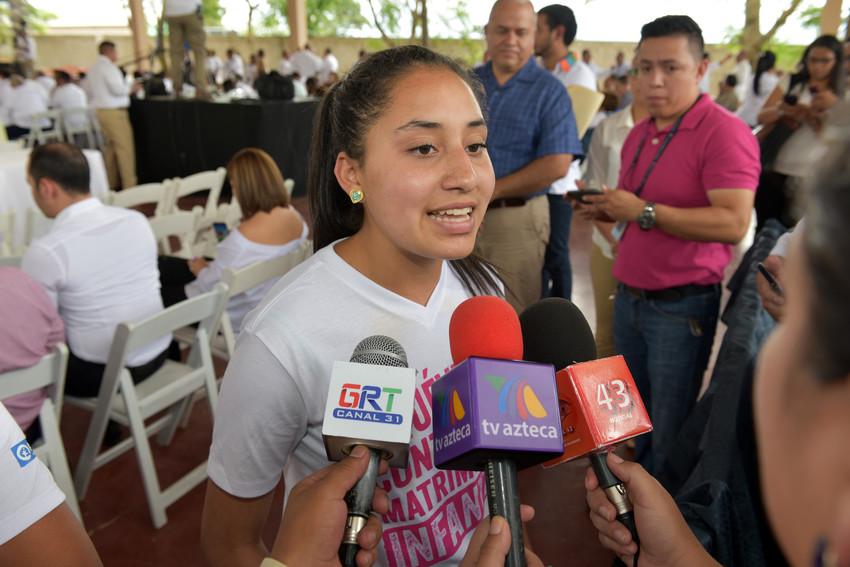
Plan website, October 17 2017. Image caption/credit: Plan International youth campaigner interviewed at the National Congress, Honduras. © Plan International / Ulises Alvarado
- Log in to post comments