










































Usage of Scientific References in MMR Vaccination Debates on Twitter
University of Illinois at Urbana-Champaign and Imam Mohammad bin Saud University
When online users discuss topics on Twitter, they often include evidence to support their claims, including links to online sources such as newspapers or blogs. However, these sources may include unverified or even false information, which may amplify the perceived risks of the issues under discussion - e.g., health issues. Another challenge that presents itself in social media discourse is selective exposure to online information. Instances of selective exposure, including when like-minded people share their views with one another to reinforce their pre-conceived biases, are known as "echo chambers". This research analyses scientific information sharing behaviours on Twitter in the context of the controversy over the supposed linkage between the measles, mumps, and rubella (MMR) vaccine and autism.
This study showcases emerging data analysis approaches. These approaches are inherently interdisciplinary, bringing together principles and practices from health informatics, data analytics, and network analysis.
In order to conduct the observation, specific instances in the ongoing MMR vaccine debate from January 1 2016 to November 28, 2016 served as a case study. The researchers examined the usage pattern of scientific information resources by both sides of the ongoing debate. Then, they explored how each side uses scientific evidence in the vaccine debate.
First, the researchers collected a corpus that contained "gold standard" data - that is, tweets that contain scientific versus non-scientific evidence on the topic of vaccines. The corpus contained two main datasets. One dataset contained tweets that discussed the topic of MMR vaccines and their relation to autism, providing different types of supplementary evidence. The second dataset contained tweets that talked about vaccines and provided supplementary scientific evidence in the form of URLs linked to a scientific paper about vaccination. These two datasets are referred to as non-scientific and scientific, respectively. After finding 94 tweets that appeared in both datasets and removing them, the researchers arrived at final combined datasets that contained 36,428 tweets.
The next step was to annotate tweets for their stance towards vaccines. The researchers identified 6,112 tweets as having an opinion: 430 tweets with a pro-vaccine opinion and 5,682 tweets with an anti-vaccine opinion. (They also found 215 tweets containing both anti-and pro-vaccine hashtags, which were removed from further analysis.) These results show that there is a much higher number of tweets discussing anti-vaccination than pro-vaccination attitudes.
Another goal was to identify the use of scientific references in the discussion of vaccines on social media. To accomplish this, the researchers recorded the number of pro- and anti-vaccine tweets with references to scientific and nonscientific evidence. The ratio of pro-vaccine tweets containing links to non-scientific evidence compared to scientific evidence was 1:2.09, while the ratio of anti-vaccine tweets that contained a links to non-scientific evidence compared to scientific evidence was 1:5.01. These results show that people with both attitudes reference more non-scientific evidence than scientific evidence. When sharing non-scientific evidence, people mostly share links from social media websites such as Facebook, Twitter, and YouTube. Sources such as news sites and personal blog posts are the next most commonly shared links.
To better understand the usage of scientific references in discussions of vaccines via social media, the researchers did a thorough analysis of the URLs shared. The ratio of anti-vaccine tweets that contain URLs compared to tweets that do not is 5.31:1, while the ratio of pro-vaccine tweets with URLs compared with non-URLs is 3.53:1. This shows that users with anti-vaccine attitudes refer to external sources more often.
For users sharing scientific references, the top 15 URLs shared in pro-vaccine discussions show that this group shares references containing scientific evidence against the supposed link between the MMR vaccine and autism. Meanwhile, the top 15 URLs shared in anti-vaccine discussions all claimed to show a link between the MMR vaccine and autism. The article provides details on what exact publications were cited most by each group.
The results showed that people with anti-vaccine attitudes linked many times to the same URL, while people with pro-vaccine attitudes linked to fewer overall sources but from a wider range of resources, and they provided fewer total links compared to people with anti-vaccine attitudes.
Moreover, the results showed that vocal journalists have a significant impact on users' opinions. Journalists often report on controversy by presenting claims both for and against an issue in a relatively "balanced" fashion, which appears to lead to more uncertainty on the part of their readers.
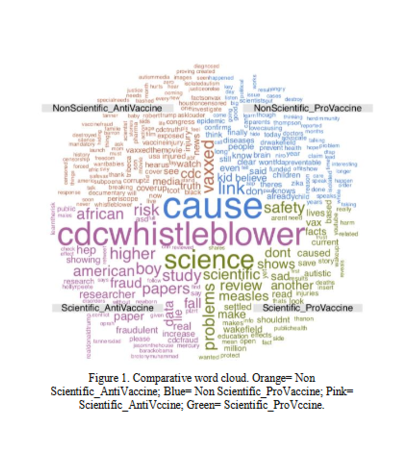
The researchers carried out a unigram analysis; Figure 1 shows a comparative word cloud visualisation of the 100 most frequently encountered terms in each of the 4 data corpuses: non-scientific anti-vaccine, non-scientific pro-vaccine, scientific anti-vaccine, and scientific pro-vaccine. Furthermore, to understand how different internet domains are used as supports in online users' discussions regarding the linkage between the MMR vaccine and autism, the researchers created a network graph of domains connected through user activity - specifically, the URLs shared in their tweets. Taken together, the observations the researchers share show how different opinion-holders express their attitudes toward the issue.
According to the researchers, this study has the potential to improve understanding about how health information is disseminated via social media by showing how scientific evidence is referenced in discussions about controversial health issues. Monitoring scientific evidence usage on social media can reveal concerns and misconceptions related to the usage of these types of evidence. In future work, the researchers plan to explore the strength of the attitudes held by each side of the debate and study if people with strong opinions differ in the usage of information sources from users with moderate or no opinions towards the debate.
2018 IEEE/ACM International Conference on Advances in Social Networks Analysis and Mining (ASONAM), August 28-31, 2018, Barcelona, Spain
- Log in to post comments