










































Using Actor-Partner Interdependence Modeling to Understand HPV Vaccine Acceptance
Syracuse University (VanderDrift, Vanable, Bonafide, Bostwick); University of Cincinnati (Brown); Centers for Behavioral and Preventive Medicine, The Miriam Hospital (CareyCarey</i)
"Consistent with prior research, the majority of predictors of an individual's own intention to vaccinate were individual-level variables; uniquely though, some predictors endorsed by one member of the dyad influenced the intentions held by the other member."
In 2012, the United States (US) experienced the first year in which rates of human papillomavirus (HPV) vaccination did not increase for female adolescents, and rates of increase since have been more modest than in earlier years. Believing that a fresh approach is needed to understand vaccine acceptance, these researchers sought to determine whether a dyadic context can provide additional information to help bolster HPV vaccination uptake. Several meta-analyses and systematic reviews have found that the strongest predictors of HPV vaccination are perceived susceptibility to HPV, perceived barriers to vaccination (i.e., cost and safety), subjective norms (i.e., social pressure to obtain the vaccine), self-efficacy (i.e., the belief that one can obtain the vaccine), and intentions. Yet all of the meta-analyses and the studies integrated in them have taken an individual perspective on HPV vaccination.
The researchers explain that dyadic perspectives in HPV vaccination are important because parents and adolescents often think differently about HPV vaccination. They cite studies finding that parents report greater positivity for the vaccination than do their adolescents, despite female adolescents believing HPV is more severe and that they are more susceptible to it than their parents believe. When disagreements occur, parents remain the primary decision maker with regard to HPV vaccination. Even so, adolescents likely influence their parents. Thus, a full dyadic analysis of parents and adolescents' HPV vaccine decision-making should: (i) explain whether and how parents and adolescents influence each other, which is important for designing interventions for greater vaccine uptake, and (ii) inform whether the individual-level approaches to this topic are theoretically reasonable, or if the final decision is so dyadically situated that results from individual-level examinations are incomplete.
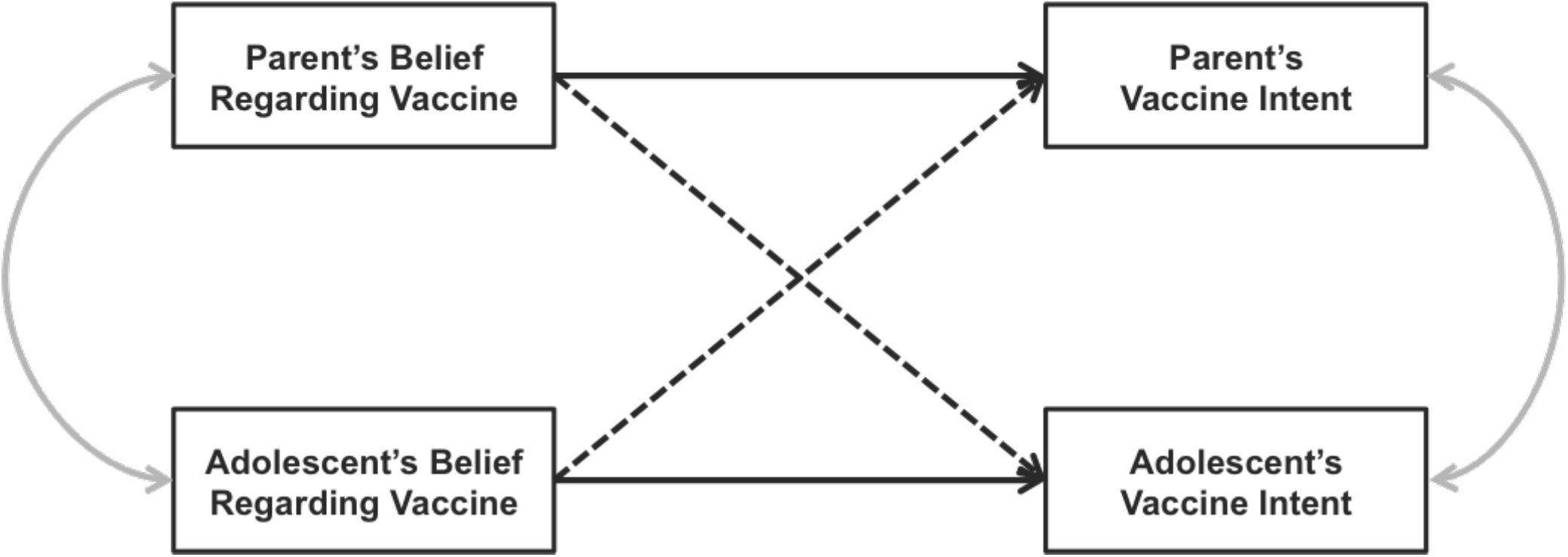
This study uses the Actor-Partner Interdependence Model (APIM) to assess HPV vaccination acceptance because it allows for the examination of dyadic processes that models the unique associations within- and between-individuals while accounting for covariance in both the predictors and outcomes. Figure 1 in the report (also above) provides a conceptual depiction of the APIM model, and the paper explains it in depth. In short, it is expected that the parents and adolescents will, in large part, share similarities regarding the predictors and outcomes, so this covariance must be modeled. Of interest, above and beyond the covariance, APIM will identify whether any of the known within-person predictors of HPV vaccination acceptance produce between-person effects.
The researchers recruited low-income African American female (n = 93) and male (n = 116) adolescents and their parents (n = 209, 88% female) to complete a survey regarding HPV vaccination acceptance. Despite nearly identical rates of vaccination for other vaccines, Black adolescents complete the HPV vaccine course at a lower rate than do other races in the US, making this sample particularly important for increasing HPV vaccination rates. Drawing upon prior empirical work, the researchers tested 4 categories of predictors that were relevant to both the parent and the adolescent: 1) knowledge of HPV and the vaccine, 2) concerns regarding the HPV vaccine, 3) perceived need for an HPV vaccine, and 4) self-efficacy and intent regarding vaccination. Intent to obtain the vaccine was the outcome of interest.
The researchers examined:
- whether adolescents and parents differed with respect to their beliefs regarding HPV vaccination. Results indicate that there is statistical advantage to treating parents and adolescents as distinguishable. Specifically, models in which the intercepts, actor effects, partner effects, and error variances are fixed to be equivalent across parents and adolescents results in poor model fit for all variables examined. The practical implication of this is that interventions need to be designed specifically to reach each member of the dyad.
- which actor effects are significant among parents and adolescents. Briefly, for parents, all actor effects were significantly different from zero, except for the constructs tapping knowledge of HPV and whether HPV is severe. For adolescents, all actor effects were significantly different from zero except for the belief that the vaccine is unsafe.
- which partner effects were significant among parents and adolescents utilising the same models as tested for the actor effects. Briefly, only one partner effect was significantly different from zero, and that was the effect of the parent's self-efficacy on his or her adolescent's intent, which predicts in the opposite direction from the actor effect (i.e., as parents self-efficacy increases, their adolescent's intent decreases).
- which model (i.e., actor-only, couple, contrast) best fits each predictor of HPV vaccination for each dyad member. In general, the actor-only model (the model assumed by the literature) fit most of the predictors. Practically, this suggests that interventions aimed at changing the beliefs of one member of the dyad will impact that member's intent to vaccinate, with little impact on the other member of the dyad. There are, however, a few exceptions. For example, a contrast model was plausible for parents when looking at the predictors of believing the vaccine is stigmatising and believing the vaccine will lead to greater promiscuity. A contrast model was also plausible for adolescents when considering self-efficacy. A couple model was plausible for adolescents when considering beliefs that HPV is severe. (These models are described in the paper's discussion section.)
With regard to clinical and public health implications of this work, the researchers indicate that:
- Because "most predictors were well-fitted by actor-only models, interventionists can be confident that the extant literature, in which predictors of vaccine intent and uptake are examined within individuals, holds well even in dyadic contexts. Thus, interventions targeted at individuals based on this literature are likely to be successful."
- For both marketers and interventionists, it may help to know that parents must believe that their child is vulnerable to HPV prior to intending to obtain it. Thus, education aimed at publicising the prevalence of HPV would be expected to help with vaccine uptake, as would informing both parents and their adolescents about what causes vulnerability to HPV.
- There was "little evidence that adolescent attitudes influence parents' self-efficacy and intent; however, if an adolescent knows that a particular part of their lifestyle makes them vulnerable to HPV, and they are aware of the risks of HPV, they may communicate their vulnerability to their parent, thus enhancing uptake."
- It may be "beneficial to normalize the risk of HPV from a marketing and intervention standpoint. By virtue of their age, all sampled adolescents were at some risk for HPV, or would be, yet parents were not overwhelmingly aware of their own adolescents' vulnerability, which undermined their vaccine uptake intentions. Instead of relying on adolescents to communicate their lifestyle details to their parents, marketing and interventions aimed at generating the idea that all adolescents are vulnerable to HPV could enhance uptake."
In conclusion, the researchers assert that use of APIM "improves understanding of HPV vaccination uptake and can be used to guide intervention efforts."
PLoS ONE 12(7): e0181662. https://doi.org/10.1371/journal.pone.0181662
- Log in to post comments