










































Using Google Earth to Study Children's Neighborhoods: An Application in Dhaka, Bangladesh
Bangladesh University of Engineering and Technology
"In megacities like Dhaka, residential compound yards, streets, pedestrian pathways, and associated circulation spaces are usually the only spaces available to children for outdoor play. Empirical knowledge is required to positively influence urban development policy and practice related to the functions of such spaces for children."
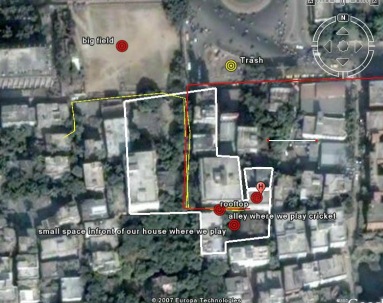
This paper describes a methodology developed for gathering reliable and valid data about urban children’s use of their neighbourhood. The study was conducted with children aged 9 to 14 in Dhaka, Bangladesh. "A goal of this study was to develop a method that was not place-specific; in particular, one that could be administered outside of school. The adopted method employed satellite imagery available on the Internet to collect information from children about their use of outdoor neighborhood spaces. The use of online satellite imagery was key to success, as it enabled collection of data wherever needed across a wide expanse of the city."
Children mapped their neighbourhoods with online satellite images and discussed their maps with researchers during structured interviews based on Growing Up In Cities questionnaires. Children’s maps were then verified through child-led neighbourhood field trips. The method was reported to be attractive to children and ensured their active participation. According to the author: "Information gathered using this method is easy to express visually, to analyze, and to apply to children-neighborhood investigations."
"Two approaches to collect information from children regarding their use of neighborhoods were initially tested on a small number of children. The first approach was mental mapping, and the second approach used printed aerial photographs."
1) "Mental mapping linked to a questionnaire was tested on 11 respondents. We asked children to make a drawing of their neighborhood, but the drawings did not support making concrete conclusions about behavior-related physical components. Moreover, mental maps may reflect stereotyped images rather than people’s actual experience....
2) The second approach involved aerial photographs along with a questionnaire, which was tested on 17 children....the main study used online satellite imagery and a questionnaire, along with child-led field trips to supplement survey answers."
Children were taken on field trips to confirm independent mobility routes and locations that they liked or didn't like as they had shown them on the maps. "Overall, the proposed method of integrating satellite images with questionnaires and child-led field trips succeeded at collecting information from children about their use of the outdoors in the neighborhood. Moreover, the information obtained could inform policy makers and influence policies regarding housing and street design, design of routes from and to schools, green space, etc. In most developing countries, the rules and regulations regarding planning and design of cities do not consider the needs of children."
The findings presented here are part of a larger study focused on developing cost-effective research methods appropriate to the developing-country context with implications for built-environment policy and practice.
[Editor's note: For a full PDF format document of this article, please consult the Children, Youth and Environments Journal website.]
Children, Youth and Environments website, Vol. 22, No. 2 (2012), ISSN 1546-2250, accessed on December 18 2012.
- Log in to post comments