










































Using ICTs to Integrate Frontline Views into Strategic Planning for Climate Change Initiative Overview
"VFL is seen to provide a generic model by which the voices of local communities can be heard in the debate on climate change and on wider resilience by those in strategic decision-making positions."
This case study from the University of Manchester, United Kingdom (UK)'s "Climate Change, Innovation and ICTs" research project, funded by Canada's International Development Research Centre (IDRC) and managed by the University's Centre for Development Informatics (CDI), describes 'Views from the Frontline' (VFL), created to fill a gap in the monitoring process of the climate-related Hyogo Framework for Action 2005-2015 (HFA) by providing a complementary view of progress based not on government self assessment, but on the experience and views of people living in disaster-prone communities – those on the 'frontline'.
"'Views from the Frontline' is a process of gathering information on disaster risk reduction at a local level. Local organisations gather both qualitative case studies and quantitative data from face to face surveys - low-cost digital video technology is used to create annotated case study videos, and email and spreadsheets are used to coordinate and manage survey data. In 2011, VFL also trialled an experimental programme to research the use of SMS surveys using mobile phones...."
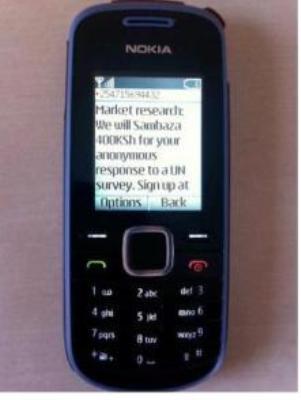
The Global Network of Civil Society Organisations for Disaster Risk Reduction (GNDR) "worked with the telecommunications company Txteagle (renamed Jana in late 2011) on an experimental programme to research the use of mobile phone technology for surveys.... Txteagle uses various mechanisms to recruit phone subscribers as 'members, who opt in to the process. Txteagle then invite members to complete surveys in exchange for airtime.... Respondents could choose to complete the survey using a webpage, or through a multiple exchange of SMS messages."
In addition, "[f]ace-to-face interviews and group discussions with key informants were carried out by Participating Organisations (POs). POs are typically local civil society organisations, which are supported by a National Coordinating Organisation (NCO). A data entry tool (running on Excel) was provided to enable NCOs to input the data into a structured database for analysis....
While the VFL process is essentially one of communication upwards through a network, it has been eased by access to simple ICT infrastructure. Email was used to send questionnaires to POs throughout the network, to return data sets to the secretariat, and to disseminate findings and reports to network members. Although Web 2.0 technology has been used to enable members to take part in blogs, online discussions, and a session at the Global Platform event in 2011 was streamed through the GNDR website, members make greater use of simple email discussion lists."
"....VFL 2011 extended the reach of the survey [from a 2009 survey in which over 400 civil society organisations were mobilised to conduct over 7,000] to over 20,000 interviews conducted by over 500 organisations in 69 countries. This success reflects the value that POs themselves attribute to this kind of information in their own advocacy work. [Findings were] therefore used as a central campaigning and advocacy message."
The case study concludes that the e-survey proved a cost-effective way of extending the reach of the VFL process, but the methodology does not appear to have reached into vulnerable communities. "It was clear that the 'reach' of the eSurvey into low income subscribers was constrained by issues linked to airtime credit - people with no or low credit were not able to complete the survey because remuneration was awarded only on completion of the survey, and people opting to use the internet interface tended to be from higher status socioeconomic groups....Designing the eSurvey approach stimulated more critical thinking on the sampling methodology for VFL. By targeting key referents, the face to face process generates informed views from at-risk communities. By sending invitations to a pool of mobile phone subscribers, the eSurvey offers the potential to generate information that is representative of a given demographic. The network needs to reflect on a methodology that will be most helpful in influencing change at a local level." (Please see the document linked below for further recommendations/lessons learned.)
Email from Richard Heeks and Angelica Ospina to The Communication Initiative on February 15 2012, and the Nexus for ICTs, Climate Change and Development website on March 27 2012.
- Log in to post comments