











































Using Technology to Document Violations: Enabling Sex-worker Communities to Document Violence Against Them in India and Cambodia
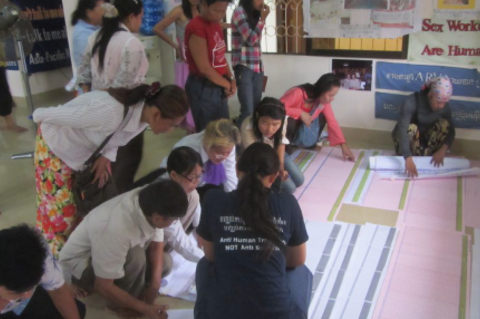
Carried out by the Tactical Technology Collective (Tactical Tech) and funded by the International Development Research Centre (IDRC), this project was based on the assumption that enabling sex workers in India and Cambodia to document violations and amplify their advocacy messages via new technology may provide a fuller picture of the levels, types, geographical locations, and perpetrators of violence, abuse, and discrimination against sex workers. Working with two sex worker collectives/advocacy groups - the Durbar Mahila Samanwaya Committee (DMSC) in India and the Women's Network for Unity (WNU) in Cambodia - researchers undertook action research with the goal of empowering sex workers and their organisations to prevent, respond to, and address situations of abuse, violation, and discrimination encountered in the sex industry.
The project (2010-2012) involved the following approaches:
- Shifting partners' advocacy strategies from reactive to proactive strategies, with a potential impact on the lives and wellbeing of 70,000 sex workers;
- Transforming human rights documentation processes carried out by partners, which included evidence gathering and analysis on violence against sex workers and visualisations of this evidence;
- Increasing knowledge of the importance of effective information management in digital documentation;
- Gaining insight into community-owned and aggregated data - given a growing global movement towards open data for accountability and transparency;
- Developing integrated self-evaluation tools, which will continue to be used by partners; and
- Contributing to the scholarship on violence against sex workers and advocacy for their human rights.
At the beginning of the project, baseline reviews and needs assessment visits with both sex worker organisations revealed that they were documenting their work in some detail, but they were not able to use this information in a way that impacted on their advocacy. Evidence and documentation remained in handwritten ledgers, binders containing individual case studies and testimonies, printed reports, and spreadsheets. Furthermore, researchers found that advocacy on violence against sex workers was reactive rather than proactive. DMSC and WNU were able to respond to immediate and local threats, but were not strategic in identifying key messages, backed up with evidence, that could be conveyed to policymakers, parliamentarians, local government leaders, and law enforcement. So, from an initial objective of enhancing the groups' use of technology to document violence, the goal of the project shifted to strengthening their use of information in advocacy and helping them refine their advocacy strategies on violence against sex workers.
Reviews of existing research on sex workers show a focus on HIV prevention, care, and support, as well as debate between competing lobbies who are either for or against the implementation of antitrafficking legislation as a means to end sex work. There is little research on violence against sex workers and advocacy for their human rights. Data and evidence about sex worker communities are often collected by outsiders, and the ownership of the data is rarely with sex workers themselves.
In order to challenge this dynamic, Tactical Tech developed the idea of the 'Atlas of Sex Work' using the data collected by WNU and DMSC themselves. The 'Atlas of Sex Work' concept was an opportunity to showcase ideas for creative aggregations of information about the lives of sex workers and the conditions of mistreatment they face. The concept proved useful for further developing ideas and inspiring advocacy messages. Also through this process, both organisations gained insight into how data about mistreatments can be transformed into visual outputs for advocacy. Through a series of capacity building and planning workshops, Tactical Tech shared other examples of evidence-based advocacy from around the world. Tactical Tech tried to build processes to equip both organisations take on further projects on visualisation of evidence and develop their own Atlas of Sex Work packages in the future.
Namely, DMSC conducted detailed questionnaires across 48 locations in West Bengal, collecting data from around 22,000 women sex workers about the violence they had experienced. Supported by design partner Mediashala, Tactical Tech worked with DMSC to frame their data as a series of information graphics around the theme 'Who Victimises Sex Workers' that show the extent and type of victimisation faced by sex workers. Three of these infographics are aimed at the police, MLAs (Members of the State Legislative Assembly), and Panchayat Pradhans (leaders of the local self-government under the Panchayati Raj decentralised rural administration), and two are aimed at general audiences, the media, and sex workers. The infographics demonstrate that the police and babus (long term clients-turned-partners) are the main perpetrators of the violence. The data also revealed how the stigmatisation of sex workers is reflected in the kinds of violence they face. After analysing the data, DMSC reportedly became more aware of the scale and nature of violence against sex workers, finding that some of the data contradicted their own beliefs. For instance, at the start, DMSC believed that their work with police in Calcutta had reduced levels of violence against sex workers. However, the data showed that in fact the police in the city were responsible for the highest proportion of the violence against sex workers.
WNU's objective was to collect evidence to show the negative impact of the Anti- Trafficking Law on sex-workers and to show how the police were misusing the powers this law gives them for detention and arrest. The issue facing WNU is that raids and arrests under the Anti-Trafficking law have forced sex workers to go underground. It has become difficult to reach out to sex workers with condoms, and HIV prevention, care, and treatment. Tactical Tech worked with WNU to develop three briefs for visualisations of their evidence: "Rescue Us from the Rescuers", "Your Law Brings Us More Problems, Not Solutions", and "Not Being Rescued from Poverty". Using pilot data, WNU made their own maps and charts about the impacts of the Anti-Trafficking law on sex workers. These have been shared with policymakers, bureaucrats and MPs, and partner non-governmental organisations (NGOs). WNU reports that the aggregation of evidence about violence against sex workers, even in a pilot form, garnered interest and attention from their peers and audiences and gave the small collective the confidence to work with evidence, appreciating how it can strengthen their advocacy. They were also approached by other organisations and institutions interested in using their data to support other advocacy efforts around gender-based violence.
Based on what they learned in a May 2011 training workshop on using audio and visual tools for data collection, WNU also compiled their audio and video recordings (featuring sex workers talking about their experiences and the impact of the Anti-Trafficking Law) into a short film about the raids (called "rescues" by the authorities) on sex workers under the Anti-Trafficking programme and the resulting human rights violations of sex workers. The film calls for the Cambodian government and the Parliamentarian to amend this law, while asking the donors, religious/church leaders, fundamentalist feminists, and NGOs, who claim to be rescuers, to stop harming sex workers and to support the right to work of adult and voluntary sex workers.
Throughout the project, the shift from reactive to proactive advocacy occurred through the process of getting DMSC and WNU to think about the kinds of information that would make a convincing argument by:
- Answering questions about their own data and how it resonates against anecdotal information gathered from the field;
- Asking organisations to follow the thread of how policies and laws directly related to the violence; and
- Examining the connections between those who had the power to change these laws and people that could influence them.
Both DMSC and WNU reported thinking more strategically, and with a better analysis of their own contexts, so as to convey convincing arguments to police, parliamentarians, and other audiences.
Gender-Based Violence, Rights, HIV/AIDS
IDRC explains that, in most societies, sex work is highly stigmatised, and sex workers are subject to blame, disapproval, and discrimination. As a result, violence against individuals involved in sex work is seldom visible and, in some contexts, even condoned. Hence, there are few sources of reliable, ethical, and confidential data on violence against sex workers - as defined by the sex workers themselves - over time. Digital advocacy techniques have been used to document human rights abuses and communicate these to people of influence, but these have yet to be systematically applied to sex-worker-led advocacy.
Brief profiles of participating organisations:
- Tactical Tech is a non-profit organisation working to raise awareness about privacy, provide tools for digital security, and mobilise people to turn information into action. They find practical solutions for a global network of activists, technologists, and engaged citizens, sharing their outputs worldwide through applied research, capacity building, trainings, workshops, events, and exhibitions.
- A forum of 65,000 sex workers based in West Bengal, India, DMSC is active in challenging and addressing the structural barriers that form the everyday reality of sex workers' lives as they relate to their material deprivation or their social exclusion with the aim of altering them. DMSC is one of the first sentinel surveillance sites for recording HIV prevalence in the sex worker community. In addition, the organisation is explicit about its political objective of fighting for recognition of sex work as work and of sex workers as workers. Female sex workers, who were field coordinators and peer educators, were involved in the project development and planning, participated in capacity-building workshops, and were tasked with data collection.
- WNU is a grassroots representative collective of 5,000 sex workers in Phnom Penh and regional provinces outside the capital. It is staffed and managed by sex workers, current and former, and by transgender people. They were involved in all stages of the project development, planning, and implementation (including data collection). The network seeks to promote the rights of sex workers to earn a living in a safe environment, free from exploitation and social stigma.
- IDRC funds research in developing countries to promote growth, reduce poverty, and drive large-scale positive change.
According to Tactical Tech, the data collection process encouraged communication about the violence sex workers face - in particular, those types of violence that are taboo or difficult to articulate. For example, many sex workers did not know that if a babu beats a sex worker that is violence. DMSC said the data collection process made them feel that they better understood how to approach the community, especially by having sex workers as part of the data collection team and by conducting more regular visits, not just in the event of a crisis. One DMSC staff member commented: "I found that after the survey on violence, there was an increase in reporting of violence cases which led to higher number of redressals....The survey created trust and confidence in the community that DMSC could keep the information confidential and support them in cases of violence. This survey was different because it was the first survey on violence done in a systematic manner and by sex workers themselves." Tactical Tech contends that the project also raised awareness among sex workers of the services offered by DMSC, and strengthened the trust between the two parties.
Tactical Tech offers the following recommendations from this project:
- Begin any technology project with a proper assessment relating to the use and application of technologies to the organisation's goals. Criticisms of information and communication technology for development (ICT4D) projects indicate that they tend to introduce technologies as solutions without effectively assessing what they will imply for the workings of beneficiaries and if technology, understood in the narrow sense of devices and platforms, is in fact an effective solution. Information and knowledge management can be a challenge; the more devices and platforms are used to aggregate, process, and communicate information, the greater the pressure to process the information that the use of these technologies generate. Many organisations want to use social media or databases without really thinking about their overall management of knowledge and information and how it can be used.
- Continue to design implementation projects that integrate self-reflection tools. Active, participatory reflection on process can be very useful if it is integrated with the project activities and simultaneously develops strong monitoring and evaluation (M&E) methodologies and feedback loops.
- When collaborating with advocacy organisations working in marginalised communities, support and allow for adaptive and substantial changes during the course of the project.
- Enable grassroots communities to leverage social and web 2.0 media technologies to convey their messages. Digitally enabled activism has become a strong factor in global politics, but many smaller groups are being left out primarily due to infrastructural limitations (from poor bandwidth to lack of multi-language platforms). Basic digital advocacy trainings can be useful for grassroots communities in leveraging their information more effectively. Collaborations between better resourced groups and those just starting out could take the form of direct capacity building. (DMSC and WNU were not ready for this type of training during the project.)
- Foster greater connection between open-data movements and grassroots advocates to ensure accessibility and usability of data released by public institutions. The kinds of knowledge created by grassroots groups - e.g., that gleaned from research with and amongst marginalised communities - also needs to find greater connection with the kinds of knowledge developed by more well-resourced and powerful groups such as research institutes. Essentially, an open-data approach to community owned and community-based data could be beneficial to advocates.
Tactical Tech, DMSC, WNU
Emails from Liane Cerminara to The Communication Initiative on November 6 2017 and November 22 2017, including "Using Technology to Document Violations: Enabling Sex Worker Communities to Document Violence Against Them in India and Cambodia", by Dirk Slater and Indira Maya Ganesh, Tactical Tech, July 5 2012; and IDRC website and Tactical Tech website - both accessed on November 30 2017. Image caption/credit: The WNU Outreach Team works with print outs of the spreadsheets containing the data collected from their survey efforts. Photo: Tactical Tech
- Log in to post comments