










































Voices against Violence: A Non-Formal Education Programme for Children and Youth to Help Stop Violence against Girls and Young Women
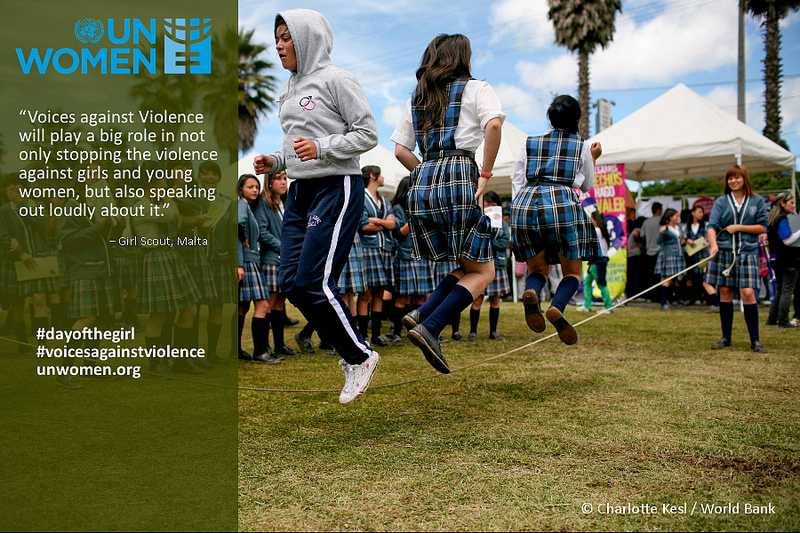
"The new curriculum stems from the understanding that prevention should start early in life, when values and norms around gender equality are formed, by educating girls and boys about respectful relationships and gender equality. Effective prevention efforts entail a cross-generational approach, working within schools and communities, and providing young people the tools they need to challenge gender stereotypes, discrimination and violence."
On the occasion of the International Day of the Girl Child, UN Women (the United Nations Entity for Gender Equality and the Empowerment of Women) and the World Association of Girl Guides and Girl Scouts (WAGGGS) launched this non-formal co-educational curriculum on ending violence against women and girls, putting young people at the heart of prevention efforts. Designed for various age groups ranging from 5 to 25 years, "Voices against Violence" provides girls, boys, young women, and young men with tools and expertise to understand the root causes of violence in their communities, to educate and involve their peers and communities to prevent such violence, and to learn about where to access support if they experience violence.
According to available data, 1 in 3 women and girls worldwide experience abuse in their lifetime. Violence against women and girls is the most pervasive human rights violation. Gender-based violence starts early, and girls and young women are particularly vulnerable. Over 50% of sexual assaults are committed against girls under 16 years. Globally, 1 in 3 girls are married before the age of 18, and 1 in 9 before they turn 15.
In that context, the curriculum handbook is designed to help peer educators deliver age-appropriate sessions through non-formal educational activities. The youngest groups may start out with storytelling and games that prompt them to think about gender bias and stereotypes, while older age groups can organise poster competitions, visit and volunteer with local shelters, and/or develop local community-based campaigns and projects to address specific forms of violence against girls and women. From the handbook: "Participants can use their knowledge and skills by speaking out and taking action to raise awareness on the important role their communities play in protecting the rights of girls and young women."
SECTION ONE introduces the curriculum.
SECTION TWO provides the group leader with a preparation checklist that will help him or her to get ready for delivering the curriculum, including conducting a risk assessment to assess the impact on the community and to deliver the curriculum safely.
SECTION THREE includes factsheets, guidance, and tools to help the leader develop his or her knowledge and skills to deliver the activities.
The curriculum also includes age-specific sections with non-formal education activities, which are made available to those interested in and capable of implementing the curriculum. Working with youth organisations, UN partners, and governments, UN Women and WAGGGS are rolling out the curriculum to young people around the world. It will be adapted to national contexts, translated into local languages, and reach an estimated 5 million children and young people by 2020. Members of the Girl Guiding and Girl Scouting Movement can earn a "badge" by completing a set of 6 age-appropriate sessions from the curriculum.
- Click here to view a related Flickr album: Voices against Violence Curriculum for International Day of the Girl Child.
- Click here for more information on Voices against Violence.
124
Press release sent from UN Women to The Communication Initiative on October 10 2013; UN Women website, February 5 2014; and email from Urjasi Rudra to The Communication Initiative on February 5 2014.
- Log in to post comments