










































Walking the Path of Unity - A Film for Social Change
The process of getting the entire community of Diégoune to agree to a new tradition — that of not cutting - firstly involved the participation of roughly 60 community members in Tostan's Community Empowerment Program (CEP). Simultaneously, there was the formation of Diégoune's Community Management Committee (CMC) and active outreach from Diégoune’s CMC to neighbouring communities. Then the class participants from the CEP travelled to neighbouring villages where they performed skits, sang songs, and recited poetry in order to share with their neighbours the themes and information that the Diégoune community members learned in the CEP. In addition, the process required careful organisation and outreach of numerous CMCs from Diégoune and neighbouring villages to unite all of the communities in the social network to also abandon FGC.
In the spring of 2008, the community went a step further in their effort to actively promote and protect the human rights of women and girls. Diégoune partnered with Tostan and Respect to create, Walking the Path of Unity, a film about the community’s decision to abandon FGC. The film was shot in and around Diégoune from May to October 2008 and gives a voice to key players in the movement for the abandonment of FGC in this area. From the rice fields to the central square of the village to the local mosque, men and women explain with pride the reasons and events that led to the community's decision to abandon a traditional practice that they came to understand was threatening the well-being of their children.
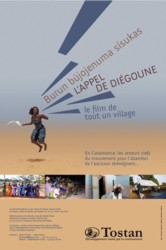
According to Tostan, what is unique about this film is not only the directors — which were Diégoune community members — but also the intended audience. While most films about traditional practices are created by outsiders to educate or inform audiences different from that of the subject of the film, Diégoune's film was created to share with other Diola communities why Diégoune chose to abandon FGC. The film, titled Buru bújojenuma sísukas (The Diégoune Call to Action: Walking the Path of Unity) is entirely in Diola, the language of Diégoune.
Since May 2009, Walking the Path of Unity has been shown every evening in a different village in the Casamance region. Cinema Numérique Ambulant, an organisation with experience in providing mobile cinema to remote communities, provided training to Tostan's staff who travel to each village to project the film. The showing begins with the black and white comedy sketches by Buster Keaton. For most viewers, the film screening is the first time they have ever seen a movie on a big screen. The funny skits of Buster Keaton are meant to create a relaxed atmosphere in which to address the issue of FGC. After the comedy skits, Call to Action opens with a deep voice well known in the Casamance, Bacary Tamba, a Diola leader who led the Tostan programme in the region ten years ago.
According to Tostan, Walking the Path of Unity illustrates a respectful, community-based, non-judgmental methodology. The film does not include offensive images or distant authorities in an attempt to scare or threaten communities into change. Instead, the film shares the individual stories and perspectives of ordinary people: a mother, a father, an Imam, a teacher, a doctor, a husband. The experiences shared by these individuals are all familiar to Diola communities and that familiarity contributes to the film's ability to create a starting point for the dialogue and public debate necessary to bring about a large-scale, permanent change.
At each projection, at least one person featured in the film, as well as social mobilisation leaders who took part in the Tostan programme, present the film and lead the audience in a group discussion after the showing. Informal dialogues, such as these, help to build consensus and encourage communities to raise issues and identify their own solutions. Like the film, the discussions that follow showings are framed by the fundamental values of people, such as health, unity, and solidarity.
Click here to read a detailed account of a screening in the village of Diacoye Banga (PDF document).
Diégoune’s vision for the reach of the film does not stop with the Diola communities in the Casamance. At the request of Diégoune’s residents, Tostan France is helping to show Walking the Path of Unity in cities and towns in Europe where Diola families are living. The goal in doing this is to enable the entire Diola community, wherever they are, to participate in the collective decision to protect the welfare of their children.
Children, Women, Rights
Cinéma Vérité has selected Walking the Path of Unity for the 2009 International Tribute in Paris and Geneva. The film was shown during this tribute to illustrate Millennium Development Goal (MDG) number five: to improve maternal health. In the fall of 2009, UNICEF organised the 20th anniversary of the Convention on the Rights of the Child with an international film festival to take part in all of its committees and offices. Walking the Path of Unity was selected to be screened in several countries in Europe, Africa, and the Americas to demonstrate the strength of collective decisions for social change and the protection of the rights and health of girls.
For 30 months, beginning in 2007, the village of Diégoune has benefited from the Community Empowerment Program (CEP), developed by Tostan over the past 20 years. Conducted in national languages, the CEP is a holistic, nonformal education programme designed to raise awareness and promote sustainable change within communities. It is aimed at adults and adolescents who often have not attended formal school, and trains them to become agents for the development of their communities. In the participatory classes, a facilitator from the area uses traditional African methods of communication (theatre, poetry, songs, stories), to inform participants about human rights, democracy, the problem-solving process, hygiene, health, literacy, basic math and project management. A fundamental strategy of the CEP is the organised diffusion of knowledge, whereby a group of informed individuals share new information learned in the classroom with others in the community. In addition, villages that host the CEP reach out to surrounding communities through inter-village meetings. The movement towards the abandonment of female genital cutting was born as a result of the Tostan programme, but the CEP impacts many aspects of life: hygiene, health, leadership, citizenship, community harmony and economic capacity.
The Swedish International Development Cooperation Agency (SIDA); Cinéma Numérique Ambulant (CNA); the Respect association; Tostan France; United Nations Children’s Fund (UNICEF); and the Wallace Global Fund.
Tostan website on August 24 2010.
- Log in to post comments