










































We Beat TB Campaign
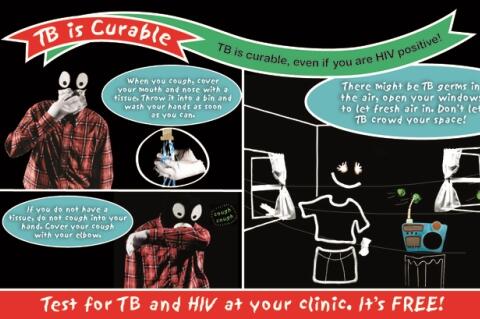
The We Beat TB Campaign is working to combat tuberculosis (TB) in South Africa through multi-media and community level interventions as a part of the National Department of Health's Kick TB strategy. The campaign used radio, television, and outdoor advertisements featuring dancing cartoon characters to communicate information about TB prevention and treatment. The campaign was developed by Johns Hopkins Health and Education in South Africa (JHHESA), as part of the TB South Africa programme being led by University Research Co., LLC (URC) and funded by the United States Agency for International Development (USAID).
We Beat TB is an advocacy, communication, and social mobilisation campaign designed to support URC’s work to strengthen TB initiatives at the national, provincial, and district levels, as well as strengthen the health system to manage the pressures exerted by the HIV and AIDS epidemic. Three television public service announcements (PSAs) were produced in several languages and broadcast on the national TV broadcaster. Radio PSAs were also produced. The campaign had four media bursts on national TV and radio stations: November 2009 to January 2010; March 2010 to April 2010; October 2010 to December 2010; and July 2011 to September 2011.
The intended audiences for the adverts were urban, peri-urban, and rural South Africans of all ages, particularly those between the ages of 16 to 64, from low to middle income households. The mass media component of strategy was implemented at national level, whereas community mobilisation activities were implemented at provincial and district levels.
The television PSAs were field tested prior to broadcast and findings were used to revise adverts and scripts. The key messages of the adverts were as follows:
- Infection control: Open your windows and cover your cough - Messages: open the window, cover your cough, and wash hands after coughing or sneezing to prevent the spread of TB.
- Treatment adherence: Take 180 doses to be number one okay - Messages: Complete the full course of treatment to be cured of TB; "180 to be number one okay".
- TB/HIV co-infection: TB is curable even if you have HIV - Messages: TB is curable even if a person is living with HIV; get tested for HIV and TB.
Click here to view to access the radio, television, and poster advertisements.
Tuberculosis, HIV/AIDS, Health
A post broadcast evaluation was conducted five months after the adverts were last broadcast on TV. The evaluation found that the advert "Take 180 to be number 1 okay" was well remembered and seen across the various localities. The advert was generally described as "the advert with the dancing cartoons," perceived as attractive, appealing, and attention-grabbing. The inclusion of dance was said to communicate a positive message about TB. Focus group participants reported four messages from this advert. Overall, the common message or lesson and the one most often reported as taken from this advert was the importance of completing the full course of TB treatment. The second most common message among focus group participants was that TB treatment needed to be taken for 180 days.
According to the evaluation, the advert on TB/HIV co-infection generated a strong response, and critical engagement with and debate over features of the animation. Multiple messages were derived, including: how TB impacts the immune system destroying your "balance"; everyone is vulnerable to TB infection; and you can be cured of TB if you are HIV positive. Overall participants liked the ad and found positive meaning in it. Some participants struggled to remember the advert during unaided recall, but after aided recall additional meanings were found. The final advert, Open your windows and cover your cough, overall was well-liked, although engagement was not as strong as with the other two adverts. Key messages centred on infection control through opening your windows and covering your cough, and also the importance of supporting someone who has TB rather than ostracising them. In some groups there was poor unaided recall, especially of key features such as the hand washing action. Some participants said they did not derive anything new from the ad, having been exposed to this information from past campaigns.
Johns Hopkins Health and Education in South Africa (JHHESA), University Research Co., LLC (URC), and United States Agency for International Development (USAID).