










































What Drives Health Professionals to Tweet About #HPVvaccine? Identifying Strategies for Effective Communication
Drexel University (Massey, Budenz, Klassen); Thomas Jefferson University (Leader); Association of American Medical Colleges (Fisher); Microsoft Research Israel (Yom-Tov)
"Disseminating and communicating information on new scientific evidence that supports the HPV vaccine is important to strengthen uptake, and an opportunity exists to better synchronize dissemination of scientific evidence with national awareness days to maximize potential reach and impact."
A key predictor of human papillomavirus (HPV) vaccine uptake is a health professional's recommendation. As more parents and health professionals are turning to online resources for health information and communication, there is an opportunity to address barriers and misinformation through social media. This study adds to a growing body of literature quantifying the use of Twitter to communicate health information, with a focus on characterising and quantifying 3 types of Twitter messages related to the HPV vaccine: 1) tweets sent by health professionals, 2) tweets intended for a parent audience, and 3) tweets sent by health professionals and intended for a parent audience.
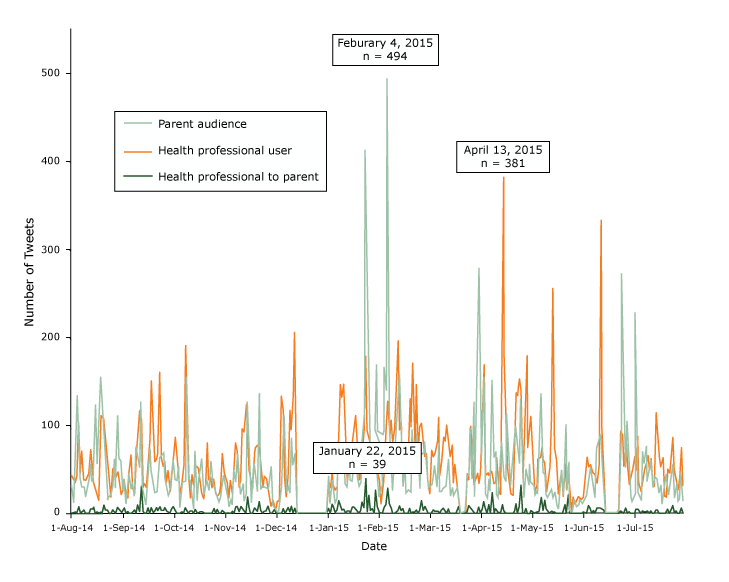
The researchers used data mining software to access the Twitter Search API to collect prospective data. They defined inclusion criteria as tweets that contained any of 5 search terms related to the HPV vaccine ("HPV", "HPV vaccine", "HPV shot", "Gardasil", and "Cervarix"), as well as the 5 corresponding hashtags. The final data set contained 193,379 English-only tweets collected from August 1 2014 through July 31 2015; it included both original tweets and retweets. They operationalised their 3 subsample tweet types using the following study variables: 1) type of user = health professional; 2) target audience = parent; and 3) type of user = health professional AND target audience = parent (consisting of an overlap of the first 2 categories). For each type of tweet, they identified the period with the highest volume of tweets (or "spikes"). To examine activity surrounding these spikes, they considered 3 days before and after each spike, totaling a 7-day period.
Of the 193,379 tweets, 20,451 tweets were from health professionals, 16,867 tweets were intended for parents, and 1,233 tweets overlapped both groups. The largest spike in tweets from health professionals (n = 851) focused on communicating recently published scientific evidence. Most tweets were positive and were about resources and boys. The largest spike in tweets intended for parents (n = 1,043) centred on a national awareness day and were about resources, personal experiences, boys, and girls. The largest spike in tweets from health professionals to parents (n = 89) was in January and centred on an event hosted on Twitter that focused on cervical cancer awareness month.
The use of Twitter engagement features, including links, mentions (@), and hashtags (#), also differed across the 3 spikes. For example, in the health professional spike, most tweets included one link (66.3%), whereas most tweets in the other spikes did not include a link. Many of the links in the tweets were links to news stories in the popular media that covered a recent scientific publication, rather than the original publication. The use of links to news stories may be due to the ease of linking a popular news source to Twitter messages (e.g., by clicking a "share on Twitter" button), as well as the fact that many peer-reviewed articles are only accessible if a subscription is paid. Future studies may consider the impact of disseminating a popular news source that reports on a new study versus the original peer-reviewed article of the study. This consideration is particularly relevant in an era marked by the proliferation of online fake news.
Tweets in the health professional spike also included far fewer hashtags than the other 2 spikes, which could lead to less exposure or engagement with a wider audience. One way users are exposed to tweets is that a user must follow another user to see their tweets. However, additional avenues for exposure and engagement exist, including users searching for key words on Twitter or clicking on a hashtag that is a topic of interest. This indirect exposure strategy, which uses different engagement features on Twitter, may decrease the likelihood of creating "echo chambers", whereby health professionals may be tweeting only to other health professionals (i.e., their followers).
In 2 of the 3 spike periods, nearly all of the tweets were retweets, a much higher percentage than in the full sample of tweets. These data suggest that behaviours during awareness days and national campaigns may differ from general use behaviours, and capitalising on the "retweet" phenomenon during these spike events could lead to a heightened level of interest and engagement in the topic area.
As noted here, Twitter chats may be effective in connecting health professionals and parents around a health topic such as the HPV vaccine. In this study sample, many of the tweets in the spike during Cervical Cancer Awareness Month did not explicitly mention the HPV vaccine, which may have been due to the fact that much of the spike was driven by a hosted chat event that focused on cervical cancer awareness, and the HPV vaccine was mentioned but not discussed during the chat.
The researchers suggest that, in addition to syncing communication messages with seasonal events, health professionals could consider personalising scientific evidence. Also, studies have found that the most persuasive messages from physicians to parents are straightforward and strong, such as "your child could get cancer as an adult, but you can stop that right now", as well as messages that take an "announcement" approach that may normalise the vaccine, as compared with a "conversation" approach that may be less effective in mitigating hesitancy.
Certainly, most research to date has documented the importance of a physician's recommendation in the context of a clinical encounter, that is, a face-to-face interaction. A gap remains in understanding how a physician's recommendation contributes to vaccine uptake in a virtual space, particularly in the social media environment. It is possible to conclude, though, that there is the potential for health professionals and health organisations to use social media to disseminate important information and evidence in a more strategic way, maximising reach and impact, with the ultimate goal being higher rates of vaccination.
Preventing Chronic Disease 2018;15:170320. DOI: http://dx.doi.org/10.5888/pcd15.170320.
- Log in to post comments