










































The World Bank Live: A Model of Marketing Success, But Is It the Right Model?
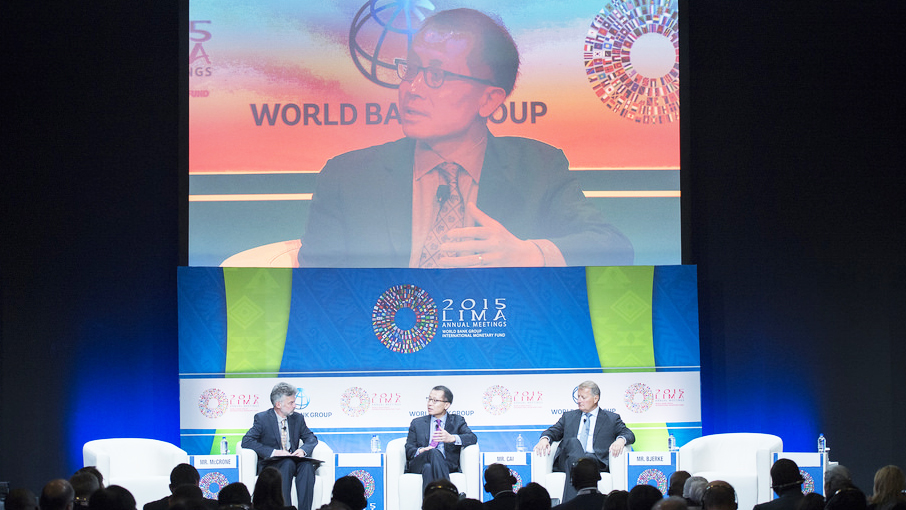
"With a stated mission to end poverty by 2030, the Bank should be motivated to rethink how it shares knowledge via webcasting and how it influences development outcomes via its online engagement."
Published by the Bank Information Center (BIC), a civil society organisation (CSO) that monitors World Bank activities, this paper critically examines World Bank Live (WBL), the institution's video content platform which is designed to be conduit for sharing information to the public. "WBL's model of marquee lineups of development figures featured in well publicized events raises important questions: Is this the only or even the most appropriate use of WBL to share knowledge with its stakeholders? Would an adjustment in WBL's emphasis make it a more effective instrument in achieving [current Bank] President [Jim] Kim's vision of a solutions bank? Would a new model for WBL put less stress on the Bank's finite resources?"
To explore these questions, author David Shaman explains that, while the primary audience of the World Bank's knowledge creation and sharing is internal, over the past half-decade, the Bank has made efforts to open itself to the public such as through WBL. WBL began operation in 2003 but only offered a few dozen webcasts to the public during its first 9 years. In 2011, WBL's volume began to grow in response to a coalition of civil society actors who petitioned then-President Robert Zoellick to invest in B-SPAN, a defunct webcasting system launched by the Bank in 2000. Following a second coalition letter to President Kim in early 2014, WBL's volume more than doubled over the next 12 months. Yet as pressure from external stakeholders grew to increase WBL content volume, the Bank responded by focusing WBL to feature senior officials; since assuming his position, President Kim has been the featured participant on more than one-third of WBL's webcasts. This provides a marked contrast to the model deployed by B-SPAN, which actively sought to decentralise content sources, and the vast majority of event hosts were lower-ranking Bank officials directly involved in project implementation and research. While WBL invests heavily in promoting live events, B-SPAN's model allowed it to offer coverage that was far more diverse and inclusive and at far less cost.
Shaman argues that "[k]nowledge sharing is as much about receiving knowledge from stakeholders as it is about sending information. In the end, giving more opportunities for external stakeholders to watch, learn and provide feedback will make the Bank a more effective instrument." In that spirit, he suggests that traffic metrics may not be an appropriate measurement for the value of content shared and undermine the ability of viewers to make this determination. "The value of its knowledge may not always be obvious or immediately assessed. Some parts of the Bank and some stakeholders will value high-profile, carefully orchestrated and targeted video content that seeks to maximize audience interest and message penetration. However, other parts of the Bank and we think most stakeholders will value in-depth knowledge sharing and learning from niche events that may enjoy less audience per event but may more powerfully influence development outcomes." He notes that the Bank hosts hundreds of policy dialogues during the year focused on the institution's repertoire that are invaluable to the development community but are not shared online.
Shaman also recommends that WBL's model of live webcasting shift to a model that primarily features on-demand webcasting. An on-demand model would allow WBL to vastly reduce webcasting expenses and will enable it to increase coverage and make the system far more diverse and inclusive. For example, WBL could add a plethora of content offerings available from the Civil Society Forum during Bank-Fund meetings, the Development Economics Vice Presidency's research brown bags, InfoShop events, and other events held daily. "An increase in volume and decentralization of sources would provide notable and tangible internal benefits as well: increased engagement with the Bank's resident missions; reduced staff and guest travel costs; more opportunities for staff to build networks of influence with external networks; more content offerings for the institution's pedagogical activities; and elevated digital metrics for the Bank's social media channels, blogs and websites."
In conclusion, Shaman says: "The Bank's stated goal is it wants to improve stakeholder engagement, because it recognizes that it must partner with stakeholders to achieve development objectives. Therefore, it must invest in them more strategically. Concurrently, stakeholders want to increase access to the Bank's knowledge because they see it as vital in achieving successful outcomes. A revised model for WBL is an opportunity to achieve both objectives simultaneously."
Email from David Ian Shaman to The Communication Initiative on June 2 2016. Image credit: Korina Lopez, World Bank
- Log in to post comments