










































Y-PEER (Youth Peer Education Network)
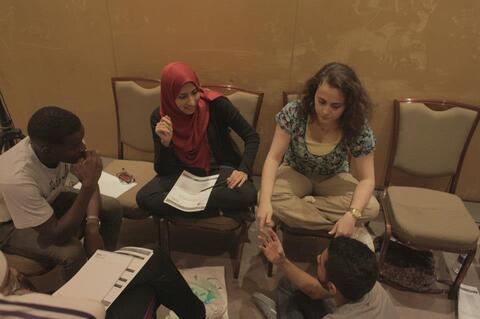
Broadly, youth peer education is an approach whereby well-trained and motivated young people actively attempt to ensure that their peers have the optimal knowledge, attitudes, beliefs and skills to be responsible for, and to protect, their health and well-being. Peer education can happen in small groups or through individual contact, can be formal and/or informal, and can take place in a variety of settings. For instance, trained young volunteers working with the Romanian non-governmental organisation (NGO) Youth for Youth Foundation have engaged in such actions as standing outside the main entrance to Bucharest's Polytechnical University handing out information on reproductive health and safe sex. The young trained volunteers stop students on their way to and from classes and ask them if they would like to win a free prize by answering a question. The questions, all on reproductive health, sexuality and preventing STIs and HIV, are printed on strips of paper. If the student gets the right answer, the prize is a free condom.
Y-PEER is an initiative to connect young people who are engaged in these types of efforts. The network is based on person-to-person meetings and electronic communications via an interactive web site, as well as providing access to national and international listservs. It also offers computer-based distance learning courses, sponsors annual national and international training events, campaigns, workshops, and video-conferences, and produces tools related to peer education, youth-adult partnerships and youth advocacy. The goal is to promote youth participation in sexual and reproductive health issues and in build partnerships between young people and adults.
Training events planned in locales around the world draw on a number of different strategies. For example, a Y-PEER Theater Based Peer Education Training scheduled to take place in March 2007 in New Paltz, New York (United States) was expected to build the capacity of selected experienced trainers of trainers (ToT), as well as certified Y-PEER trainers, to plan, design and deliver high quality theatre-based peer education training programmes in Eastern Europe, Central Asia, and the Arab States. Organisers anticipated that the weeklong training would result in the establishment of a cadre of Y-PEER certified Theater Based Peer Education Trainers.
Collaboration with youth-oriented mass media and celebrities is another strategy shaping Y-PEER. For instance, a "Youth Pop Culture, Media and HIV/AIDS Workshop" scheduled to take place in Istanbul, Turkey (April 9-12 2007) was expected to provide the opportunity for Y-PEER, MTV (Music Television), and UNFPA - together with journalists and celebrities - to explore and develop plans for action and partnership. This event was planned in the context of a large inter-regional multimedia campaign taking place in 2006/2007 through which UNFPA's Division for Arab States, Europe and Central Asia and MTV have crafted a region-specific, youth-oriented media campaign. This campaign is using what is described as a gender-sensitive approach to programming to raise awareness about women's empowerment, decision-making about family planning, condom use, violence against women, and the role of men in gender equality. Specifically, MTV is designing 3 multi-media public service announcements (PSAs) for video and cell phones; on-air spots promoting the interactive Staying Alive website, which will be available in Arabic and Serbian, are also planned. MTV will design, develop and brand promotional materials to fit the look and the feel of the overall campaign in 10 languages, and will launch it at various public "red carpet" events.
Information and communication technologies (ICTs) are used to share details about Y-PEER and other organisations' upcoming and past training events and campaigns such as those highlighted above, as well as to connect youth peer educators with each other and share information and resources that may be helpful to their work. Specifically, the interactive Y-PEER website includes sections such as the following:
- Several interactive spaces designated to help establish conversations between peer educators on regional and country levels. Through this communication tool, peer educators are invited to share experiences, feelings, thoughts, lessons learned and good practices.
- Access to resources, lesson plans, advocacy materials, distance learning courses, and details about events focused on peer education among young people, and on topics related to their health and well-being. To cite one example of the publications available here, the main Y-PEER manual has been translated into 15 languages, including Armenian, Azerbaijani, Estonian, Georgian and Lithuanian; this is part of a strategy for reaching out to young people in their native languages, which organisers believe can be crucial when dealing with sensitive, nuanced subjects and when trying to communicate with adolescents who may be out of school or marginalised for other reasons.
- "Peer Classroom", a searchable knowledge database covering a range of issues related to peer education, from factual information on content areas (e.g., sexual and reproductive health, HIV/AIDS and substance abuse), to more methodological issues (e.g., suggestions for games, ice-breakers and other interactive techniques or guidelines on planning and implementing peer education programmes.) Visitors who cannot find an answer to their particular question (about peer education issues) are invited to email questions through the "Ask the Expert" section; an advisor will personally answer and post the answer online.
- A tool through which one may browse youth peer education "experts" by country, language spoken, or expertise (master trainers, trainers of trainers, peer educators); the focus here is on the Eastern Europe and Central Asia region.
Youth, Adolescent & Reproductive Health, HIV/AIDS.
The development of Y-PEER is one of the activities of the Subcommittee on Peer Education of the United Nations Interagency Group on Young People's Health Development and Protection (IAG). This subcommittee was established in 1999 and has - to date - provided support to peer education in 27 countries in the Central and Eastern Europe, Commonwealth of Independent States, the Baltic States and Central Asia through sub-regional training workshops, advice on project development and educational materials, and through dissemination of information and exchange of experience and good practice.
Before the project was launched, an extensive needs assessment was carried out. This provided a detailed inventory of 185 peer education initiatives in Eastern Europe and Central Asia (most were started by non-governmental organisations (NGOs) and work with both young women and young men) and identified technical support needs. The results showed that there were few evaluation mechanisms in place, few training manuals, a lack of consistent funding and no knowledge-sharing or support networks. Based on the assessment, the project took shape as 5 major interconnected elements: training, developing regional networks, mobilising national networks, using information technology, and developing peer education training tools. Since its inception, the network has expanded to include youth from outside of this region.
"Experience shows that youth-to-youth programmes are much more effective in delivering the right messages on health in general and HIV/AIDS prevention in particular to both in-school and out-of-school youth," in the words of Inga Akisamitauskaite, a peer educator and member of Y-PEER from Lithuania. "Once young people are motivated and engaged in fighting STIs, including HIV, progress in reducing infection rates can be rapid and sustained."
Development Gateway Foundation's dgCommunities: HIV/AIDS, December 12 2006; UNFPA website; Y-PEER website; and email from Nazim Benchikh to The Communication Initiative on May 31 2007.
- Log in to post comments