










































Young and Restless: Harnessing the Economic Resilience of Displaced Youth in Nairobi
Women's Refugee Commission
"Refugee youth report that education and training, as well as personal security, are their highest priorities."
The Women's Refugee Commission reports on young people displaced in Nairobi, Kenya, who "have little knowledge of their rights, of refugee laws and policies or of the few programs that exist to assist them. Very few refugee... youth - perhaps fewer than 500 individuals citywide - access any kind of economic strengthening program." Because, as stated in the research, displacement has often been found to destroy livelihoods (defined as the capabilities, assets, and strategies that people use to make a living), refugees are often left with insecure and unsafe activities for economic survival. In this joint (with the International Rescue Committee) field assessment, the organisations aimed to identify factors and determine what are existing services that increase resilience of displaced urban youth.
Using a semi-structured interview tool, youth aged 15-24 were asked about their daily activity patterns, the livelihood strategies employed by their households, and the opportunities and challenges in their quest to earn a living. "Interviews were also conducted with representatives of 18 organizations that provide livelihood services for displaced youth or that advocate on their behalf." Recent literature was reviewed as well.
"Many of the youth in the sample clearly lack such basic information as what mechanisms they could employ to earn a livelihood and what skills they would need to match labor market demand....After education/training, youth said they need help obtaining their official refugee status." Non-governmental organisations (NGOs) work to help satisfy youth needs, for example, the Family Health Options Kenya (FHOK) Eastleigh Youth Center which provides a relaxed environment with pool tables, a gym, and a health clinic run by young people, providing life skills, access to reproductive health services, vocational training, small business development services, and educational theatre.
Social networks can be particularly useful to refugees, but some groups have limited access to informal associations or self-help groups, outside of attending a mosque. Youth interviewed indicated that they needed safe spaces to talk to peers about problems, ask for help, borrow money, develop relationships with mentors, expand social networks, and build self-esteem. Further, problems exist in the process of obtaining refugee status and permits for work and business.
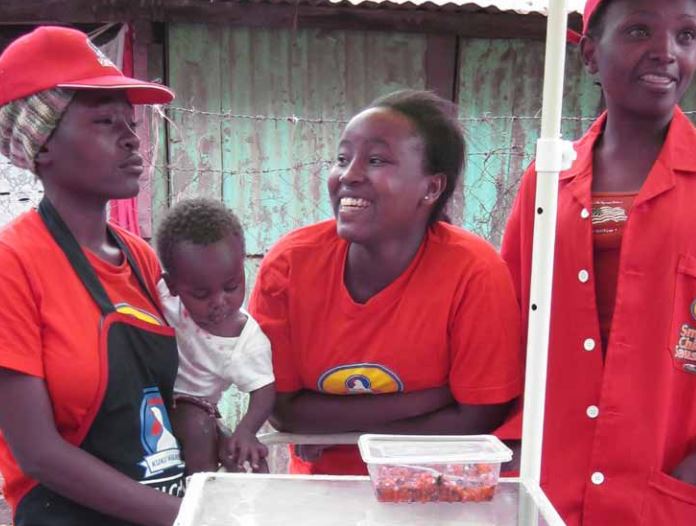
NGOs work on setting up micro-franchises and on training for micro-enterprise. An example of a business programme is Girls Empowered by Micro-franchising (GEM), which is fundedf by Nike and supported by NGOs working with refugee females aged 17-19 for the creation of "scaled-down versions of existing successful businesses using proven marketing and sales techniques," with supplies and training from Kenyan firms for youth in sales teams selling hair products, food, and solar lighting. Further, working on micro-business training, Il Comitato Internazionale per lo Sviluppo dei Popoli (CISP) "specializes in business development services that engage beneficiaries over a year or more, monitoring grantees in groups and focusing on 'mindset change' to get people thinking more entrepreneurially. CISP has established drop-in business information centers to address the lack of knowledge among micro- entrepreneurs. Engaging mixed groups of Kenyans and refugees, CISP also facilitates the creation of clusters of businesses for the purpose of networking, each of which holds a conference at the end of the year with banks and public officials." A technology-related project is NairoBits, "a partnership of Kenyan web design firms and NGOs that offers practical training in multimedia, entrepreneurship, reproductive health and life skills to disadvantaged youth, including some displaced youth. The information and communications technology (ICT) curriculum is updated by active ICT firms to reflect trends in the employment market."
Demand for skills training is not as high as it could be - possibly, for females, due to family duties. The Jesuit Refugee Service (JRS) "helps clients find qualified skills training institutes in the areas in which they live, to cut down on the time and cost of transport. Many of the business JRS supports are home-based, which allows parents to care for their children while they work." Few service providers use sports to provide a platform for arousing youth interest in programmes, in spite of sports being the main leisure activity, at least among male youth.
The research concludes that a more comprehensive and longer-term approach to livelihoods support is needed for young women and men in Nairobi. It includes recommendations for ways forward and states that "[t]he new UN High Commissioner for Refugees (UNHCR) frameworks for urban livelihoods and education has the potential to help realize that goal."
Youth Economic Opportunities website, September 12 2013. Image credit: Josh Chaffin
- Log in to post comments