










































Risk Communication and Countering the 'Infodemic': UNDRR Asia Pacific COVID-19 Brief [and Webinar]
"Trusted, accurate, simple, and widely shared risk information saves lives, particularly when it reaches 'the last mile' and is used by vulnerable communities. This is the case in all communities, all countries and all disasters, including during the current COVID-19 pandemic."
This brief, developed by the United Nations Office for Disaster Risk Reduction (UNDRR), Regional Office for Asia and Pacific, highlights challenges and opportunities for effective risk messaging in the context of the COVID-19 pandemic. It provides examples of such risk messaging in action from the Asia-Pacific region and elsewhere, outlines the value of information and communication technology (ICT) in these efforts, and explains how "the currency of trust" is integral to all approaches. The brief reflects interventions and feedback from a UNDRR Asia-Pacific webinar held on April 30 2020, titled "Risk communication to Prevent the Spread of COVID-19: Countering the 'Infodemic'". Co-organised with World Health Organization (WHO), this webinar (described below) was the fifth in a series of webinars on COVID-19 hosted by UNDRR Asia-Pacific.
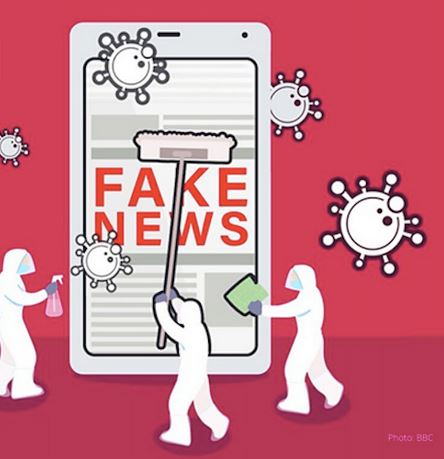
The brief opens with an overview of what the WHO Director-General Dr.Tedros Adhanom Ghebreyesus has described as an "infodemic". In short, widespread access to mobile internet and social media, two technologies that were not common in past pandemics, has helped fuel the speed by which the misinformation fire has spread. Rumours that originate in one region quickly appear in repackaged forms in other regions. The wide dissemination of false information risks undermining the efforts of health and disaster authorities to share advice on how to prevent transmission of the disease, and it is encouraging - rather than reducing - risky behaviour. In the face of the infodemic, Dr. Ghebreyesus has implored: "This is a time for facts, not fear; for rationality, not rumours; for solidarity, not stigma."
UNDRR stresses that effective risk communication is a cornerstone of early and effective responses to stop the spread of COVID-19 and to save lives. However, in any risk communication campaign, messages may not reach the intended audience; even when the messages are received, they may not trigger the appropriate response. While communicating about the COVID-19 pandemic, officials need to overcome a number of challenges:
- There has been a rise of social media and unaccountable information sources - While official and reliable sources of information do exist on social media, the majority of accounts and shared content tend to be from unofficial sources that might offer unverified, misleading, or outdated information.
- Misinformation is difficult to prevent - One reason is that it sometimes has the support of credible voices such as community or religious leaders.
- One message does not fit all - For example, in the case of the Pacific, messages around frequent hand washing needed to be modified for the local context because, to some groups of people, they seemed to contradict earlier messages from the government about the need to conserve water.
- There are challenges associated with reaching the "last mile" - This includes reaching out to pockets of rual populations or those who live nomadic lifestyles, elderly individuals who speak "forgotten" languages, and people in abject poverty or who are homeless and lack any access to mass media or mobile technology.
- Communicating during an evolving crisis means information may be incomplete - The science underpinning the health advice is still evolving; the most notable point of confusion has been around the use of masks.
In this context, messages must be tailored and trusted and to rise above the sea of misinformation. Some recommendations include:
- Tailor the message for the audience - Key to triggering the desired behavioural response is developing an understanding of the needs and concerns of different groups to connect at a visceral level.
- Tailor the medium to ensure no one is left behind, and the "last mile" is reached - For instance, communicators should seek alternative approaches by consulting with community leaders and group representatives, exploring ways to reach vulnerable groups who may not have access to ICTs, such as public posters, loudspeaker announcements, and billboards.
- Actively counter misinformation - For example, BBC Media Action launched a 7-country campaign in Asia-Pacific, built around audience research to understand how to best package and deliver facts and misinformation rebuttals. One output of this campaign is the Thangyat traditional dance public service announcement (PSA), which was produced by BBC Media Action's Myanmar team and was viewed by millions of people on social media and television.
- Build your networks before the crisis ("currency of trust") - Governments need to build trust by exhibiting transparency around COVID-19 and by seeking to engage with communities. They can do this by partnering with civil society organisations, local leaders, religious organisations, or local celebrities. For example, in Fiji and the Solomon Islands, Oxfam was able to fact-check, facilitate, and adapt pandemic risk messages from ministries of health to the communities via established and trusted local networks, such as traditional leaders and faith-based organisations.
- Leverage ICT to its full potential - For example, South Korea used its preexisting cellular broadcasting service, which was built to transmit emergency text alerts for all hazards, to communicate to the public on COVID-19.
- Develop a communication strategy around COVID-19 recovery and exit plans - If recovery is months away, authorities should communicate the challenges and expected timeline for recovery to the public to manage expectations.
The webinar that inspired this brief convened representatives from the WHO, government (i.e. of Mongolia and of South Korea), the media (i.e., BBC Media Action), and civil society (i.e., Oxfam). The panel outlined: examples of effective messaging; how this information is reaching and helping to protect vulnerable communities; and what can be done to counter misinformation that could put people in harm's way. Click here to view the 1-hour video on Zoom.
UNDRR website, July 17 2020. Image credit: BBC
- Log in to post comments