










































Faces, Voices and Places
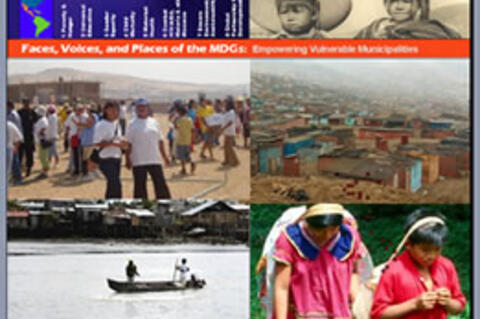
Faces, Voices and Places emphasises the importance of participation and cooperation in efforts to achieve the MDGs - particularly those related to health - in this region by 2015. PAHO contends that, whereas the global strategy for achieving the MDGs has centred largely around the measurement of national development averages and indicators, the strategy underpinning this initiative seeks to find ways to identify the most vulnerable municipalities and to involve communities in their own development processes.
To support this process, PAHO has created an action network that involves the ministries of health and other sectors, mayors from participating communities, civil society, non-governmental organisations (NGOs), and international agencies. This work involves coordinating actions amongst diverse institutions and sectors to integrate policies and programmes, linking national and local authorities in a common focus on equity in communities with the greatest risks and levels of neglect. A "community of practice" for Faces, Voices and Places has been developed through the use of information technologies. This tool is designed to bridge distances, reduce costs, and foster close collaboration among those working directly at the local level. By communicating "virtually", these practitioners can access technical knowledge, and bring it to bear on the resolution of community problems.
Projects in each participating country vary, but are unified in the commitment to create ways for community members to directly take part in identifying and recognising their problems, and developing and managing appropriate solutions. As detailed below, participatory research is a core part of the process that shapes the development of each project:
- Community selection and initial diagnosis: Communities are selected by Ministries of Health in collaboration with PAHO and World Health Organization (WHO) representatives, among others. As part of this process, an initial diagnosis takes place, and a baseline is developed.
- Participatory diagnostics: Based on the results of the situation analysis and the process of community organisation, a community participatory diagnosis takes place using the participatory action research (PAR) methodology. One goal is to assess the way in which the baseline survey was carried out.
- Defining key interventions: Commissions are created for each of the MDGs, in which community members, supported by experts, work to define, plan, and implement key interventions.
- Monitoring and follow-up: Monitoring instruments are created to evaluate progress and the impact of interventions and to support follow-up.
- Dissemination: Periodic updates are provided on the initiative's progress and on opportunities and remaining challenges to achieving the MDGs at the local, national, subregional, and regional levels.
Health, Economic Development, Rights.
According to organisers, more than 200 million people in the PAHO Region live in poverty and are not included in national averages. "We need to identify their places, see their faces, hear their voices....Although much progress has been made over the last few years in reducing poverty and extreme poverty, prospective studies using the Gini coefficient suggest that unless something is done, in 2015, the PAHO Region will continue to be the most inequitable region in the world."
As of this writing, Faces, Voices and Places is developing initiatives in over 30 communities/municipalities in 16 countries throughout the region.
Email from Agustin Alejandro Alcantara to The Communication Initiative on February 7 2008; "Faces, Voices and Places" [PDF]; and Faces, Voices and Places website.
- Log in to post comments