










































Strengthening Community Participation in Early and Pre-school Bilingual Intercultural Education (APEDIBIMI)

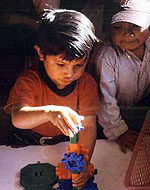
The APEDIBIMI methodology intends to optimise early education through the joint efforts of various actors including APEDIBIMI, the Guatemalan Ministry of Education the communities, and the United Nations Children's Fund (UNICEF). The Ixil indigenous area of the province of Quiché has 20 bilingual Ixil/Spanish nursery schools decorated with bright colours, drawings, and bilingual posters. When children come to school, each chooses one of three ‘corners’ identified in the classroom: language and communication; logical thinking; or artistic expression. After spending some time in these corners, they gather around for a ‘dialogue in chorus’ to openly express themselves. Both languages are spoken in the school by children and adults. Teachers are selected from the community. The parents are directly involved in the educational process, going over at home what the children have learned in the classroom and collaborating on making classroom toys or preparing school snacks.
UNICEF implements workshops to keep teachers updated, train mothers in early education, and deliver support materials. The programme trains mothers of children under three on the importance of early education, stimulation, and health care. Workshops include capacity building for health promoters and teachers and organised circles of interaction on themes related to the curriculum, including comparing it to the national standards.
Meetings of parents in the programme include local community leaders and elaborate what the community and parents can do to support the schools. These meetings also provide parents with guidance on how to support their children's education.
Education, Children
The project focuses on the geographic region called the Ixil triangle, identified by the centralised communities of Nebaj, Chajul, and Cotzal. In 2005, the project included 40 teachers, 25 health promoters, 1,771 children from 0-6 years old, and 700 parents. Community- and school-based projects included a festival of stories and legends for children, a document on the rights of children, an exchange of information and experiences among the promoters and teachers from all the communities, a student exchange of experiences for those entering first grade, and special attention for the needs of 34 youths. Parents met to make toys from local materials for the schools. The education ministry (MINEDUC) certified the teachers and registered the schools. MINEDUC is also involved with ongoing curriculum formation and provision of materials.
APEDIBIMI, UNICEF, Ministry of Education, Bernard van Leer Foundation, Volens/Itinerans, Global Fund for Children, Proyecto Ixil, Red de Información para el Pueblo (the Information Network for the People), Centro de Comunicación Comunitaria Ixil (The Centre of Community Communication Ixil), SERJUS - Servicios Juridicos y Sociales (Legal and Social Services), the Work Group.
The UNICEF website and the Volens America website, December 15 2010. Image: UNICEF Guatemala
- Log in to post comments