










































Children's Action for Disaster Risk Reduction: Views from Children in Asia
"Today's children and youth are the generation who will inherit the legacy of our actions and so their involvement is a crucial first step to ensure that actions to reduce risks are not only effective but sustainable for years to come."
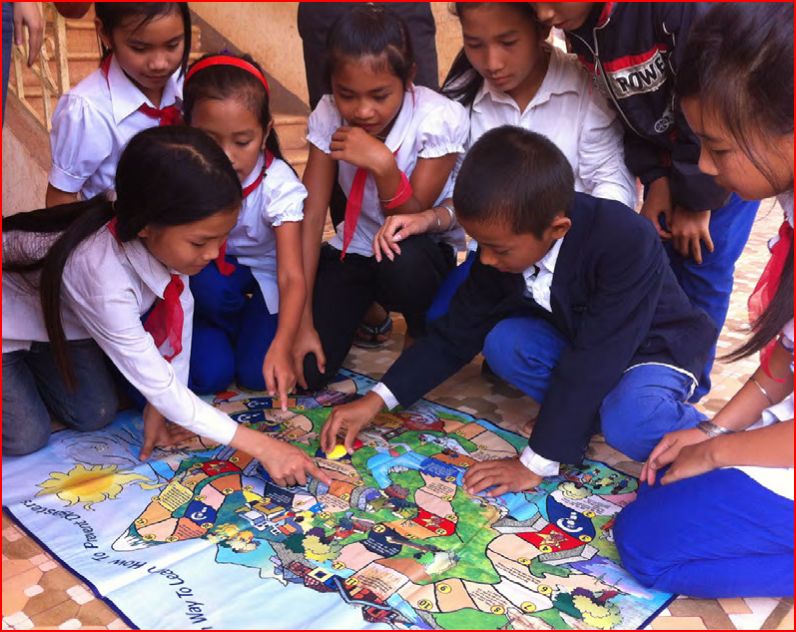
This publication seeks to document the perspective of children and young people from 7 Asian countries on how disasters and climate change affect their lives and their rights. It highlights their views on what they believe their role can be in addressing disaster risk reduction (DRR) and climate change adaptation (CCA) in their communities, as well as what they are expecting from their government, non-governmental organisations (NGOs), and the private sector. By presenting their own experiences of participating in DRR activities, it aims to highlight the capacity of children in order to inspire other children and youth, as well as encourage local governments, NGOs, and the private sector to support child-centred community risk reduction and CAA. The publication was co-funded by United Nations International Strategy for Disaster Reduction (UNISDR) and Plan International.
The publication is written by children and youth themselves. For example, in one essay, 14-year-old Mark, Child Leader from Eastern Samar, the Philippines, describes the right of children to participate in community capacity development from his own experience and perspective. In his words: "Last August 2011, I had the opportunity to join a consultation on Climate-Smart Disaster Risk Management. The purpose was to consult children on how our participation makes a difference in reducing the effect of climate change and disaster. During the discussion it was shared what the relationship is between the causes of climate change and a community who practiced cutting trees and then later experienced a disaster. We also discussed how to prepare and how to save ourselves when an extreme hazard event happens....The discussion emphasized the importance of children having this capacity and the need for us to be protected. When I went back to my village I discussed what I learnt with fellow children. The discussion ended with the plan to organize a 'DRR Texter Clan'. Using our mobile phone we send text messages about Disaster Risk Reduction, warning people of an incoming typhoon and preparedness to our friends who live in high risk areas. When a typhoon is coming, I forwarded text messages on the weather forecast shared by our DRR Project staff taken from the weather bureau....We also send tips on what to do during bad weather. Our initiative was appreciated by the people in our town. Our members reached to 95 youths who came from different barangays of Oras, Eastern Samar. After that our group committed to help other vulnerable children..."
Following the essays written by children and youth, the publication concludes with a list of documents and links on child-centred DRR and CCA.
Email from Caroline Borchard to The Communication Initiative on March 21 2013.