










































Theatre as Democracy: Staging South-South Dialogues
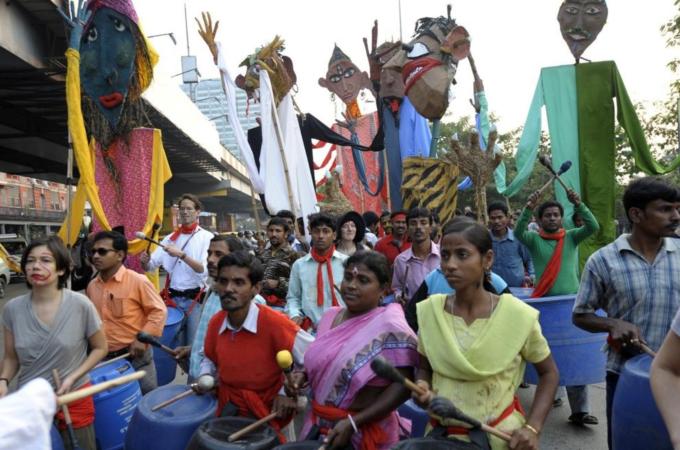
"There are many ways to activate democracy. The question is which ones actually generate social change. Theatre forums are efficient tools to design better politics."
This opinion piece tells the story of a theatre form developed by Augusto Boal in Brazil taking root in rural areas of West Bengal, India - which, to author Manuela Picq - "shows the meaningful cultural exchanges that are happening within the so-called Global South without triangulating through the Global North." As detailed here, Augusto Boal developed the Theatre of the Oppressed in the 1970s, when Rio de Janeiro's art scene was under military surveillance. Picq explains that, instead of didactically telling people what to do and struggle for, Boal wanted to create a platform for people to tell their own stories. These "spect-actors" have an opportunity to intervene through a theatrical space where participation is encouraged to foster critical thinking.
Founded in 1986, Bengali theatre company Jana Sanskriti has brought the Theatre of the Oppressed to villagers across West Bengal, reaching about 40,000 spectators in 24 districts. People travel long distances at day's end to act, sing, and dance, discussing community matters as they take turns to intervene on stage. Building on Boal, Sanjoy Ganguly, the founder of Jana Sanskriti, likes to speak of "spect-activists". His purpose is to inspire spectators - who witness their own actions on stage - to become "act-ivists" off stage. "We rehearse the revolution on stage," he says." Picq explains that all participants are not professional actors, but "all believe in the contribution of art for social change and the possibility to tackle issues like immigration, domestic violence, or food security through theatre." Over half of the actors in villages are women, and 10 out of 30 satellite teams established by Jana Sanskriti are run only by women.
One of the results of Jana Sanskriti forums is the Human Rights Protection Committee, created by a village in 2001.
Picq concludes that, "[b]eyond its local impact, the best part in the story of a political theatre invented in Brazil and appropriated in India is the interaction it engenders among countries of the Global South. It means that it is possible to dialogue directly without the mediation of Western conventional knowledge."
Aljazeera website, July 26 2013.