










































As Madiba leaves us: Tribute to Nelson Mandela
Author: Steve Kibble, originally posted December 6 2013, cross-posted January 13 2014 It must have been sometime in the '90s when Nelson Mandela addressed a massive crowd in Trafalgar Square from the balcony of South Africa House where many had demonstrated in previous years. "I would like to put you all in my pocket and take you home with me," he told his cheering supporters.
There was also the time when he came on stage at Wembley for (I think) his 80th birthday and the crowd wouldn’t let him speak, instead singing 'You’ll Never Walk alone' for about five minutes. I got the impression he loved it. A great one term president - a truly democratic leader who stepped down after his term, unlike so many other African leaders who seek to hold onto power forever…
My mind went back to the mid-1980s when I was in Crown Mines in Joburg at a National Union of Mineworkers party, where the then illegal 'Free Nelson Mandela' song was put on the turntable, cranked up to full volume and we all 'toyi toyed' to it.
CIIR [Catholic Institute for International Relations] (as Progressio was then known) worked hard behind the scenes, and to some extent in the forefront, of the struggle against apartheid but always as an independent voice and never really part of the uncritical solidarity movement, although sharing a lot of the values.
That story is told elsewhere in many publications* and in the history of Mildred Nevile as previous General Secretary of CIIR. One perceptive moment stands out when my South African colleague, suspecting future problems, suggested that instead of the picture of Nelson and Winnie (Madikizela) Mandela being on the front of our then magazine CIIR News, we just put Nelson.
In 1994 I was an EU [European Union] election observer in the Little Karoo region and we had a glimpse of several faces of South Africa. White supremacists blew up a building in Jeppe Street in Joburg as a protest against multiracial elections, whilst in a sleepy one horse dorpie in the Little Karoo, when our team of election observers turned up, there were no voters waiting to vote and a full game of cricket going on between ANC [African National Congress] and National Party agents and supporters. Somewhat reluctantly they abandoned the game...
Fellow South African leader Desmond Tutu said of Mandela: "He made us walk tall." South Africa was lucky to have two world class heroes at the time in Tutu and Mandela despite their faults.
I never even met the bloke despite being very close on occasion. After being an EU election observer I completely abandoned neutrality and thanks to a CIIR contact wangled my way into the ANC victory party. Grabbing a few beers from the bar, I saw Joe Slovo approaching with Mandela. Giving a beer to Joe Slovo, I got a big grin from Madiba. That was it but it was terrific.
Bye Madiba we will miss you.
___________
Nelson Mandela was released from prison in 1990 and led the African National Congress to victory in South Africa’s first multiracial election in 1994.
*A selection of titles published by CIIR in the 1980s:
South Africa in the 1980s: State of emergency (1980; further editions 1983, 1986, 1987)
War and conscience in South Africa: The Churches and conscientious objection (1982)
The South African disease: Apartheid health and health services (1984)
Report on police conduct during township protests (1984)
Vukani Makhosikazi: South African women speak (1985)
Whose Rubicon? Report of a visit to South Africa by representatives of the British Churches (1986)
The scope for sanctions: Economic measures against South Africa (1986)
Cries for freedom: Women in detention in South Africa (1988)
No life of my own: An autobiography by Frank Chikane (1988)
Out of step: War resistance in South Africa (1989)
Rule of fear: Human rights in South Africa (1989)
Fruit of the vine: The human cost of South African wine (1989)
Sanctions against apartheid (1989)
Titles published in the 1990s include:
South Africa: Breaking new ground (1996)
The people’s conscience? Civil groups in the South African and Guatemalan transitions (1997)
South African NGOs: The path ahead (1998)
From truth to transformation: The Truth and Reconciliation Commission in South Africa (1999)
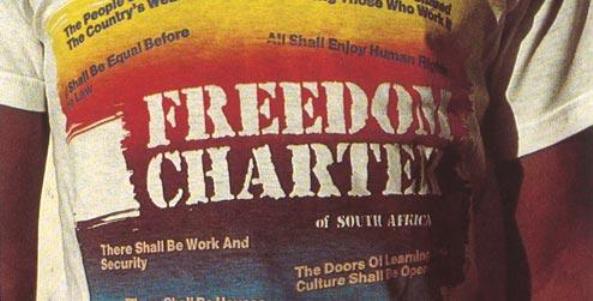
Image above taken from Resistance art in South Africa by Sue Williamson (David Philip, South Africa, 1989; CIIR, London, 1990)
____________
- Log in to post comments