










































How can religious leaders support progress for women?
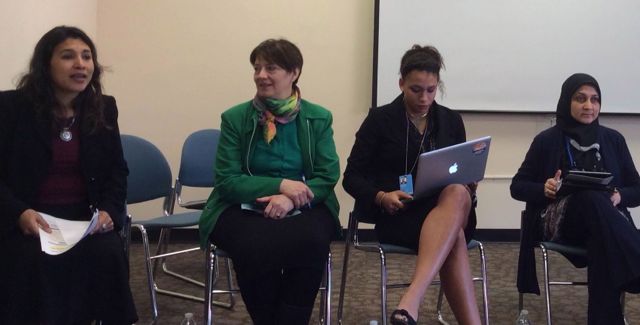
Progressio's Policy Officer, Lizzette Robleto-Gonzalez (left side of the photo) comments on the role religious leaders can play to make progress towards equality, posted March 17 2014:
Acid throwing, body scarring, cigarette burn marks, stabbings, rape, beatings, coercion, manipulation, threats of (mental and physical) harm… this list goes on. At first glance, you may think this is a list assessing the scars of a torture survivor. Well, it is and it isn’t. These are some of the consequences of violence carried out against women and girls around the world as reported in testimonies from Tonga, Mexico, Zimbabwe and Japan. Violence against women is a destructive social ill, which crosses continents, language, cultures, social hierarchy and religions. Both at home and in the public sphere, women continue to suffer just because they are perceived as being inferior.
It has always been an implicit assumption that religious leaders stand beside the poorest and the most vulnerable. When it comes to the rights of women and girls, it is therefore a disappointment that religious leaders have not been more outspoken. After all, religious leaders from any faith background have influence to change and shape society. Their teachings and recommendations are listened to by their congregations and often the wider community as well.
A testimony from Tonga
At a workshop I attended this week, a woman from Tonga explained that practices of violence against women and girls runs directly against Christian beliefs. Nonetheless she explained that numerous domestic violence cases take place in Christian homes and that many Christians justified the fact that they had done nothing to tackle violence against women saying ‘there was little if anything that they could do’.
Faced with this situation, this brave woman decided to take matters into her hands and joined other women in the fight against violence. Violence was destroying her home, her community and the new generation of children was being brought up in an environment of violence. “Violence is evil and should not be allowed. Religious leaders should stand up against this abuse rather than keeping it behind closed doors,” she told those gathered.
How can civil society support religious leaders who are willing to speak out?
It would be foolish to keep religious beliefs out of the equation of the development agenda, especially where human rights and women’s rights are concerned. The influence of religious leaders is huge, and therefore they are well positioned to be a catalyst for change. This afternoon I attended a session on the role of religious leaders on the Post-2015 agenda. I was quite curious to hear from religious leaders of what they thought their responsibilities were in enhancing poverty rights, human rights and women’s rights, for that matter. It was quite refreshing that some religious leaders are already taking a stance. My next question is: how can civil society and NGOs support religious leaders so that they can speak out?
- Log in to post comments